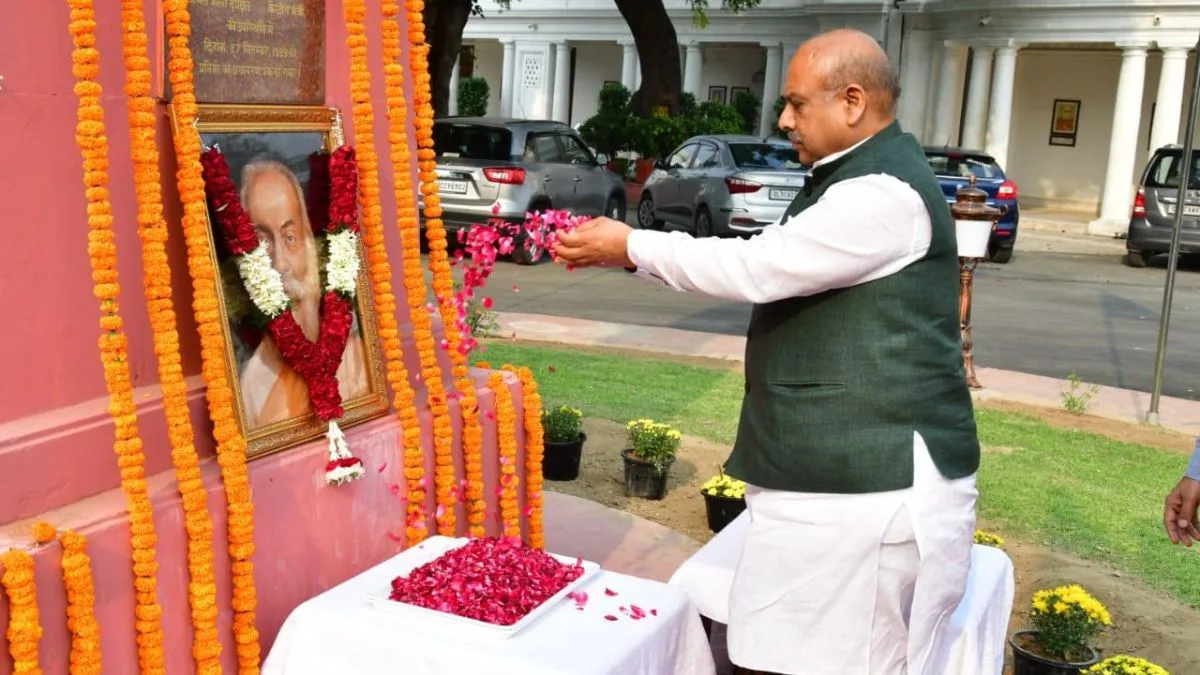
Remembering the first Indian President of the Central Legislative Assembly (British Era), Vithalbhai Patel, on his death anniversary, Delhi assembly speaker Vijender Gupta on Wednesday said his vision transformed representation into responsibility, proving that courage, conscience, and conviction are the true pillars of democracy.
Gupta, along with the Deputy Speaker of Delhi assembly, on Wednesday paid floral tributes to Patel at the Vidhan Sabha premises here.
Advertisement
The Delhi assembly speaker said that Patel had passed away in Geneva, Switzerland, on 22 October 1933, and that his mortal remains were brought back to India aboard the SS Narkunda, which arrived in Bombay on November 10, 1933.
Gupta mentioned that although Patel had expressed his wish to be cremated at Chowpatty Beach, the permission had not been granted back then by the British authorities, and his final rites were performed at the Sonapur crematorium.
He observed that Patel’s tenure as the first Indian to preside over the Central Legislative Assembly (1925–1930) transformed the office of the Speaker into a seat of integrity, independence, and constitutional dignity.
His insistence on fairness, procedural propriety, and legislative autonomy set the moral and institutional standards that continue to guide India’s parliamentary democracy, Gupta added.
The Delhi assembly speaker emphasised that Patel’s foresight and conviction turned legislative governance into a moral enterprise, where authority derived its legitimacy from reason and justice, not rank, and his leadership symbolised the transformation of India’s political spirit—from subordination to self-governance, from compliance to conscience, Gupta added.
Further reflecting on Patel’s journey, Gupta described him as one of the earliest architects of India’s parliamentary tradition.
He noted that Patel’s journey from being Mayor of the Bombay Municipal Corporation to being elected as the President of the Central Legislative Assembly in 1925 represented India’s democratic awakening under the then colonial rule, a transition from municipal leadership to national statesmanship.
Gupta remarked that the Delhi Legislative Assembly continues to draw inspiration from Patel’s democratic ideals, which underline that a strong democracy is built upon debate, discipline, and duty.
“To honour Vithalbhai Patel,” Gupta said, “is to honour the moral courage that gives meaning to parliamentary life — where service to the people stands above all personal or political considerations.”