Delhi Assembly Speaker Vijender Gupta has emphasised the importance of House committees, saying that the committee system represents one of the finest traditions of legislative functioning.
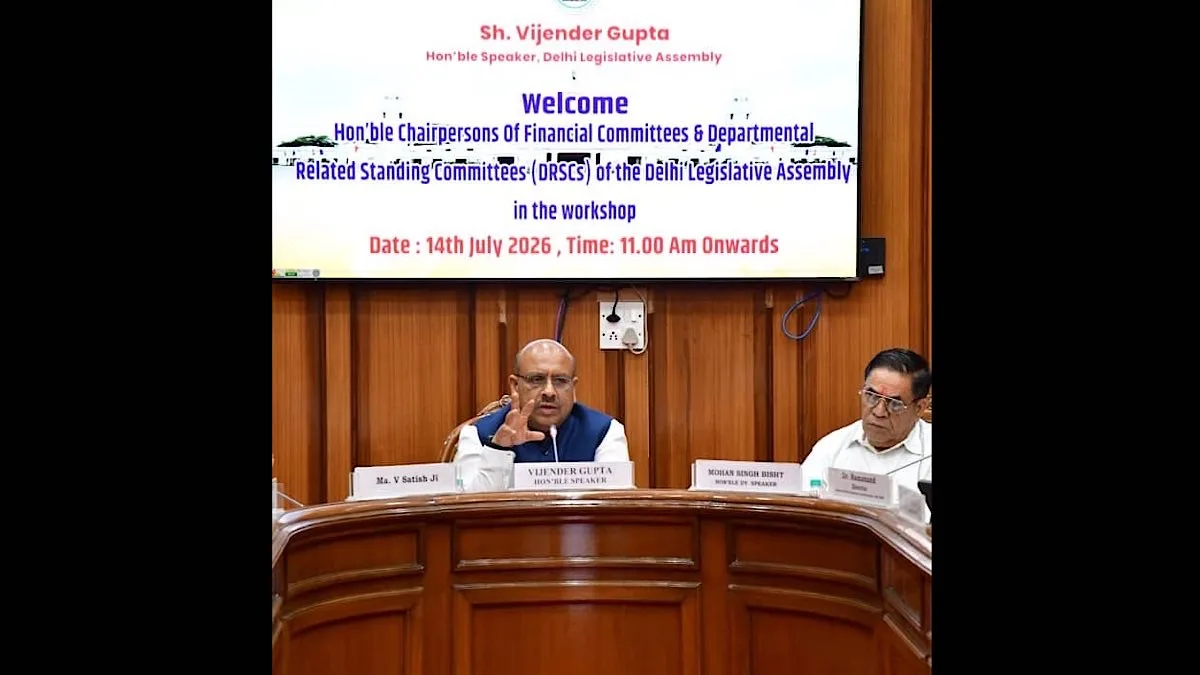
Gupta, who inaugurated a workshop organised by the legislature for the chairpersons of the Financial Committees and Department-Related Standing Committees, said that through patient deliberation, careful scrutiny and evidence-based recommendations, these panels strengthen not only executive accountability but also the quality of governance itself.
Advertisement
Congratulating the newly appointed chairpersons, the Speaker said that their appointment was not merely a procedural assignment but an opportunity to strengthen one of the legislature’s most vital institutions for ensuring accountability, transparency and good governance.
Stating that debates in the House remain the most visible expression of parliamentary democracy, Gupta observed that much of the legislature’s detailed and substantive work takes place through its committee system, where members examine policies, scrutinise public expenditure, review departmental performance and assess the implementation of government initiatives through informed deliberations.
The purpose of the workshop was to acquaint the chairpersons with the constitutional, procedural and functional aspects of the Financial Committees and Department-Related Standing Committees, with the objective of strengthening legislative oversight, accountability and good governance.
Deputy Speaker Mohan Singh Bisht, parliamentary affairs expert V. Satish, Director CPRG, Dr Ramanand, senior officers of the Delhi Legislative Assembly Secretariat, and others were present on the occasion.
The technical sessions at the workshop included “Roles and Responsibilities of Committee Chairpersons” by V. Satish, “Leveraging Institutional Support” by Dr Yumnam Arun Kumar, Secretary, Delhi Assembly, and “Strengthening Accountability and Public Trust” by Dr Ramanand.
Gupta observed that the standing committees have evolved into one of the principal pillars of legislative democracy as governance has expanded in both scale and complexity.
According to the Speaker, these panels provide an institutional forum where members rise above the immediacy of political debate to collectively examine issues on their merits, engage with officials, experts and stakeholders, and undertake evidence-based scrutiny of interconnected sectors such as public finance, urban development, health, education, transport, technology and environmental sustainability.
He pointed out that committee recommendations frequently improve administration, refine public policy and strengthen public confidence in democratic institutions.
Describing the workshop as an exercise in institutional capacity building, Gupta said effective committees are built through informed leadership, careful preparation, constructive engagement and a shared commitment to institutional excellence.
He added that the workshop would familiarise chairpersons with the constitutional and procedural framework governing committee functioning, promote best practices, and encourage greater use of research support, institutional expertise and evidence-based analysis to strengthen committee deliberations.
Addressing the participants, Deputy Speaker Bisht emphasised that standing committees are among the most effective mechanisms for ensuring legislative scrutiny and executive accountability. He observed that the effectiveness of committee proceedings depends on informed leadership, regular engagement and constructive deliberations.