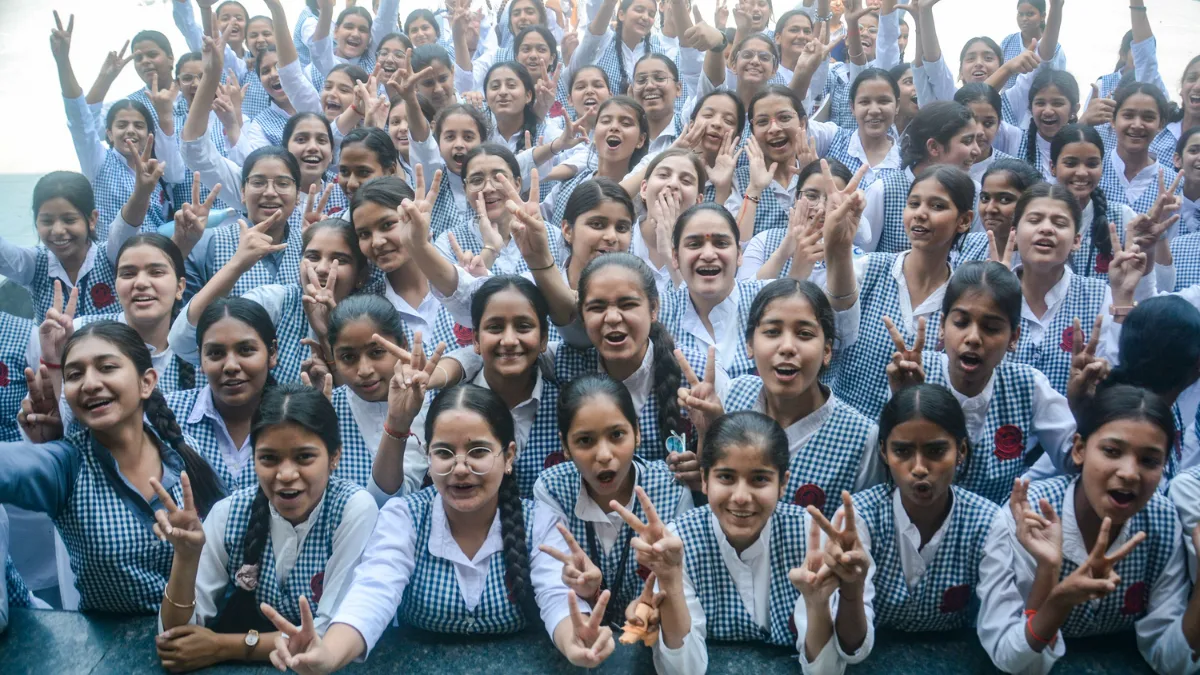
A month-long language camp was conducted at Serampore Girls’ High School in Howrah under the direction of the Paschim Banga Samagra Shiksha Mission of the School Education Department in West Bengal. The programme showed that language can act as one of the most effective bridges for connecting people, cultures, and communities.
Instead of following the usual approach of language courses which typically involve grammar exercises and rote memorisation, the Telugu camp changed the entire concept of how language is learned.
Advertisement
At the camp, words were sung before being written down. Sentences were developed through laughter rather than out of fear of making mistakes. Pronunciation was achieved through the use of rhythm, games, storytelling, role-play, music, conversation circles and collaborative activities.
Sarika Khatun, a student in Class IX, remembered that what at first looked like a difficult subject later became an exciting experience full of songs, stories, friendships and laughter.
Ivy Sarkar, the Headmistress of Serampore Girls’ High School said, “The success of the initiative is due to the devoted work of Mr B. Yoganandam (Anand Rao), Assistant Teacher at Mahesh Sri Potti Sriramulu Andhra High School (Telugu Medium), who volunteered to act as the Resource Person during the entire programme. I think that learning a language should be enjoyable, inclusive and culturally immersive, and this idea has influenced all parts of our camp. Multilingualism is no longer an optional extra but an essential life skill which can open the way to higher education, employment, travel, research and a greater understanding of other cultures. At our school nowadays, ‘Ek Bharat Shreshtha Bharat’ is not merely a slogan but a real-life experience.”
The students also worked on their own using the Bhasha Sangam App and obtained e-certificates from the Ministry of Education, Government of India. Each student who had successfully finished the Basic (Foundation) Course in Telugu was awarded a certificate.
The closing ceremony was a celebration rather than a formal farewell. The students showed off their newly learned linguistic skills by singing Telugu songs in chorus, reciting rhymes, taking part in enthusiastic conversational exchanges, and giving performances of graceful dances set to Telugu music.
The most symbolic moment of the day came at the refreshments. Rather than sticking to a normal menu, the organisers thoughtfully created a culinary expression of cultural harmony. Idli, which stands for the warmth and simplicity of South Indian food, was served together with jalebi, since the celebration came after the “Ulta Rath Yatra”, one of Bengal’s beloved festive events.