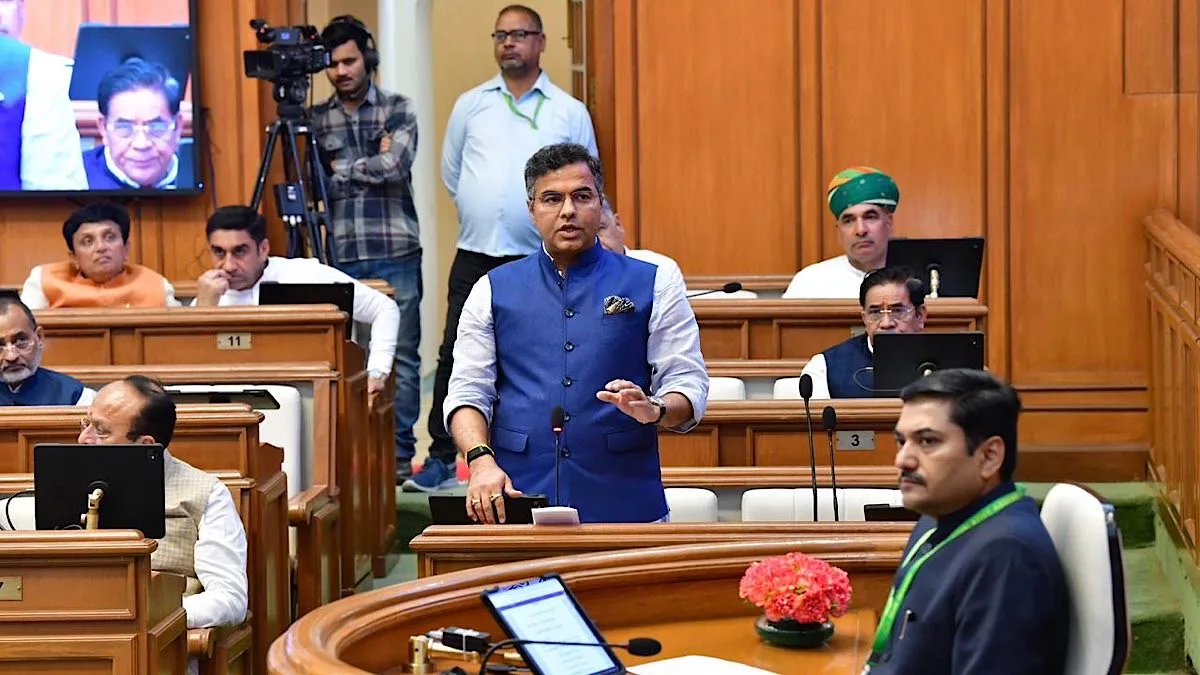
Delhi Water Minister Parvesh Verma on Friday said the findings of the Comptroller and Auditor General’s report tabled in the Delhi Assembly exposed years of negligence of the water management of the national capital, its sewer infrastructure, and Yamuna cleaning, while outlining a comprehensive and time-bound roadmap for reforms.
The Minister noted that during the assembly session, several MLAs raised concerns over water supply, sewer issues, and local infrastructure in their constituencies reflecting the grievances of citizens. He strongly criticized the Opposition for its the absence during such a critical discussion. “Those elected to raise the voice of the people chose to walk out. When the time came to answer on water, sewer, Yamuna, and corruption, they chose silence over accountability,” he remarked.
Advertisement
Sharing key findings of the CAG report, he highlighted the seriousness of the situation and listed from the report the lack of scientific planning for water demand and sewage treatment, over 200 MGD untreated sewage directly entering the Yamuna, more than 1000 colonies without proper sewer network.
Lisitng more findings, he shared that several Sewage Treatment Plants (STPs) failed to meet environmental norms. There was no effective monitoring of fecal contamination. There were Non-Revenue Water (NRW) losses which rose to to 45-53 per cent but no expansion of sewage infrastructure in line with population growth in the city during the past years.
“These are not allegations but findings recorded by the CAG,” he emphasized.
He said that Delhi currently requires approximately 1200 MGD of water, while the supply stands at around 1000 MGD, creating a persistent gap.
The Minister pointed out that beyond supply constraints, poor management and massive transmission losses have worsened the crisis. “In most parts of the world, NRW losses are around 15 per cent. But in Delhi, they crossed 50 per cent. This is not just leakage… it is a reflection on systemic failure,” he said.
He further highlighted that nearly 30 lakh households still lack formal water connections, leading to illegal usage, inefficiency, and revenue loss.
On Yamuna cleaning, he said, “The biggest reason Yamuna appears polluted is untreated sewage. If we stop untreated discharge, Yamuna can be revived,” he added.
Key measures for the purpose as specified by the minister include construction and upgradation of 35 STPs with global standards, expansion of treatment capacity to 1500 MGD for future needs, in-situ treatment of major drains including the Najafgarh drain and strict monitoring of sewage discharge and quality.
He announced that Delhi will have more treatment capacity than sewage generation within 2 to 2.5 years, ensuring long-term sustainability. “Delhi does not lack water… Delhi suffered from lack of planning,” Verma added, while reaffirming government’s commitment. “Clean Yamuna, modern sewer systems, and reliable drinking water…this is not just a plan, this is our responsibility.”