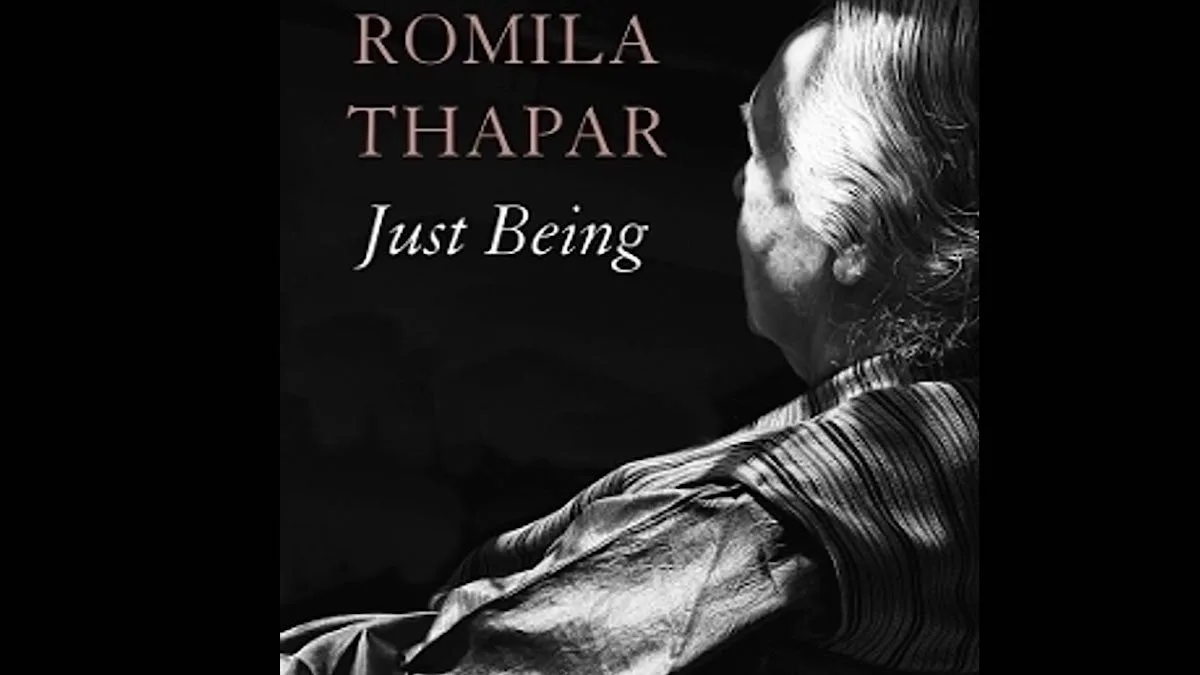
The opening pages of Thapar’s memoir are filled with evocative depictions of her garden. From recalling her childhood memories of colonial-style cantonment gardens to her later preference for Zen gardens. Her ideal garden is diverse in every shade – not just floral, but alive with animals and birds. Bulbuls, sunbirds, mynahs, doves, magpies, squirrels, and lizards are all welcomed. Pigeons are grudgingly tolerated, but crows and cats are strictly barred. Curiously, this almost obsessive engagement with curating a garden seems emblematic of Thapar’s life.
Just as she shaped her garden, she struggled to shape her personal life, and took on the larger task of fashioning a particular social vision for the Indian nation. Her memoir is a recollection of that endeavour. Born into a newly emerging class of western-educated Indian elites, Thapar’s early life was spent across various Indian cities and government cantonments – Lahore, Khyber Pakhtunkhwa, Peshawar, Pune, and finally Delhi owing to her father’s profession as a medical officer. She describes her parents as not particularly conservative, a fact evident in her upbringing.
Advertisement
This manicured upbringing insulated her from the contestations and contradictions of social existence. The experience of true freedom came only in London, the former Imperial metropole. It was in London that she turned to Indian history and society, eventually pursuing a research degree in Ancient India. London days also initiated Thapar into a lifelong exploration of multiple destinations across the world for vacations, research projects, and conferences.
At some point one almost gets the impression of reading a travelogue. However, what was foundational to her intellectual making was her interactions with a range of noted scholars, engagements with like-minded students, and wide and diverse readings. From writings of Black authors, Ismat Chugtai, Simone de Beauvoir to works of T. S. Eliot. Thapar placed a great emphasis on reading. Her admiration for Nehru (p. 133), and her distaste for other politicians, stemmed in part from the fact that Nehru was well-read. She appears to treat books as gardening manuals through which the complexities of the social world could be navigated.
These readings and interactions in London introduced her to the problems of building secular, plural, democratic, post-colonial societies, and the place of history writing in such an endeavour. Later, at the Jawaharlal Nehru University, an institution extremely close to her that she got a fertile ground for her ideas of ‘New History’ to take root. Impatient with dry political histories, her idea was to develop history under the ambit of social sciences, and in dialogue with other disciplines.
It was not sufficient to describe the past, she felt, but what was needed was to explain historical change, social structures and cultural phenomena. A conception of history which stems from her critique of Colonial historical reconstructions of India’s past, whether it’s James Mill’s division of Indian history between Hindus and Muslims, or Max Muller’s conceptualization of the Aryan racial supremacy. It’s specifically here that her lifelong fight with the ideology of Hindutva is rooted in. Hindutva appears to be the lone pest threatening to infest Thapar’s aspirational garden.
According to Thapar, it’s a political ideology which differs from Hinduism, the religious tradition (p.214). The ideology of Hindutva, Thapar proposes, is rooted in Colonial assumptions of India’s past which leads to the idea of Hindu supremacism and majoritarianism. The memoir is not wanting in its critique, but fortunately subsequent chapters are filled with her experience of other historical and political developments. From her opposition to the Emergency declared by Indira Gandhi and her encounters with censorship, to her understanding of the Naxalite movement, Mandal politics, LPG reforms, Ayodhya controversy, and, obviously to the rise of Hindu right-wing in the form of BJP as a hegemonic political power.
However, even though the memoir runs to around seven hundred pages, it still does not feel exhaustive enough. This is perhaps because gardening as an endeavour is a selective enterprise. Be it the Indo-China war, the subsequent Indo-Pak wars, the genocide and pogrom of Hindus from Kashmir or the terrorist attacks on the Indian Parliament – such pivotal moments and their politics do not appear to be of much concern for our gardener, even if they intimately influenced and shaped much of the ‘right-wing’ ideologies that she assigns herself to critique and understand.
Perhaps more unfortunately, Thapar appears to be oblivious to her gardened existence. Her insistence on framing herself as ‘middle class’ lacks nuance and feels detached from reality. Belonging to the family of a well-established government officer, who could afford to self-finance her daughter’s initial education in London in those days, one wonders if today’s middle-class India has experienced a drastic fall from grace. At one point, she talks about going on a date at the Imperial hotel and visiting the Gymkhana Club in Delhi, only to describe her ‘middle class’ existence (p. 94).
Thapar’s curated garden appears to have insulated her from the socio-economic realities informing her epistemological blindspots. Though she textually critiques the historical development of the caste system in ancient India, the reflection on the Dalit question – a jungle fire in contemporary India, barely touch the boundaries of her garden. Given her long engagement with Buddhism, her lack of comment on Navayana or Ambedakarite Buddhism is puzzling.
In fact, the only time she reflects on the contemporary caste politics in India at some length is in her dismissal of caste-based reservations as a policy of caste emancipation. Perplexed by the supposed Dalit support for the BJP in elections, she wonders, whether the Dalits are satisfied with the status of ‘lesser Hindus’ provided jobs are guaranteed or has the reservation policy silenced critical social analysis (p. 631)? Such an understanding denies agency to subaltern communities and blames them for exhibiting ‘false consciousness’.
It’s the result of an outdated garden manual, which views Indian/Hindu society as fossilized, frozen in time and divided for eternity between High castes and Low castes, whose interests are never to coincide, no matter the quantum of socio-economic, cultural and political changes. A particular section of the Indian intelligentsia poses as the greatest opponent of understanding history and society through simplistic binaries and cultural essentialism.
Except when the binary is Brahmana-Sramana or Savarna-Avarna, and the essentialism equates Hinduism with the caste system. In similar enthusiasm, Thapar appears to have missed the opportunity of revisiting her previously contested claims. She attributes to Patanjali for comparing the Sramana-Brahmana duo with that of Snake and the mongoose, suggesting a perennial antagonistic relationship (p. 265). A claim already debunked by scholar Nathan McGovern in his influential work The Snake and the Mongoose.
In the liberal understanding, Hindutva emerged as a reactionary political ideology in opposition to the more secular nationalism of the Congress, something which then can be understood by drawing parallels with the rise of Muslim reactionary politics in the subcontinent. However, such a simplistic parallel is fundamentally flawed, given the communities in question differ at the level of social phenomena. This is a dimension which Thapar is forced to partially concede when she acknowledges the difference between Abrahamic religions like Islam and Christianity and religions like Hinduism (p. 214).
The success of Muslim politics in the colonial times and the failure of Hindutva politics should have invited its due investigation. Similarly, the past success of the secular politics of the Congress, and its increasing irrelevance in the contemporary times, needs introspection. It cannot be explained by pointing to the failure of public education or the misuse of media, as Thapar tries to do (p.217).
Such an introspection would require an honest reflection and assessment of the secular politics at the level of elementary assumptions with respect to the fundamentals of Indian history and society. Gardening enthusiasts at times appear to be alienated from realities of a jungle. Thapar’s contribution to the development of Indian historiography cannot be denied, as it led to the democratization of Indian historical imagination beyond the confines of discussing dry political histories.
However, her reflections on contemporary social realities suffer from serious misgivings, simplistic analysis, and glaring absences. Nonetheless this memoir provides us with a rare opportunity to understand the historical development of a particular class of old Nehruvian intellectuals, along with their thought processes and their ultimate limitations.
(The reviewer is an academic and freel)