‘Qatar is the fountainhead of Islamic terrorism, harboured 9/11 mastermind’: MEMRI | 10 points
MEMRI's latest report alleges Qatar employed and protected 9/11 mastermind Khalid Sheikh Mohammed before his escape in 1996. Here are its 10 key claims.
Every nation has the right ~ and indeed the obligation ~ to ensure that educational institutions do not become platforms for glorifying terrorism, violent extremism or secessionist violence.




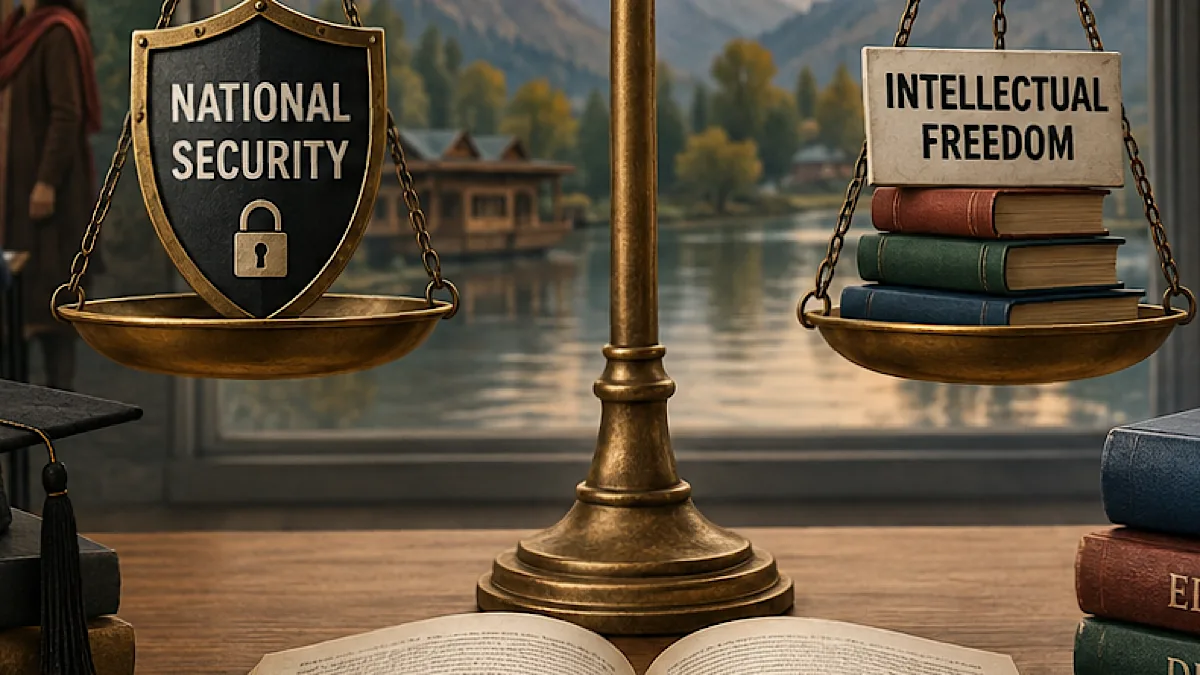
Photo:AI
Every nation has the right ~ and indeed the obligation ~ to ensure that educational institutions do not become platforms for glorifying terrorism, violent extremism or secessionist violence. That principle is neither controversial nor incompatible with democracy. The real test lies elsewhere: whether the process of safeguarding national security also safeguards intellectual freedom.
The latest directive requiring educational institutions in Jammu and Kashmir to scrutinise books and academic material brings that delicate balance into sharp focus. Kashmir occupies a unique place in India’s constitutional and political history. It has endured decades of militancy, cross-border terrorism, political upheaval and competing narratives over identity and sovereignty. The state has a legitimate interest in preventing educational spaces from becoming vehicles for radicalisation or historical distortion. No responsible democracy can ignore the influence that classroom material exerts on young minds. Yet the authority to regulate education carries an equally important responsibility: clarity, transparency and restraint.
Advertisement
A directive that asks institutions to identify “objectionable” material without defining the term with sufficient precision inevitably creates uncertainty. Teachers, librarians and researchers are unlikely to wait for official clarification. Faced with ambiguous standards, many will choose caution over scholarship, removing or avoiding works that may be entirely legitimate but politically sensitive. Such self-censorship can become far more pervasive than formal censorship itself. The issue extends beyond a single region. Democracies across the world have wrestled with disputes over school curricula, historical memory and national identity.
Advertisement
Whether in debates over race in the United States, colonial history in Britain or wartime memory in East Asia, governments have often sought greater influence over what students learn. The lesson from these experiences is consistent: history rarely becomes less contentious when states attempt to narrow acceptable interpretations. Instead, public trust depends on transparent institutions, credible scholarship and open debate. India’s constitutional framework protects freedom of expression while also permitting reasonable restrictions in the interests of sovereignty, security and public order. That balance should guide educational policy as well.
Material that explicitly incites violence or glorifies terrorism deserves scrutiny. But historical research, political analysis and competing interpretations of complex events should not automatically fall under suspicion simply because they challenge prevailing narratives. Universities, in particular, exist to examine contested questions rather than avoid them. The larger concern is institutional credibility. If reviews of educational material are perceived as impartial, evidence-based and guided by clearly defined criteria, they are more likely to command public confidence.
If, however, they appear selective or politically motivated, they risk deepening the very mistrust they seek to overcome. Kashmir has long been shaped by competing stories about its past and future. Durable peace will depend not only on security but also on confidence in democratic institutions. Education should strengthen that confidence by encouraging informed inquiry, not by leaving scholars and students uncertain about where legitimate academic debate ends and prohibited opinion begins.
Advertisement