UP’s green agenda offers a template for India
Amid global turmoil and resultant impacts on global energy networks, India has firmly stood on its climate and clean energy agenda, towards its long-term goal of Viksit Bharat 2047.
In a major boost to India’s clean energy ambitions, Lieutenant Governor V.K. Saxena on Friday commissioned the country’s first and deepest geothermal wells at Puga Valley in Ladakh, marking a significant step towards establishing India’s first geothermal power plant and advancing the vision of a carbon-neutral Ladakh.




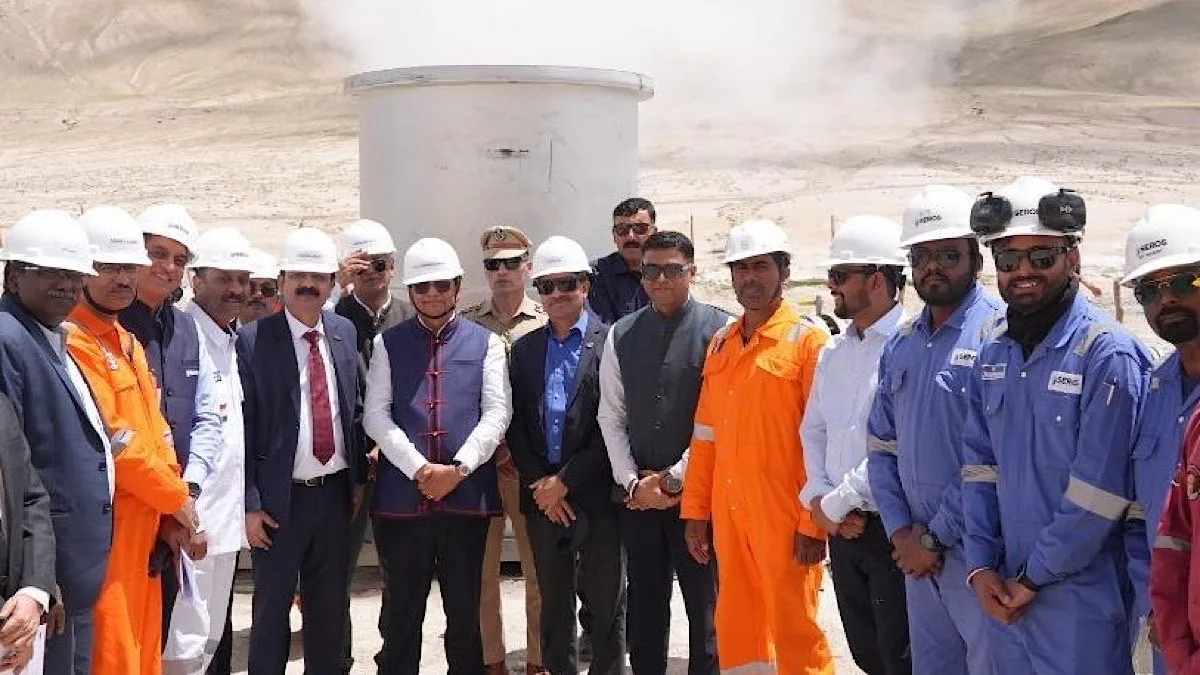
Photo:SNS
In a major boost to India’s clean energy ambitions, Lieutenant Governor V.K. Saxena on Friday commissioned the country’s first and deepest geothermal wells at Puga Valley in Ladakh, marking a significant step towards establishing India’s first geothermal power plant and advancing the vision of a carbon-neutral Ladakh.
The commissioning of the two 1,000-metre-deep wells at a high altitude of over 14,000 feet will significantly advance Ladakh’s journey towards becoming a clean energy hub, powered by renewable sources. The project also fulfils the PM’s vision of carbon-neutral Ladakh and the call to harness alternative, renewable energy sources for future security.
Advertisement
The two geothermal wells are critical for the successful implementation of the 1 MW pilot geothermal power project at Puga, which will be India’s first demonstration-scale geothermal power project.
Advertisement
Notably, the geothermal power project had suffered a major setback following the expiry of the earlier tripartite MoU between the Ladakh Administration, LAHDC Leh and ONGC Energy Centre, resulting in critical delays of several months in project execution.
Recognising the strategic importance of geothermal energy for India’s energy security and clean energy transition, Saxena personally intervened to facilitate the renewal of the MoU for another five years in June this year, following which work resumed for the completion of the two geothermal wells.
The successful completion of the two wells will facilitate critical reservoir evaluation, power plant planning and the eventual commercial development of geothermal resources in Ladakh. Project engineers reported that the maximum temperature of 135 degrees Celsius was recorded at a depth of 400 metres. Further testing is underway, and the engineers hope to achieve even higher temperatures for the operation of the 1 MW pilot geothermal power project and the eventual commercial exploration of geothermal energy.
The project has been undertaken in one of the world’s most challenging operating environments, characterised by extreme weather conditions, rugged terrain and a limited annual working season.
Despite encountering geothermal activities, complex sub-surface conditions, and operational challenges, the first of the two wells was successfully drilled to its target depth of 1,000 metres on 22 May 2026. Subsequently, the other geothermal well was spudded on 3 June 2026, and in a record time of just over a month, it was successfully drilled and completed to a depth of 1,000 metres on 8 July 2026.
Speaking on the occasion, the LG termed the commissioning of the geothermal wells as a historic milestone in India’s clean energy journey and a defining moment in Ladakh’s transition towards a carbon-neutral future.
“This geothermal power project would act as a catalyst for Ladakh’s holistic development. Beyond its scientific significance, this initiative will strengthen Ladakh’s energy security, promote environmental sustainability and contribute to regional socio-economic development,” Saxena said.
Saxena lauded the ONGC engineers, saying Indian engineers and technicians were among the best in the world, capable of achieving the most difficult engineering feats, and they truly symbolise India’s growing stature in global engineering.
Advertisement