A century-old pilgrimage keeps Kanaisar Hill’s living heritage alive
Every monsoon, long before sunrise breaks over the forests of Junglemahal, thousands of devotees begin a silent ascent up the rocky slopes of Kanaisar Hill.
Researchers have documented at least 55 species of macrofungi associated with natural Sal forests in the region.




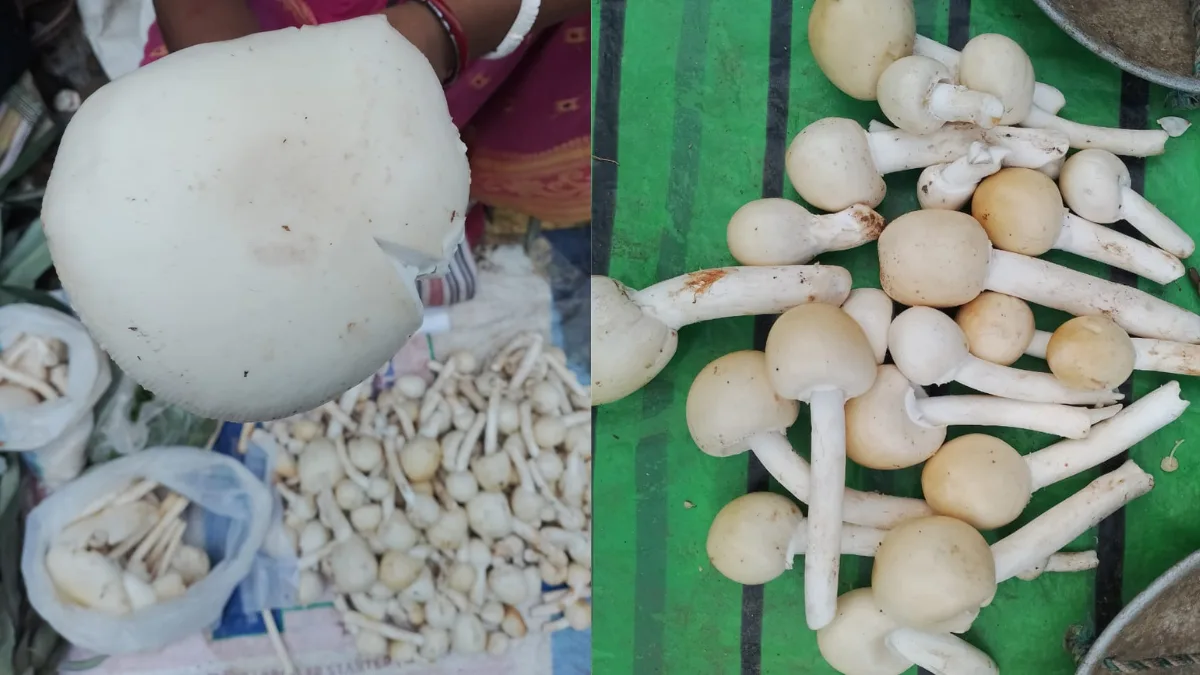
Photo: SNS
They appear for barely a few weeks each monsoon, but the wild mushrooms found in Bengal’s Junglemahal sustain thousands of tribal households and quietly reveal the health of the forests they grow in. Scientists now caution that this fleeting natural bounty is under growing threat, with degrading Sal forests and erratic rainfall reducing the diversity of mushrooms that have long linked the region’s ecology, culture and rural economy.
With the arrival of the southwest monsoon, the forests of Jhargram, West Midnapore and Bankura in West Bengal come alive with an annual natural harvest that local communities eagerly await. Long before dawn, villagers, particularly women, venture deep into Sal forests carrying bamboo baskets to collect wild mushrooms, locally known as chhatu, that emerge from forest floors, termite mounds, sandy soil and decomposed leaf litter.
Advertisement
Unlike cultivated mushrooms commonly sold in urban markets, these varieties grow entirely under natural conditions and cannot easily be farmed. Many tribal families consider them a seasonal delicacy, often preferring their distinctive flavour to fish or meat.
Advertisement
The lateritic belt of western Bengal, dominated by Sal (Shorea robusta) forests, is recognised as one of eastern India’s richest habitats for wild macrofungi. The region’s nutrient-poor acidic soils, thick carpet of decaying leaves and humid monsoon climate together create ideal conditions for dozens of mushroom species that appear only during the rainy season.
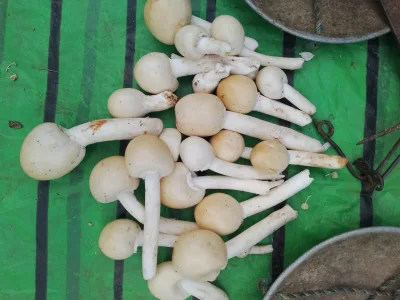
Among the most sought-after edible mushrooms are Putka (Kurkure) Chhatu, Moudal Chhatu, Khor or Poyal Chhatu, Bali Chhatu, Kan Chhatu and Kamla Chhatu, besides several species belonging to the genera Termitomyces, Russula and Volvariella. Many of these species continue to depend entirely on natural forests as commercial cultivation has not yet been successful.
One of the most prized is Moudal Chhatu, a large aromatic mushroom that grows on soil enriched by decomposed mahua leaves beneath dense Sal forests. Its harvesting season is extremely short, as heavy rainfall can quickly damage the delicate fruiting bodies, making it one of the most eagerly sought-after forest foods of the monsoon.
Researchers have documented at least 55 species of macrofungi associated with natural Sal forests in the region. Beyond their culinary appeal, these fungi perform vital ecological functions by decomposing leaf litter, recycling nutrients and forming beneficial ectomycorrhizal associations with Sal tree roots, helping maintain the health and productivity of forest ecosystems.
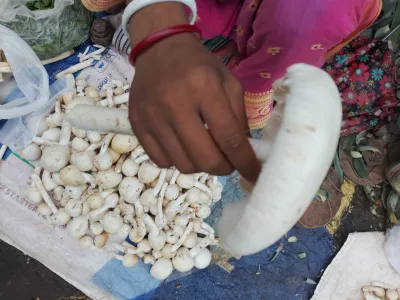
Studies have also identified 19 traditionally used mushroom species, including 17 edible and four medicinal varieties. Besides enriching household diets with protein, fibre, vitamins and antioxidants, the seasonal harvest provides a valuable source of supplementary income. During a favourable monsoon, many collector families earn around Rs 2,000 or more by selling fresh mushrooms in village markets.
Debjani Chatterjee, a nutrition expert in Midnapore note that wild mushrooms contain bioactive compounds such as beta-glucans that may support heart health, help regulate blood sugar and lower cholesterol levels. They are also rich in B vitamins, including riboflavin, niacin and pantothenic acid, which contribute to healthy blood cells, metabolism and nervous system function.
Pravat Kumar Shit, who has extensively studied the ecology of western Bengal’s lateritic forests, said the remarkable diversity of wild mushrooms is closely tied to the condition of natural Sal forests.
“The lateritic region is characterised by nutrient-poor acidic soils with a pH generally ranging between 5.0 and 6.0, along with sandy loam, clay loam and sandy clay loam textures. Natural Sal forests support a remarkable diversity of wild mushrooms because of their rich leaf litter, organic matter and favourable microclimate,” he said.
Shit said extensive plantations of Eucalyptus and Acacia auriculiformis established in degraded forest areas support significantly fewer mushroom species.
“These plantations have sparse undergrowth and exhibit allelopathic effects that suppress surrounding vegetation. Our field observations consistently show that dense natural Sal forests harbour far more wild mushrooms than degraded forest patches,” he said.
According to him, mushroom diversity can serve as a reliable ecological indicator of forest health.
“Where healthy Sal forests persist, mushroom diversity is high. As forests become degraded, mushroom populations decline. Conserving natural Sal forests is therefore essential not only for biodiversity but also for sustaining traditional livelihoods and ecological processes,” he added.
For the people of Junglemahal, wild mushrooms represent far more than a seasonal food. They embody generations of traditional ecological knowledge, linking forests, rainfall and community life in ways that have endured for centuries.
However, villagers say they are already witnessing noticeable changes. Erratic monsoon rainfall, rising temperatures and continuing forest degradation are reducing the availability of several prized mushroom species. Scientists believe protecting natural Sal forests will be critical not only for conserving the region’s remarkable fungal diversity but also for safeguarding a traditional forest-based livelihood that entirely supports thousands of families every monsoon.
Advertisement