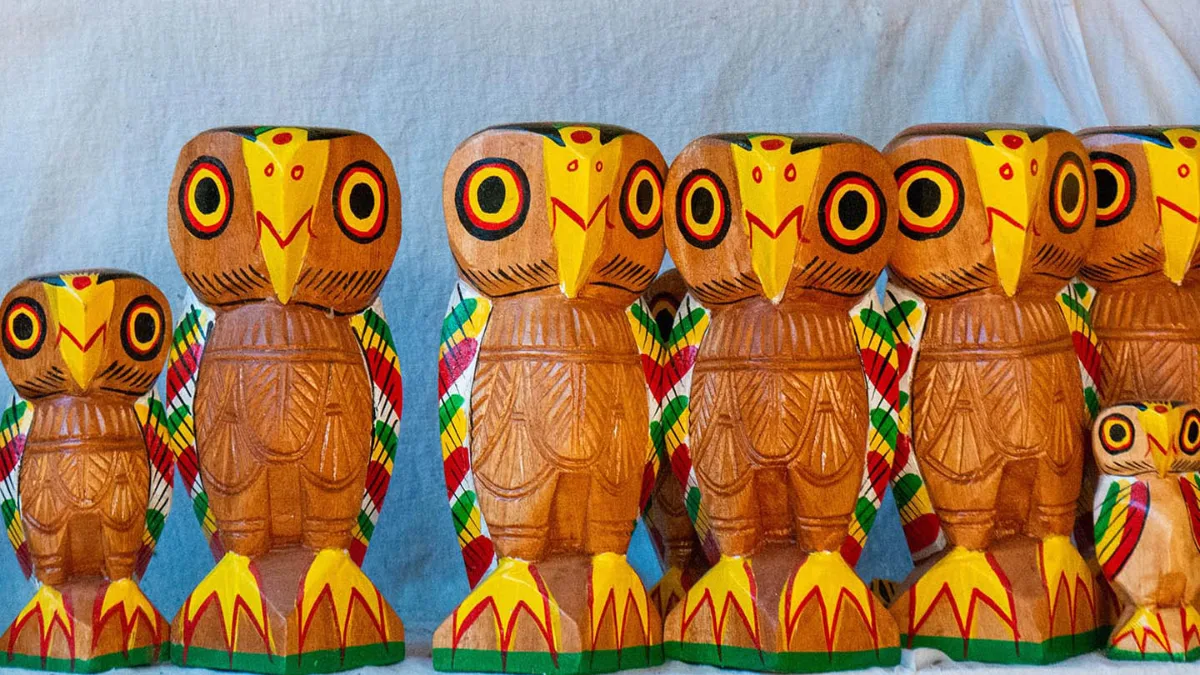
Bengal’s lone wooden doll industry centered at a small village in West Bengal’s Purba Bardhaman district is now all set to get a much-needed global push, especially in the wake of a dedicated visit by a delegation of an UNESCO affiliated agency.
The wooden doll manufacturering hub at Natungram in Kalna recently received its Geographical Indication (GI) tag.
Advertisement
The UNESCO delegation arrived at Natungram on July 8 and conducted a door-to-door visit to get a first-hand assessment of the art form. The officials interacted with the craftsmen, observed and even captured videographs of the doll-making process.
“The GI tag, followed by the visit from officials of the UNESCO agency has given us fresh hope. It would infuse fresh blood and immense courage among our craftsmen,” Dilip Sutradhar, the secretary of Natungram Woodcarving Artisans Industrial Cooperative Society told The Statesman.
The visiting experts noted that the recent GI status has gained adequate potential for Natungram to open up new avenues for it’s craft in the international market.
“We came here to help explore avenues of global marketing for this rare form of craftsmanship, which may bring better economic prospects for the artisans struggling here,” Rajarshi Das, a senior representative of the UNESCO affiliated agency said.
Purbasthali (Uttar) MLA Gopal Chatterjee under whose purview Nabagram falls, said, “The artisans have suffered a lot over the years. Now with the new government in power, we have prepared plans to provide every possible support and assistance for the sake of this rare form of art.”
Wooden doll industry, as the International Custom Market research revelations have revealed, is valued in billions. The industry is seeing the dolls segment grow at 4.2 percent Compound Annual Growth Rate driven by demand from North America and a rising middle-class in the Asia-Pacific.
Besides, Japan and Russia are the two major players in the field, with their cylindrical Kokeshi dolls (with no arms and legs) and Matryoshka set of wooden dolls (of decreasing size, placed one inside another).
The three hundred year-old Natungram craft cluster accommodates merely 51 households that supports 328 artisans relying heavily on local fair distribution.
“The craft commands niche cultural equity with operational reach heavily localized,” two of the artisans, Nimai Bhaskar, Shibshankar Sutradhar pointed out. “Our children, when they are over 12 years of age, start learning the craft, besides continuing with their academic studies. Our housewives too are involved in this craft,” they added.
A lion’s share of Natungram doll trading comes from the ‘iconic’ painted dolls like wooden owl, Gour-Nitai, King and Queen, besides the iconic Rashiputul, the dolls traditionally used in Rathayatra.