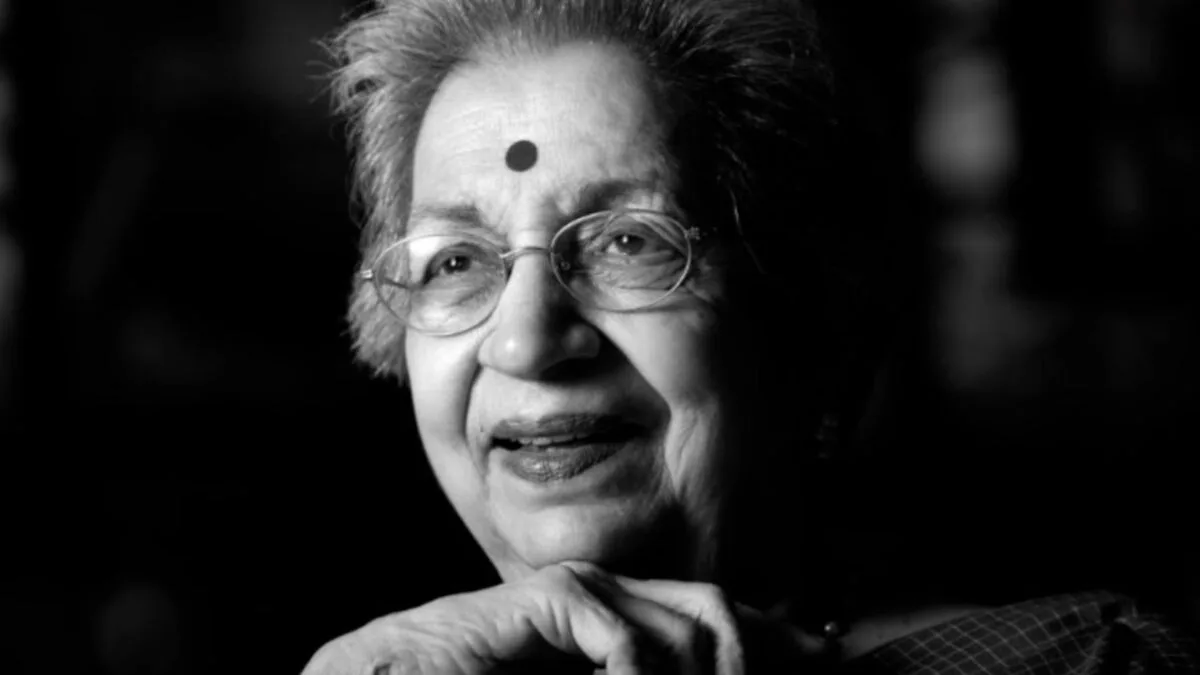
Vijaya Mehta died on July 1, 2026, at her residence in Mumbai. She was 91. Cause of death was old age. She was known in theatre circles simply as Bai. That single word carried the weight of seven decades of work across stage, screen, and television.
Mehta was born Vijaya Jaywant on November 4, 1934, in Baroda, now called Vadodara, in Gujarat. She grew up in a progressive family with deep connections to Indian arts. Her aunt was actress Nalini Jaywant. She was also related to Nutan. The film world was not distant from her childhood.
Advertisement
She completed her graduation from Mumbai University. She then trained under two of the most respected names in Indian theatre. Also, she studied with Ebrahim Alkazi in Delhi. She also trained under Adi Marzban. These were not casual workshops. They were rigorous foundations that shaped everything she went on to build.
Rangayan and the experimental theatre movement
In 1960, Mehta co-founded Rangayan, a theatre group based in Mumbai. The people she built it with tell you everything you need to know about the ambition behind it. Playwright Vijay Tendulkar was one of the founding members. So were actors Arvind Deshpande and Shriram Lagoo. This was not a hobbyist collective. It was a serious artistic institution at a time when Marathi theatre needed new direction.
Rangayan became the beating heart of experimental Marathi theatre through the 1960s. Mehta directed plays that challenged the conventions of the form. Her 1967 production of Tendulkar’s Shantata! Court Chalu Ahe was a landmark. The play examined silence, power, social complicity. It influenced a generation of playwrights and directors who came after her.
She also directed Ek Shoonya Bajirao and Ajab Nyay Vartulacha. She staged adaptations of Bertolt Brecht’s works, including The Good Person of Szechwan.
Vijaya Mehta adapted Eugene Ionesco’s The Chairs as Na-Natya, blending absurdist European theatre with Marathi theatrical sensibility. She collaborated with German director Fritz Bennewitz on Indo-German theatre projects. The international reach of her work was real, not ceremonial.
Coming to film late
Mehta entered film directing at 51. That is not early. Most directors of her eventual standing had been making films for decades by that point. The delay was a consequence of her total commitment to the stage. Film was something she came to when she was ready, not when the industry called.
Her directorial debut was Rao Saheb in 1986, adapted from Jaywant Dalvi’s play Barrister. The film starred Anupam Kher as an English-educated barrister caught between progressive ideals and social tradition. His character’s bond with a widowed woman played by Tanvi Azmi was the emotional core of the film. Mehta also appeared in the film herself, as the character of Mausi. The film captured the slow collapse of family structures under patriarchal pressure. It was measured, precise work.
Kher later said that working with her on that film made him understand how vast the craft of acting actually was. He said every rehearsal reminded him of how much he still did not know.
Her follow-up, Pestonjee in 1988, was a satire set within Bombay’s Parsi community. It had sharp wit and strong ensemble performances. Also, it received critical appreciation. It did not perform significantly at the box office. Mehta’s cinema was never built for mass audiences and it never pretended otherwise. That clarity was both her strength and her commercial limitation.
The acting side of her work
She was also an actress. Her performance in Govind Nihalani’s Party in 1984 earned her significant critical recognition. She appeared in Kalyug as well. These were not vanity appearances. She brought the same rigour to acting that she demanded from everyone she directed.
Recognition that came in stages
The Sangeet Natak Akademi Award for Direction came in 1975. The Padma Shri came in 1986. The National Film Award for Best Supporting Actress came the same year for her work in Rao Saheb. The Tagore Ratna followed in 2012.
What she leaves behind
Mehta was first married to Harin Khote, son of the celebrated actress Durga Khote. He died young, leaving behind two sons. She later married Farrokh Mehta.
The honest assessment of Vijaya Mehta’s legacy is that she is better known within the world of Indian theatre than outside it. Mainstream audiences never fully discovered her. Her films reached art-house viewers and critics but not the wider public. She made no attempt to bridge that gap on commercial terms.
That is not a failure. It is a choice. And she made it deliberately, for six decades, without wavering.