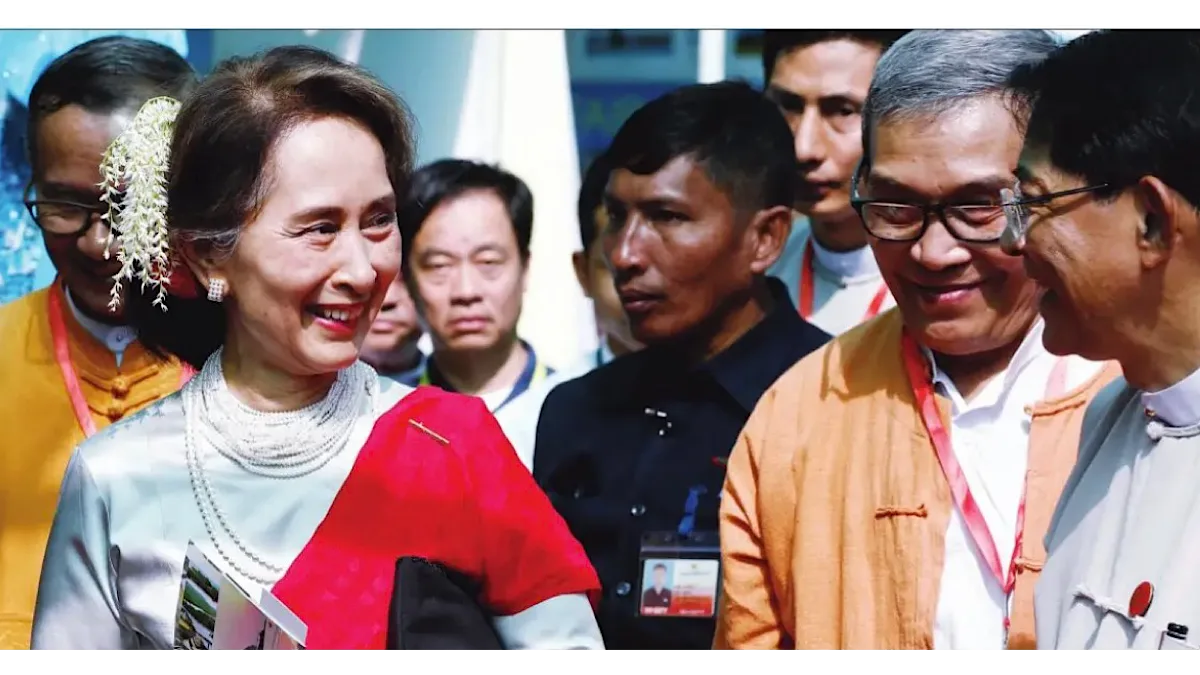
As Myanmar’s detained prodemocracy icon Daw Aung San Suu Kyi marked her 81st birthday on 19 June 2026, a coordinated international call emerged demanding her release, along with that of thousands of other political prisoners currently languishing in jails across the South-east Asian nation. The appeals came from United Nations officials, lawmakers, human rights organisations, diplomats, democratic activists, as well as a large number of pro-democracy Myanmar nationals living both inside and outside the country.
They turned the occasion into an opportunity to express serious concerns over the 1991 Nobel Peace Prize laureate’s health and the continuing socio-political crisis gripping the poverty-stricken nation of 55 million people.
Advertisement
Meanwhile, residents of India’s North-east continue to hope for the swift restoration of normalcy in neighbouring Myanmar so that they can reap the benefits of various bilateral agreements between New Delhi and Naypyitaw. The landlocked region is expected to benefit significantly from the ambitious Kaladan Multi-Modal Transit Transport Project, which seeks to connect the North-east with Myanmar’s Sittwe Port on the Bay of Bengal, as well as the India-Myanmar-Thailand Trilateral Highway. There is a growing belief that a stable, peaceful and progressive Myanmar is essential for these projects to succeed, making Suu Kyi’s release an urgent necessity.
The leader of the National League for Democracy (NLD) was arrested five years ago following the military coup. During the recent visit of President Min Aung Hlaing to India, Prime Minister Narendra Modi also raised the issues of Suu Kyi, democracy, and sustained peace in Myanmar while emphasising the need for dialogue involving all stakeholders. Modi also underlined the importance of addressing security concerns along the 1,643-kilometre Indo-Myanmar border while respecting the sovereignty and territorial integrity of both nations.
The quasi-democratic regime in Naypyitaw continues to battle a combined offensive by ethnic armed organisations and civilian resistance forces since the military coup of 1 February 2021, when then army chief Min Aung Hlaing ousted the democratically elected NLD government led by Suu Kyi. At present, more than half of Myanmar’s territory is reportedly under the control of anti-junta resistance groups. The visiting Myanmar President assured Mr Modi that his country’s territory would never be allowed to be used for anti-Indian activities by insurgent groups operating in India’s North-east.
For decades, these armed groups carried out disruptive activities in the region, at times urging residents to boycott Independence Day and Republic Day celebrations. Referring to the North-east as the “western part of South-east Asia”, they also appealed to voters to abstain from elections, but those calls were overwhelmingly rejected by the electorate. Many of these separatist groups allegedly continued their activities before retreating to safe havens inside Myanmar. Unconfirmed reports also suggest that some of the North-eastern insurgent groups maintain cordial relations with Myanmar’s military establishment.
Highlighting the current civil war-like situation in the Buddhist-majority nation, many global actors stressed the need to end violence against civilians and support an inclusive political dialogue to resolve the crisis. While Suu Kyi quietly observed her birthday at an undisclosed location in Naypyitaw under house arrest, anti-military activists marked the day with symbolic gatherings and messages of solidarity. They reiterated that she remains a powerful symbol of democratic aspirations for millions of Myanmar citizens and that her release is vital for achieving lasting peace.
The collective appeal also came from a forum of lawmakers representing member countries of the Association of Southeast Asian Nations (ASEAN), demanding the unconditional release of Suu Kyi and all other political prisoners. The ASEAN Parliamentarians for Human Rights (APHR), supported by 134 current and former parliamentarians from Australia, Cambodia, Indonesia, Italy, Malaysia, Singapore, South Africa, Thailand, Timor-Leste, and the Philippines, also called for independent access to verify Suu Kyi’s wellbeing in detention.
In an open letter addressed to ASEAN Chair Ferdinand Marcos Jr., President of the Philippines, and the leaders of member states, they argued that ASEAN’s credibility as a regional body would be strengthened through meaningful efforts to address the prolonged crisis in one of its member states. Since the coup, more than 7,800 democracy activists and civilians have reportedly been killed. Over 31,100 people have been arrested on political grounds, with more than 22,000 remaining in detention. Hundreds of thousands have also been displaced and now live in makeshift camps under conditions of acute poverty and uncertainty.
The letter further highlighted persistent reports of torture, abuse, inadequate medical treatment, and other forms of mistreatment in detention facilities. It argued that the continued imprisonment of political opponents has become one of the defining characteristics of the post-coup period. Earlier, the APHR also alleged that the authorities in Naypyitaw regularly abduct young people for forced military conscription to fight against anti-junta forces. Describing the practice as “the stealing of a generation”, the organisation urged ASEAN leaders to address the issue in keeping with the bloc’s commitment to peace, stability, and democratic principles.
The issue gained additional prominence through a campaign launched by Suu Kyi’s son, Kim Aris, a British citizen, who appealed to governments and international organisations to confirm that his mother is alive and receiving appropriate medical care. Pointing out that Suu Kyi had spent her sixth birthday in detention since the coup, Aris called for transparency regarding her exact whereabouts and current health condition. He argued that her prolonged isolation from family members and legal counsel had deepened concerns for her wellbeing. He further maintained that Suu Kyi’s continued detention reflects the unresolved nature of Myanmar’s political crisis, where thousands continue to suffer while holding on to aspirations of democracy, equality, justice, and freedom.
The Assistance Association for Political Prisoners (AAPP) also echoed those concerns while demanding her release. It noted that Suu Kyi has spent nearly two decades either imprisoned or under house arrest since entering Myanmar’s political landscape in the late 1980s. More recently, the UN Special Envoy on Myanmar, Julie Bishop, also called for her release, revealing that the issue had repeatedly been raised with the Myanmar authorities. The National Unity Government of Myanmar, formed by elected NLD lawmakers after the coup, the European Union, and diplomatic missions in Yangon representing Australia, Britain, Canada, France, Germany, Italy, Switzerland, Norway, the United Kingdom, and the Netherlands also reiterated their demand for the release of political prisoners. Similarly, the National Unity Consultative Council renewed its call, reaffirming the resolve of the Myanmar people, who continue to resist military rule while striving collectively for a federal democracy in the ‘Land of Golden Pagodas’.
THE WRITER IS A GUWAHATI-BASED SPECIAL REPRESENTATIVE OF THE