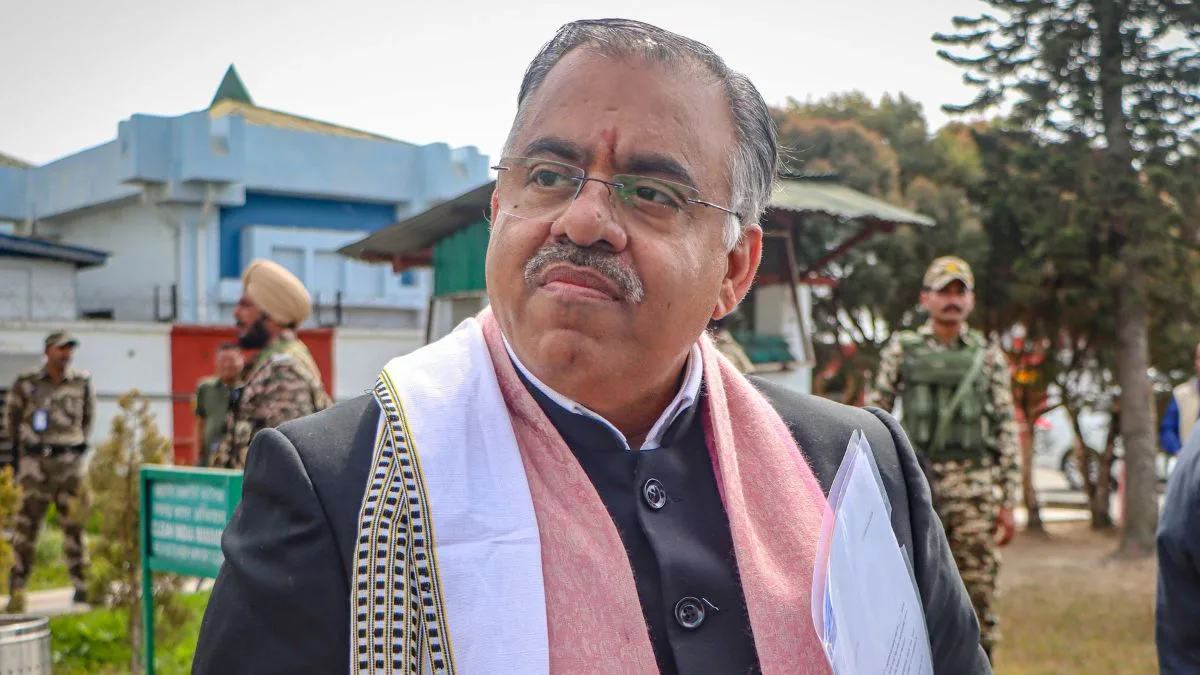
Swapan Dasgupta, the erudite intellectual-turned politician is a well known figure in India and especially his hometown Kolkata. A product of the city’s La Martiniere School, Delhi’s prestigious St Stephen’s College and of London’s School of Oriental and African Studies, Dasgupta gave up a career in his family-owned Calcutta Chemicals to first become a journalist who made a name working for prestigious publications such as The Indian Express, The Statesman and India Today among others before entering politics as a leading idealogue for the BJP.
Having been a Rajya Sabha MP, the soft spoken ‘Bhadralok’, has now been fielded from Kolkata’s prestigious Rashbehari constituency by his party. Jayanta Roy Chowdhury caught up with him for a tête-à-tête over coffee at his South Kolkata home.
Advertisement
Q. Swapan da, you are a respected intellectual. Your contribution to political thought, to external policy thinking, especially with regards our neighbourhood, is well known. What made you enter the hurly burly of West Bengal’s electoral politics?
A. This is an extraordinary election. As we discuss, Bengal is in danger of falling off the map. That is, it is in danger of becoming irrelevant in the larger scheme of things in this nation. Its industrial decline started with the Left Front and its policy of encouraging militant movements and has continued since. As industry fled from the Kolkata and people started migrating outwards in search of employment, the state went down a slippery path.
It’s been nearly 50 years since the legacy of big decline in Bengal started. There has been little or no attempts either during Left Front’s rule or during the last decade and a half of TMC rule to reverse that. Memorandums of Understanding are being signed but we see no visible signs of industrial growth.
So people like me have taken a decision to stand up and be counted in trying to reverse the order of things in Bengal. If we don’t change now, we will just lose the plot. The irrelevance of Bengal in the national scheme of things will become a permanent feature of political life in this country. We who have our roots here want to do something about that.
Q. How do you rate the chances of BJP or for that matter for TMC in this election?
A. We need a 5 per cent swing for the government to change, and that’s not much to ask for. We hope we will be able to manage it. People are fed up with the politics of doles sans jobs.
There are sufficient indicators that this swing that we are counting on may be greater than 5 per cent. It’s really the silent majority’s vote which counts, which has in the past too ensured the defeat of governments which seemed invincible.
We saw that happening in 1977, when the Congress was swept out. It happened again in 2011 when the Left was voted out. And we can hope to have it happen again in 2026 when people for vote for ‘Poriborton’.
The response of our campaign has been phenomenal. Middle-class Bengalis who have seen their children leaving homes in search of a job, see a bleak future here for themselves. Do you know there are 12 lakh Bengalis in the tech city of Bengaluru? Entire South Kolkata, New Town has become a big retirement city. Rentals and property prices are the lowest among big metros because there are no fresh jobs here, except a few in IT or food business.
Q. How do you as an intellectual who has thorough grounding in contemporary history, see this decline?
A. The tragedy is that Bengal, which was the country’s number two economy in terms of GDP, when India became independent, has now really, really sunk. More than 6,000 companies have shifted their office out of Kolkata in the recent past.
Bengal has become a branch office for most big firms which used to exist here. Name the big companies which used to exist out of Kolkata and compare the list of big firms which operate out of here and you will the list has shrunk badly.
Either those firms have shut down or they have shifted their headquarters out of this city, Kolkata is now just a big trading centre. Where are the jobs?
Bengal is seen as completely hostile to manufacturing and industrialists shy away from committing investments in factories here. People say that if the Tatas could not manage to set up a car plant here, how can small enterprises manage to survive the political culture of extortion and protests that has taken root here?
Every year, the West Bengal government is signing a large number of MoUs, but nothing is getting translated into reality. The Mamata Banerjee government is the new presiding deity of a state government which believes less in a culture of industrial transformation and more in grand spectacles of parades and managed events.
Bengal has all the locational advantages needed to become a great commercial city on the lines of Singapore, Mumbai or Shanghai. It can be India’s gateway to the East. A vibrant logistical, industrial and trading hub. But where are we?
Q. Industrialisation is a slow process. And de-industrialisation really started during the United Front government in the mid-1960 when the culture of protests and strikes started, and probably peaked during the Left Front’s rule …
A. Apart from everything else that is worrying about the lack of efforts to bring back industry which left the state or for that matter to create a new industrial climate, we can also see a drift towards criminalization of politics in Bengal. And that is what is a worrying feature.
The institutionalization of corruption has reached new heights. Right from Durga Pujas to film production at the Tollywood studios, there is extortion and corruption.
Everyday you hear of instances of how this is impacting common citizens. What we now see here is ordinary people reacting to that when they seek a change.
Cut money is demanded at every stage for even building a modest flat or a house. Unfortunately, this is the new normal of Bengal. This is what is being institutionalised.