‘Don’t turn Ladakh into another Goa or Delhi’: liberalised liquor policy sparks uproar
Religious bodies, political leaders and civil society groups are demanding an immediate review of the decision that was announced on Sunday.
In a landmark step towards climate resilience in the high-altitude cold desert, Lieutenant Governor Vinai Kumar Saxena on Friday inaugurated Ladakh’s first artificial water body at Phikar village in Stok, Leh district, marking the on-ground rollout of the ambitious Project Him Sarovar.




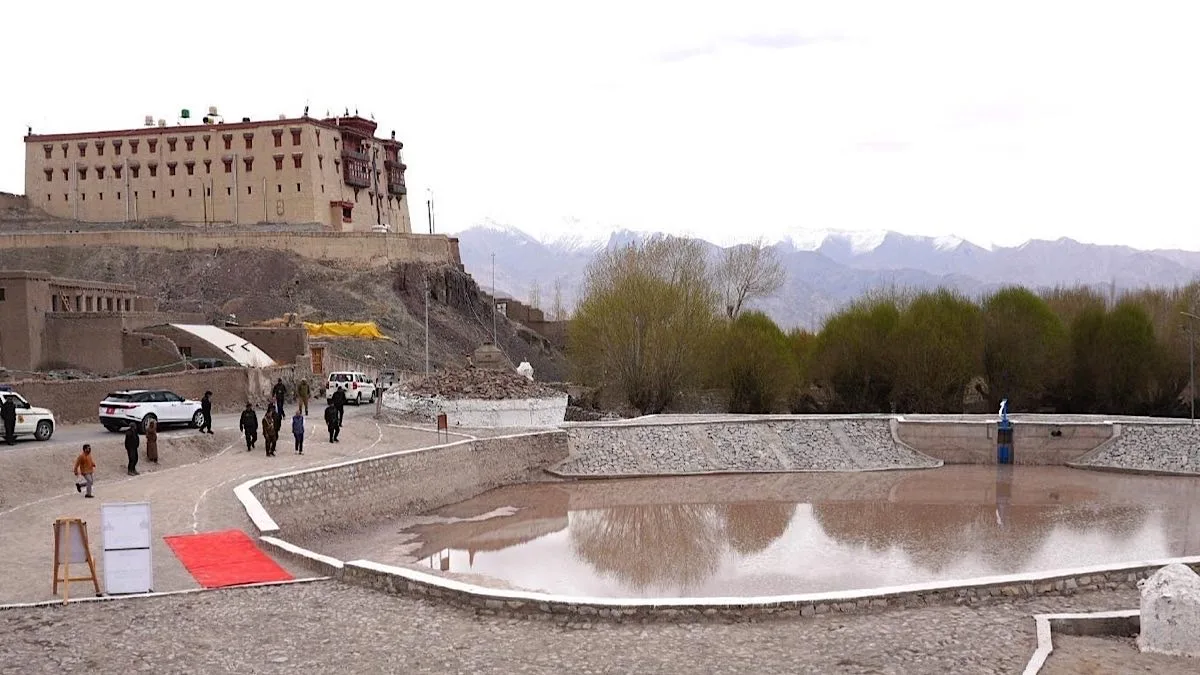
Photo:SNS
In a landmark step towards climate resilience in the high-altitude cold desert, Lieutenant Governor Vinai Kumar Saxena on Friday inaugurated Ladakh’s first artificial water body at Phikar village in Stok, Leh district, marking the on-ground rollout of the ambitious Project Him Sarovar.
By channelling glacial melt into the newly created water body, the initiative moves from vision to reality within a week of its launch on 10 April, underscoring an urgent and innovative response to climate challenges. Designed to capture and store precious snowmelt, the project is poised to transform water management in the cold desert, offering a sustainable lifeline for communities grappling with shrinking natural sources.
Advertisement
Project Him Sarovar envisages the creation of small water bodies across Ladakh to conserve snowmelt and ensure long-term water security in the region.
Advertisement
The water body has been created by restoring a heavily silted depression in the village. During his first visit to the site on 26 March, the Lieutenant Governor directed that the depression be cleaned, dredged and de-silted. The depression was also stone-pitched by the administration, with active support from locals, to prevent seepage of water. Spread over 1,824 sq metres, the water body will hold nearly 35 lakh litres of water, benefiting approximately 150 hectares of land within its command area.
Addressing the gathering, the Lieutenant Governor expressed satisfaction at witnessing the realisation of his vision, within a short span of three weeks, with the successful remodelling and operationalisation of the reservoir at Phikar, Stok. He stated that Stok village is leading the implementation of Project Him Sarovar, which will play a crucial role in ensuring water security and addressing water scarcity challenges in Ladakh.
Saxena said that under Phase I of the project, 50 water bodies—30 in Leh and 20 in Kargil—are proposed to be developed, covering nearly 25 per cent of villages in Ladakh. He further expressed optimism that nearly 50 percent of villages would be covered under Project Him Sarovar within a year. Emphasising the importance of scientific water management, he highlighted the need for innovative and sustainable solutions to address the growing challenges of climate change and water scarcity in the region. He stated that the project will serve as a shield against climate change while ensuring water security, and will stand as a model of convergence involving government departments, armed forces, and local communities.
He emphasised that with active community participation, Stok can be developed into a premier tourist destination. He further stated that tourists visiting Stok should return with a memorable and enriching experience of Ladakhi hospitality, emphasising the importance of treating visitors as part of the community. He outlined key focus areas for developing Stok as a model village, including promoting organic farming, harnessing solar energy, and strengthening tourism infrastructure.
Advertisement