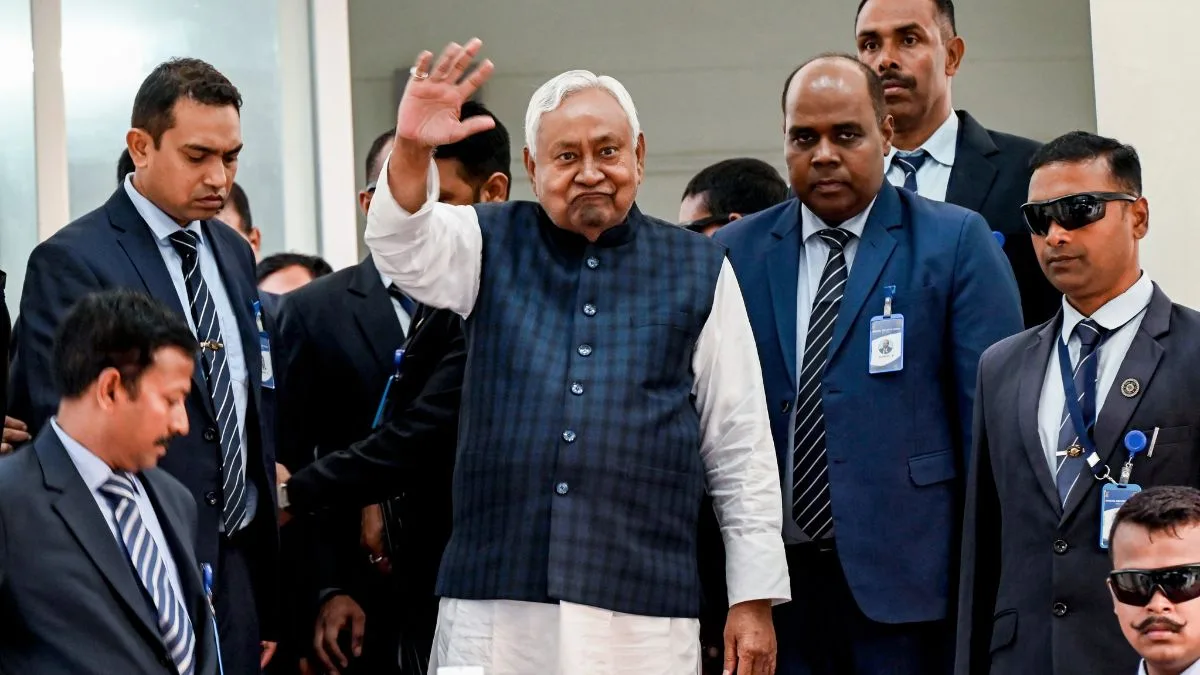
During his two-decade-long rule, Nitish Kumar has taken countless decisions, but five of them consolidated his position as a leader focused on the state’s progress.
Nitish Kumar took over the reins of the state in 2005, ending the 15-year-long Lalu-Rabri regime, which was dubbed “Jungle Raj” by the opposition.
Advertisement
His first priority was to free the state from caste and communal tensions, Naxal violence, kidnapping, robbery, and horrific incidents of crimes against women. He transformed Bihar’s image from alleged “Jungle Raj” to one of so-called “good governance,” earning him the nickname “Sushasan Babu.”
In the process of development, he strengthened basic infrastructure such as roads and bridges. There was a strong focus on infrastructure development. A network of roads was laid, connecting villages to main roads, with visible improvement in quality. Several major bridges were constructed over the Ganga, connecting Patna to even the most remote areas of the state.
Nitish Kumar was among the first leaders to focus on women’s empowerment through various welfare schemes, which drew widespread attention.
Schemes such as 50 per cent reservation for women in Panchayati Raj institutions and urban bodies, 35 per cent reservation in jobs, the bicycle distribution scheme for schoolgirls, financial assistance to families for the education and marriage of girls, strategies to enhance the role of women in agriculture, and the prohibition of liquor sales in Bihar earned him wide support among women voters.
The formation of the ‘Jeevika’ self-help group for women in 2006 remains one of the most significant achievements of Nitish Kumar.
By implementing prohibition laws, he set an example for states where such laws were introduced but later withdrawn by governments. Despite criticism from the opposition over prohibition, Nitish Kumar remained firm and unyielding.
As Chief Minister of Bihar, Nitish Kumar launched the series of “7 Nischay” (Seven Resolves). Under this initiative, schemes were designed and implemented on the ground. Infrastructure remained a key priority under the 7 Nischay programme. He not only formulated policies but also personally monitored their implementation.
After becoming Chief Minister in 2025, Nitish Kumar announced “7 Nischay – 3,” which focuses on employment, industry, and agriculture. It also includes a pledge of creating 1 crore jobs and employment opportunities over the next five years.
Nitish Kumar has left a complex, multi-faceted legacy for his successor, Samrat Choudhary.