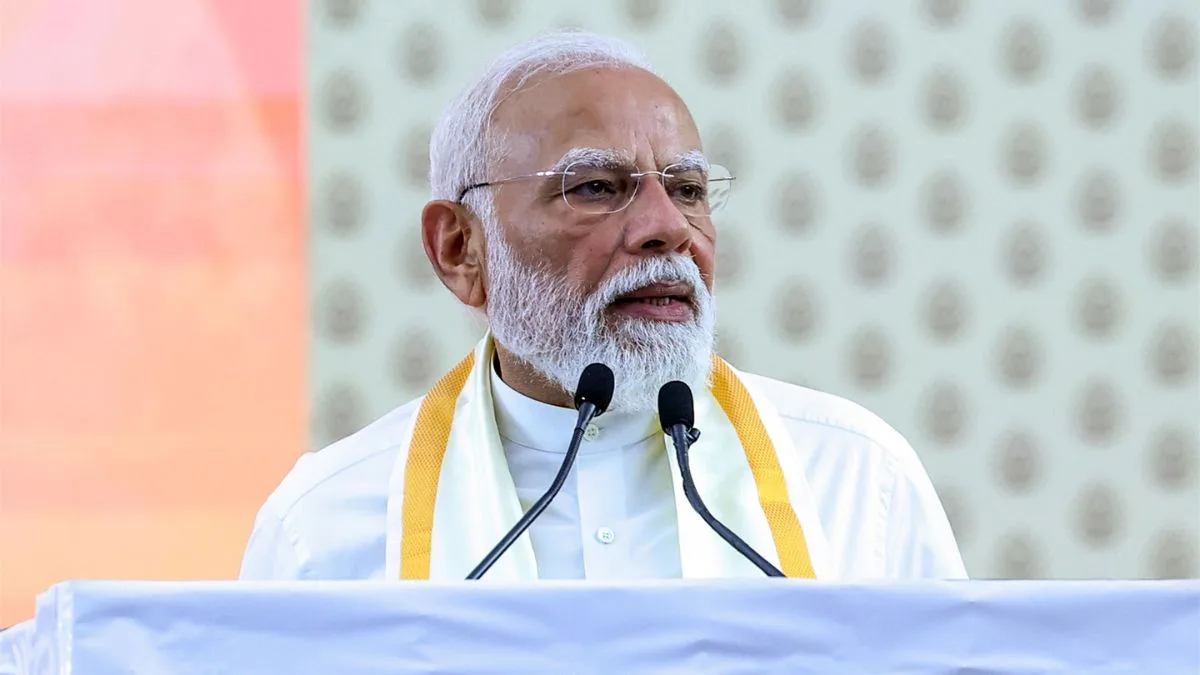
Prime Minister Narendra Modi, speaking on the occasion of the Karmayogi Sadhana Saptah, called for a governance model that is more citizen-focused, technologically equipped and rooted in a strong sense of duty.
The event, marking the foundation day of the Capacity Building Commission, was addressed by Narendra Modi via video message on Thursday.
Advertisement
Greeting participants, the Prime Minister highlighted that India’s administrative framework is now guided by the principle of “Nagrik Devo Bhava,” which places citizens at the heart of governance. “The core principle of governance we are following today is ‘Nagrik Devo Bhava’ with focus on making public services more capable, more sensitive to citizens,” he said, noting that the government is working to redefine governance as truly citizen-centric.
Pointing to the rapidly evolving global environment, Modi said India must continuously upgrade its governance mechanisms to remain effective and responsive. “Karmayogi Sadhana Saptah is an important link in that very effort to ensure our public service stays relevant and responsive in the 21st century,” he remarked.
Recalling the origins of the Capacity Building Commission, the Prime Minister said despite the presence of various institutions since independence, a focused body was needed to strengthen the capabilities of government employees. He said this led to the creation of the Commission and lauded its contributions, along with initiatives such as iGOT Mission Karmayogi, in building a skilled, modern and sensitive administrative workforce.
Connecting the initiative to the broader vision of a developed India, Modi emphasised the critical role of public servants in meeting citizens’ aspirations. “Today’s India is aspirational, every citizen has dreams and goals, and upon all of us lies the responsibility to provide maximum support to fulfil them,” he said.
He urged officials to embrace continuous learning and align their work with improving citizens’ quality of life. “Our governance should ensure that the quality of life of citizens improves day by day, this is our true benchmark,” he added.
Calling for a transformation in administrative thinking, Modi stressed the importance of prioritising duty over designation. “Before every decision, when you think about what your duty demands, the impact of your decisions will automatically multiply many times over,” he said, encouraging officials to consider the broader and long-term consequences of their decisions.
Highlighting the growing importance of technology, the Prime Minister noted its deep integration into governance over the past decade and the accelerating impact of emerging tools like artificial intelligence. “A better administrator, a better public servant, will be one who possesses a strong understanding of technology and data; this will form the very basis of decision-making,” he said.
Addressing India’s federal structure, Modi emphasised the need for stronger coordination and collaboration among states and institutions. Rejecting outdated classifications of regions, he said, “We have to break silos and move forward with better coordination, shared understanding and a whole-of-government approach, only then will every mission succeed.”
The Prime Minister further underscored the importance of maintaining public trust, noting that local government offices often represent the face of governance for citizens. “Whatever we do, at whatever level, we must safeguard that trust, it is the foundation of our democracy,” he said.
He expressed confidence that the Karmayogi Sadhana Saptah would play a key role in strengthening governance and contribute significantly to India’s journey towards becoming a developed nation.