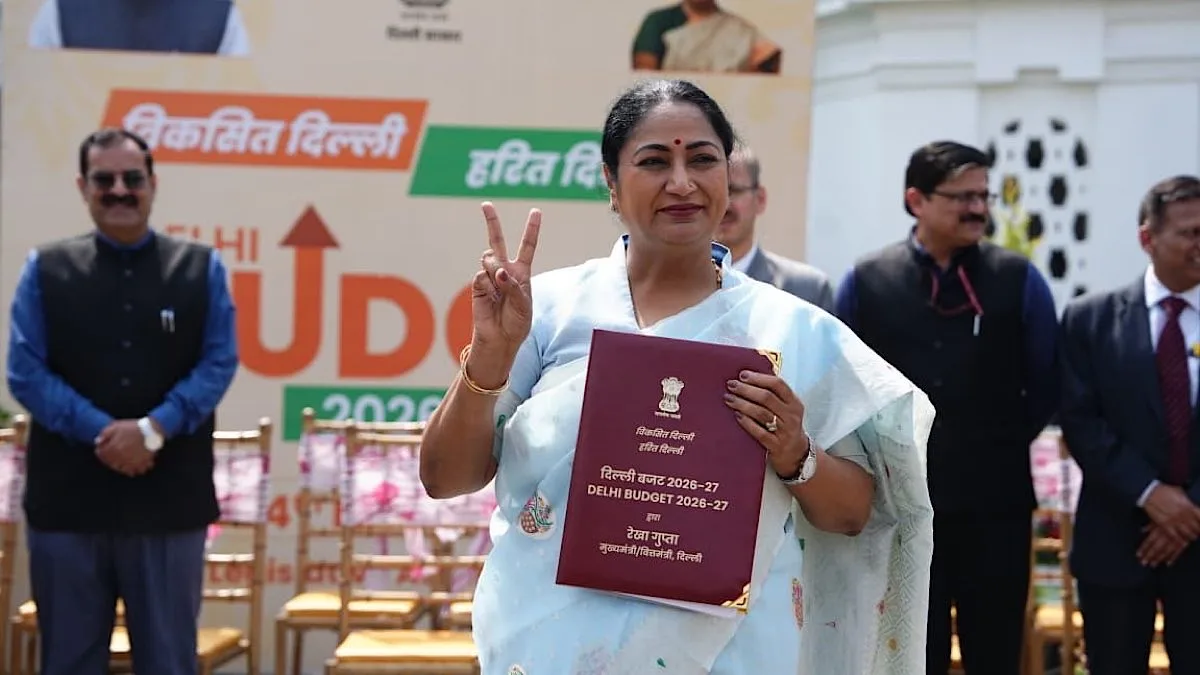
Delhi Chief Minister Rekha Gupta on Tuesday presented her government’s second Budget in the assembly, laying out a roadmap for the transformation of the national capital into a modern, inclusive, safe, and environmentally sustainable city.
The Budget for 2026-27 has been pegged at Rs 1,03,700 crore, marking an increase of Rs 3,700 crore as compared to the previous year, with an annual growth of 3.7 per cent.
It is noteworthy that this is Delhi’s first dedicated ‘Green Budget’, with 21.44 per cent of the total outlay, that is Rs 22,236 crore earmarked for environmental protection and sustainable development.
Advertisement
According to the CM, a budget of Rs 19,326 crore (18.64 per cent) has been allocated to the education sector, followed by Rs 13,034 crore (12.57 per cent) for the medical and public health sectors.
Allocations of Rs 12,613 crore (12.16 per cent) have been earmarked for the transport, roads, and bridges sector, and Rs 11,572 crore (11.16 per cent ) for the housing and urban development sector.
A provision of Rs 10,537 crore (10.16 per cent) has been made for the social security and welfare sector and Rs 9,000 crore (8.68 per cent) for the water supply and sanitation sector.
Furthermore, Rs 4,254 crore (4.10 per cent) has been set aside for public debt, Rs 3,938 crore (3.80 per cent) for the energy sector, and Rs 2,734 crore (2.64 per cent) for interest payments.
An amount of Rs 1,777 crore (1.71 per cent) has been designated for agriculture, rural development, irrigation, and flood control, while a provision of Rs 14,915 crore (14.38 per cent) has been made for other heads.
The government has placed infrastructure development at the centre of its agenda, and the Municipal Corporation of Delhi (MCD) has been allocated Rs 11,266 crore, while NDMC and DCB together will receive Rs 146 crore.
The PWD gets Rs 5,921 crore and the urban development and housing department Rs 7,887 crore.
An outlay of Rs 800 crore is made for improving basic amenities in unauthorised colonies, and Rs 787 crore for rural development through the Delhi Gram Vikas Board.
In 2026-27, 750 km of roads will undergo end-to-end re-carpeting and redevelopment at a cost of Rs 1,392 crore, with MCD roads to get investments of around Rs 1,000 crore, while Rs 160 crore has been set aside for roads and drainage in notified and non-conforming industrial areas.
Major mobility projects include the extension of the Modi Mill flyover up to Kalkaji and a new flyover at Savitri Cinema junction, with a total project cost of Rs 371 crore (Rs 150 crore allocated this year).
The Delhi Jal Board has been allocated Rs 9,000 crore, with plans to revamp the water supply and sewer system, while the government also aims to reduce non-revenue water losses from 45 per cent to 15 per cent.
Talking of the healthcare sector, it has been allocated Rs 12,645 crore, with government emphasizing that completion of pending hospital projects remains a top priority.
Hospitals in Madipur, Siraspur, Hastsal and Jwalapuri will be completed with an investment of Rs 515 crore, while infrastructure will be strengthened at Rao Tula Ram Memorial Hospital, Baba Saheb Ambedkar Hospital and Lal Bahadur Shastri Hospital under the SASCI scheme.
The education sector has been allocated Rs 19,148 crore. This includes Rs 200 crore for new school buildings and Rs 275 crore for expansion of existing schools.
The Budget allocates Rs 2,392 crore for social welfare and Rs 227 crore for SC/ST/OBC welfare, with an amount of Rs 80 crore earmarked for improving SC colonies, and Rs 35 crore for housing for persons with mental disabilities.
To improve governance, 13 mini secretariats will be set up (Rs 100 crore), offering integrated public services. All properties will be assigned a unique ID (‘Bhu-Aadhaar’) and land records digitised via the NGDRS portal.
The Green Budget totals Rs 22,236 crore (21.44 per cent of the total outlay), and the environment budget has been increased from Rs 505 crore to Rs 822 crore.
A Rs 300 crore pollution control and emergency response plan includes mechanical sweepers, anti-smog guns and water sprinklers.