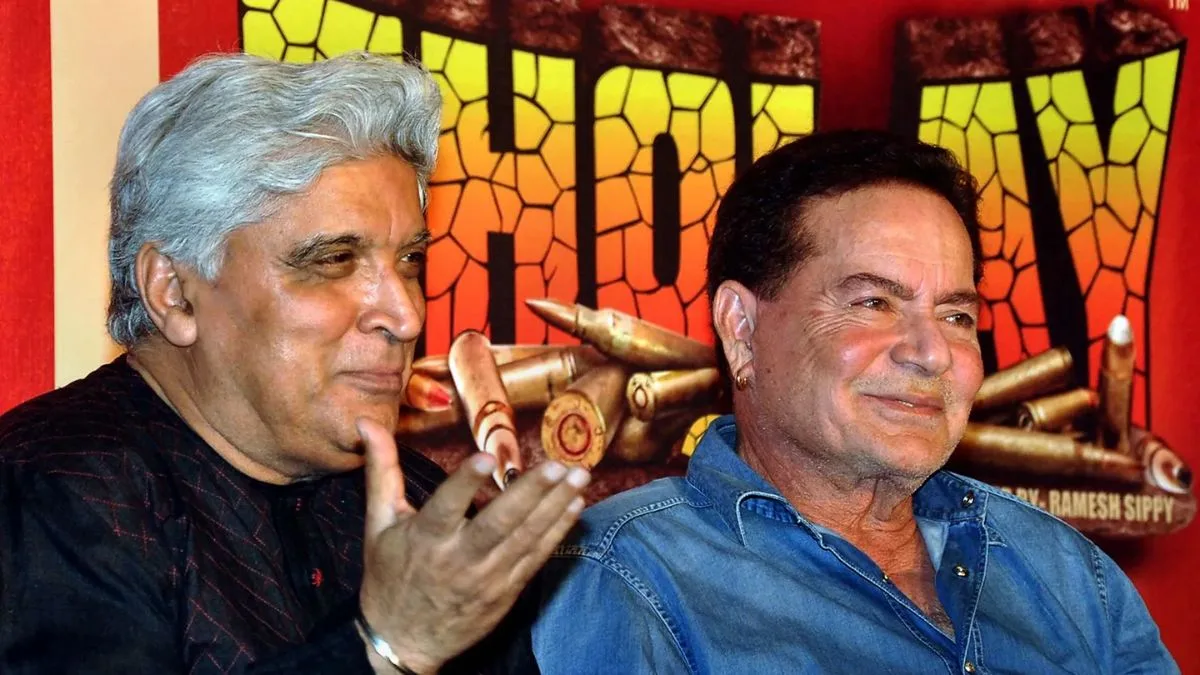
Imagine a buzzing film set in Bombay in the late 1960s. Extras milling around, lights blazing, and somewhere in the chaos, a struggling actor hoping for his big break crosses paths with a sharp-tongued dialogue writer who grew up in a house full of Urdu poetry. That actor was Salim Khan. That writer was Javed Akhtar.
Nobody on that set knew they were witnessing the start of one of Hindi cinema’s most powerful creative partnerships. For over a decade, they worked side by side and wrote scripts for around twenty films. Their names appeared on movie posters right next to producers, directors, music directors, lyricists. That was rare. Writers usually stayed invisible. But Salim and Javed became stars without ever appearing on screen.
Advertisement
‘Sholay’ and the national memory
One cannot talk about their legacy without mentioning the massive success of ‘Sholay’. Directed by Ramesh Sippy, this film mixed action, drama, humour, and strong writing.
But what truly stuck in public memory were the dialogues. Lines were performed, quoted, repeated. People memorised the film.
‘Kitne aadmi the?’ A single threatening line spoken by the villain Gabbar Singh became instantly recognisable across the country.
That was the magic of Salim-Javed. They wrote lines that behaved like cultural catchphrases.
Urban streets, underworld shadows
Their stories did not float in fantasy worlds. They were rooted in urban life. Cities, factories, docks, mines, crime networks, and struggling middle-class homes filled their narratives. They showed the darker side of development. They showed how a system could fail an honest person again and again.
The central hero often stood alone, facing a rigged world. He had inner demons. Emotional wounds. Sometimes he even questioned his own path. But he never gave up on fighting.
Many writers can create plots. Few can create unforgettable lines. Salim-Javed specialised in powerful metaphorical language. Instead of plain sentences, they used images and comparisons that painted pictures in the audience’s mind.
A mine could become a giant creature swallowing workers. Money could become poison. Darkness could symbolise emotional pain. Light could hint at hope.
These metaphors made dialogues richer and more memorable. Even when audiences forgot entire story details, they remembered the lines.
Their best metaphors usually appeared in the final parts of the film when emotions reached peak intensity.
Revenge, power, emotional showdowns in ‘Trishul’
In the film ‘Trishul’, the central character arrives in Delhi with a burning desire to avenge the suffering of his mother, who had been abandoned by a wealthy and ambitious father. What follows is psychological duel between father and son.
As the son slowly destroys the father’s financial empire, the confrontation becomes deeply emotional. When the father realises his business is collapsing, he compares himself to a ship that is not about to sink, even though investors are running away like rats. This simple metaphor captures arrogance, denial, desperation in one stroke.
That coal mine in ‘Kaala Patthar’
In ‘Kaala Patthar’, the hero works in harsh conditions inside coal mines. His personality is quiet but heavy with guilt and anger. When a tragic accident exposes the cruelty of the mine owner, the hero confronts him in public.
Instead of simply accusing the owner of exploitation, he compares the mine to a giant python that swallows workers, crushes them, drains their blood, and spits them out as corpses.
This type of metaphor turns social criticism into powerful cinema language. The audience does not just hear about injustice. They visualise it as a terrifying creature feeding on human lives.
Duty versus love in ‘Shakti’
Another powerful emotional drama unfolds in ‘Shakti’ where a strict policeman father and his rebellious son clash due to conflicting values. A childhood kidnapping incident plants the first seed of emotional distance. As the son grows up, he gradually moves toward crime, even while loving his mother deeply.
When the father realises that smugglers have essentially “bought” his son by paying his bail, he does not simply say he has lost him. Instead, he describes the moment as if someone had placed a price tag on his child and purchased him right in front of his eyes.
It is humiliation. Helplessness. A feeling that love has been defeated by money.
The emotional tension in the same story rises further when the son tries to take his ill mother for expensive treatment. She refuses because his wealth comes from dishonest means.
Many critics accused these films of glorifying violence and macho masculinity. But supporters argue that the true brilliance lay in emotional depth created through poetic dialogue. Instead of a brute, the hero became a tragic figure shaped by circumstances. That emotional poetry helped audiences sympathise with even morally grey characters.
Cinema songs and metaphors
Before this writing duo, metaphorical language existed mostly in film songs rather than spoken dialogues. Poets writing lyrics had already created memorable images comparing life to caravans, dreams to waves, love to storms.
Salim and Javed moved that poetic tradition into regular speech within films. They proved that even everyday conversations between characters could sound lyrical without becoming difficult to understand.
Dialogues that became cultural currency
The influence of their writing spilled into daily life in fascinating ways. Advertisements borrowed villain characters and dialogue styles to sell products years after film releases. Audio records containing only dialogues were sold alongside film songs. Fans memorised favourite lines and repeated them like quotes from poetry.
On fan websites and discussion forums, people listed their most loved film dialogues, often linking the words directly with the actor who delivered them. Actor and dialogue merged into one iconic memory in public imagination. Then came memes too.
But intellectuals debated their impact
Some intellectual circles worried such stories encouraged revenge-driven heroes and violent solutions to anything, everything. They argued celebration of macho anger might shape public attitudes negatively.
Supporters countered these stories reflected real frustrations faced by ordinary people. The hero’s anger was not meaningless rage. It was reaction to systemic injustice.
Male characters dominated screen time. Women provided crucial emotional direction. Budhi maa‘s silent approval or disapproval could change hero’s path. Lover’s gentle words could soften hardened hearts. Wife’s moral stand could challenge corruption more powerfully than physical confrontation. (Nah, we don’t do that here!)
How Salim-Javed changed the status of film writers
Another lasting impact was the visibility they brought to screenwriters. Earlier, writers rarely received star-level recognition. After their success, audiences began noticing who actually created the story and dialogue behind these hit films.
At the heart of Salim-Javed’s work was a simple but effective formula: take a relatable emotional conflict, place it in a socially charged setting, and express the inner turmoil through striking metaphors that amplify feelings without complicating language.
This emotional grammar made their stories timeless.