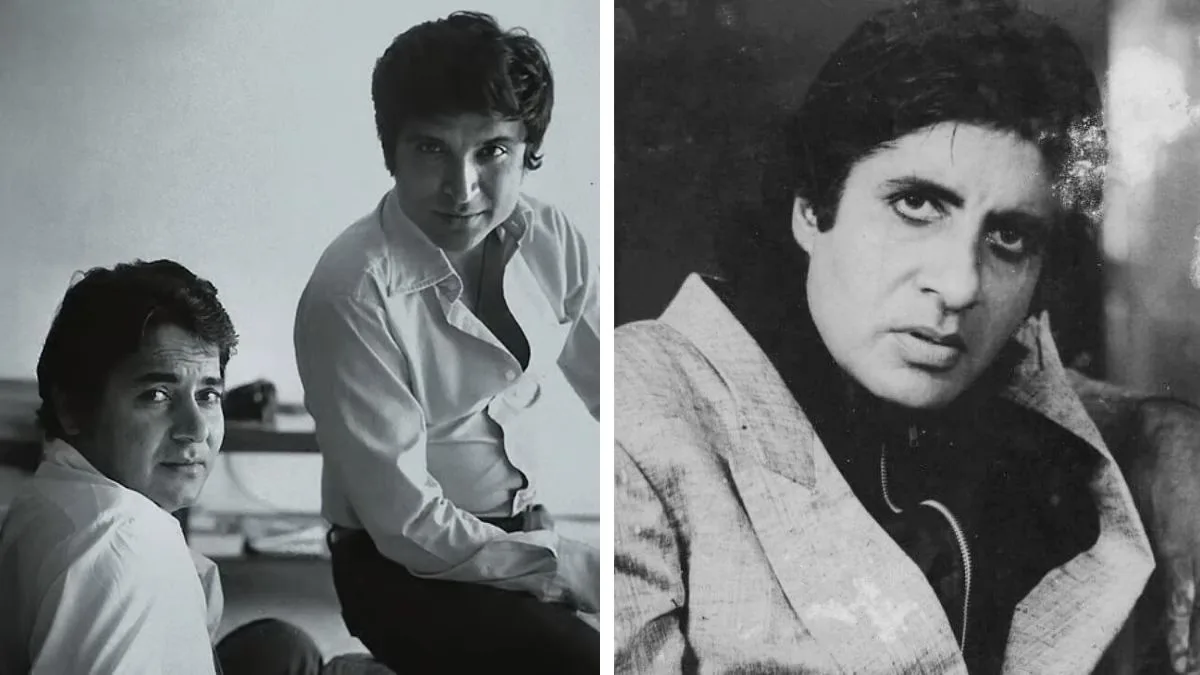
Before hashtags, before PR armies, before opening-day box office wars, there were just two sharp minds, a smoky room, and a superstar waiting to be born. Everyone credits the rise of the ‘Angry Young Man’ to Amitabh Bachchan, but insiders of the 1970s Hindi film world whispered a different truth: the anger, the rage, the simmering pain, the punchy dialogues; all came from the pen of two men who wrote rebellion. Meet the duo who quietly changed the grammar of Hindi cinema: Salim Khan and Javed Akhtar, better known as Salim-Javed.
They created a mood. A mirror. A movement.
Advertisement
And in doing so, they didn’t merely give Bollywood a hero. They gave a frustrated nation a voice.
The 1970s: India was angry… and so was cinema
Let’s rewind to the 1970s. Hope from Independence had slowly turned into disappointment. Corruption scandals were rising. Jobs were scarce. Cities were crowded. The working class was expanding but felt ignored. Then came the Emergency (1975-1977), when protests and strikes were suppressed.
The streets were boiling. But politics was silent.
Cinema stepped in.
Salim-Javed sensed the mood. They understood audiences didn’t want a dreamy romantic hero anymore. They wanted someone who looked like them, spoke like them, fought like them.
So they created Vijay. A coolie, a worker, a man of the masses. A man who had nothing to lose and everything to rage about.
That rage wasn’t fictional. It was social reality turned into cinematic fire.
Bollywood back then
Today, scripts go through dozens of drafts and writing rooms. But back then? Bollywood functioned like a chaotic workshop, what scholars called a “heterogeneous manufactory.”
In simple terms, films were stitched together piece by piece.
One person wrote the plot (often in English). Another wrote dialogues (first English, then Hindi). Someone else wrote songs. Music composers sometimes didn’t even know the full story. Songs were added later just to boost music album sales.
The screenplay was not the boss. It was just one ingredient in a big cinematic thali.
But Salim-Javed broke this pattern. They did something revolutionary: they wrote BOTH the plot and the dialogues.
This meant the story and the punch lines flowed from the same mind. The result? A tighter, sharper, more emotionally powerful narrative where dialogues became the heartbeat of the film.
Dialogue became the hero
In older Hindi films, songs carried the emotions. Dialogues were secondary. But Salim-Javed flipped this rule upside down.
Suddenly, words were weapons.
Audiences didn’t just hum songs anymore. They memorised dialogues. They repeated them in tea stalls, buses, and college canteens. Vinyl records of movie dialogues became bestsellers.
This was unheard of.
For the first time, a superstar’s image was built not on songs, but on spoken words. Amitabh Bachchan didn’t sing his way to fame. He spoke his way into cinematic immortality.
Meet Vijay Dinanath Chauhan
The characters written for Amitabh were often named Vijay. And this wasn’t random. Vijay literally means “victory.” But victory here symbolised working-class uprising.
These Vijays were coolies, labourers, mine workers; not princes or poets. They were proletarian heroes, not rich romantic leads. This shift was massive.
For decades, Hindi cinema rarely focused on a clear goal-driven protagonist. Characters were often embodiments of ideals, inspired by epics like the Ramayana and Mahabharata. Their journeys were more symbolic than action-driven.
But Salim-Javed changed that.
Their Vijay had goals. Clear ones. Personal ones. Revenge. Justice. Survival. He acted, pushed the story forward, and refused to stay passive. For the first time, Hindi cinema got an “active agent”, a hero whose actions drove the narrative.
And that hero wasn’t bourgeois or elite. He was working class. Angry. Raw. Real.
Deewar: The blueprint of the Angry Young Man
When discussing Salim-Javed’s writing magic, one film stands like a monument: Deewar.
In Deewar, Vijay (Amitabh) walks the path of crime, while his brother represents law, religion, and the state. This symbolised India’s moral conflict: rebellion versus order, anger versus righteousness.
Yet Salim-Javed did something clever. Even though Vijay chooses the wrong path, they gave him such emotional depth that audiences still rooted for him. They humanised his pain.
Cinema of interruption
Unlike Hollywood’s strict three-act formula, Hindi films were structured differently. Long runtime, intermission break, and multiple song sequences.
But Salim-Javed streamlined this messy structure.
They reduced unnecessary song sequences and focused more on narrative momentum. This made the storytelling sharper and engaging.
Instead of pausing the story for songs every few minutes, they let dialogues and dramatic confrontations take centre stage.
The famous dialogue battles
One of the most iconic scenes in Deewar is intense verbal confrontation between two brothers.
Here, Vijay actually loses the rhetorical battle. And that’s the brilliance. Salim-Javed didn’t create invincible heroes. They created wounded warriors who sometimes lost morally even when they won physically.
These dialogue-driven scenes became the backbone of Amitabh’s star persona. His power came not just from fists but from fiery words loaded with pain, sarcasm, rebellion.
Religion meets realism
Western screenwriting manuals often warn against coincidences or divine interventions. But Hindi cinema has always embraced faith as narrative tool.
Salim-Javed didn’t reject this tradition. They reshaped it.
In Deewar, Vijay enters a temple for the first time to pray for his sick mother. The prayer works. She recovers. But this is not just plot convenience. It becomes an emotional monologue where Vijay pours out his lifelong anger and suffering to God.
Technically it’s a prayer. Dramatically it’s a dialogue with destiny.
Religion here isn’t just a miracle machine. It becomes a psychological mirror of the hero’s inner conflict.
Patchwork of minorities
Another subtle brilliance in Salim-Javed’s scripts was the presence of marginalised characters: Muslims, Christians, widows, sex workers. These characters were not random side roles. They supported Vijay’s journey often acting as moral donors who shaped his fight against the corrupt system.
This pattern reflected a larger ideological message: the Angry Young Man wasn’t fighting just for himself. He represented all ignored and exploited groups.
Interestingly both Salim Khan and Javed Akhtar themselves were Muslims working in a largely Hindu-dominated industry. Their scripts naturally carried sensitivity toward diverse communities.
The political pulse
To truly understand Salim-Javed’s impact, one must look at the Emergency period. Political dissent was controlled. Public protests were risky. Voices were silenced.
Cinema became the safe battlefield.
Through Vijay’s rage, audiences experienced a cathartic release. He fought corrupt systems, crooked bosses, moral hypocrisy; things people wanted to challenge in real life but couldn’t.
Thus, these films were emotional protest packaged as mass cinema.
Evolution, not revolution
It is tempting to say Salim-Javed “revolutionised” Bollywood. But a more accurate truth is that they evolved it. They didn’t discard traditions like melodrama, faith, symbolic characters but integrated them into more dynamic, dialogue-driven storytelling style.
This delicate balance made their scripts both familiar and fresh. Traditional enough for older audiences. Modern enough for restless youth.
No universal storytelling rules
One key takeaway from their work is that storytelling rules are not universal. Western idea of goal-driven individual hero emerged from specific historical and philosophical contexts.
Indian storytelling influenced by mythology and collective belief systems traditionally focused more on destiny, ideals, moral dilemmas rather than individual agency.
Salim-Javed bridged this gap.
They created hero who was both symbolic and active. He was rooted in Indian ethos, driven by personal goals. This hybrid model proved massively successful.
Perhaps their biggest innovation wasn’t just narrative style. It was their working method.
They collaborated closely with Amitabh Bachchan shaping his star image deliberately. Unlike earlier stars tied to songs or romantic roles, Bachchan’s persona was built on conflict, confrontation, intense verbal showdowns.
In short: the superstar was written before he was worshipped.
The pen that made the superstar
Looking back, it becomes clear that Amitabh Bachchan’s rise cannot be separated from Salim-Javed’s scripts. They gave him not just roles, but a recurring archetype: the Angry Young Man who spoke for the oppressed, fought injustice, carried emotional scars of a broken society.
This character changed Hindi cinema’s hero template forever. Romantic softness was replaced by moral rage. Songs gave way to scorching dialogues. Passive heroes turned into active agents of justice.
And behind all of this stood two writers who understood that cinema is not just about fantasy. It is also about reflecting collective emotion.
Salim-Javed created a moral battleground where class anger, personal pain, social injustice collided through words as much as action. It was this fusion of social critique and star persona that made their scripts as foundation of Amitabh Bachchan’s iconic screen image whose dignity, rage, wounded pride spoke for an entire generation.
And that legacy of defiant self-respect still lingers because ‘aaj bhi main phenke huye paise nahin uthaata (uthaati)’!