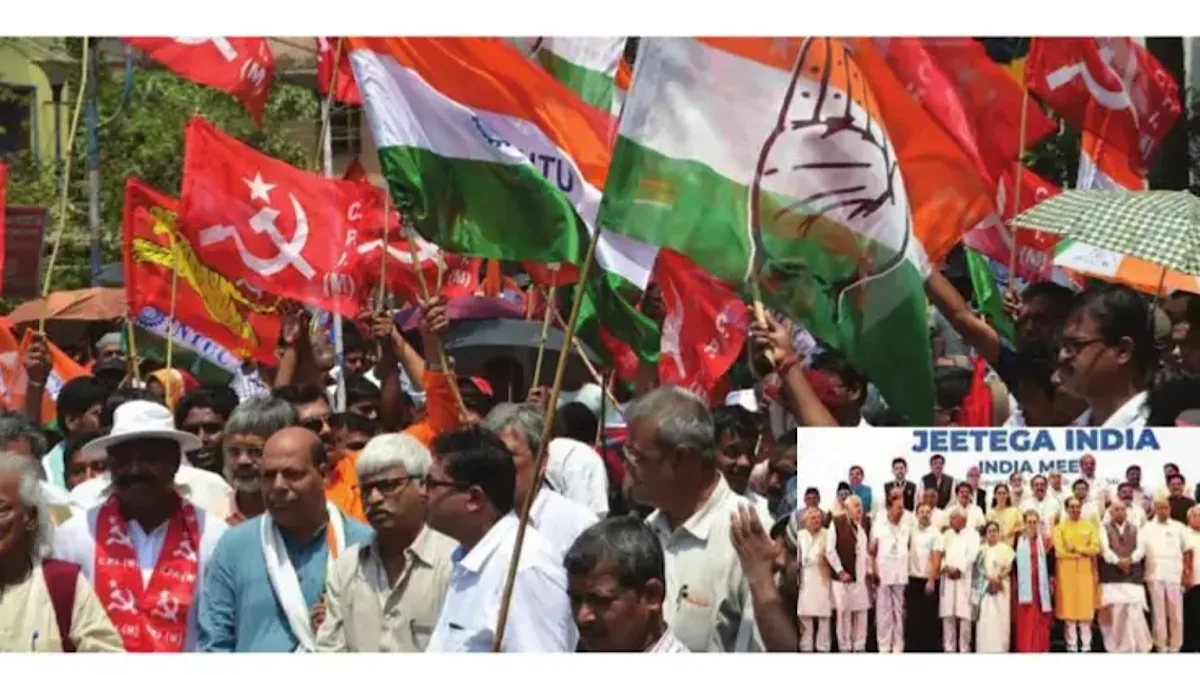
Today, Kerala is going back twice as fast than it is surging ahead. The imminent collapse of the Left Front should not, however, give comfort to believers in secular democracy including, one hopes, the Congress which, despite its many failures, enabled India to maintain its identity as a secular, democratic, broadly inclusive India though it can be said to have overcompensated a section of fundamentalists. Therefore, the first submission to both the Congress Party and the Left Front is that they must realize that our country is at the moment undergoing a counter-revolution.
Opposing and resisting it will require a political process that is far more rigorous than that which defeated British colonization. The Congress, in its present condition, does not have the wherewithal to initiate such a process on its own. Instead, it should give shape to a socio-economic and political values-based confederation, not a quick-fix INDIA bloc electoral arrangement. Rather, the proposed confederation must be built on strong foundations which can carry the weight of all the welded parts ~ the Congress, a re-unified Left, former Socialists, Trinamool Congress, NCP, YSR Congress, and all other groups that had quit the Congress at various points in time. This is similar to the strategy adopted by the South African National Congress in its struggle against apartheid, in which the Communist Party was a member. However, the Left Front that holds hands with the Congress should be a partner ~ either in the form of a single party or as a Left bloc that has cast off its Stalinism and democratized itself thoroughly.
Advertisement
It serves the interests of the Congress too to forge cooperation with a Left Front that has completely discarded its Stalinist underpinnings and adopted a national perspective. After all, modern Indian nationalism is a product of our freedom struggle. In this era of nation-states, India should stand as a powerful nation-state. Only a modern Indian nationalism can hold together the India of various languages, cultures, religions and castes. This feat cannot be achieved by means of class ideology, as a left party like the CPI-M ~ that is, Stalinist from top to toe ~ seems to think. This is because class ideology can be effectively applied only in struggles for social justice.
Only an alliance between a Left Front that realizes this fact and a Congress which accepts it can put up a successful resistance against rightwing forces of all descriptions. The Left should also recognize the fact that it was the Congress that succeeded in maintaining India as a single nation post-1947 despite the plurality of languages, races, religions and cultures. Dr Bipan Chandra spoke on precisely this subject (“The Long-Term Dynamics of the Indian National Congress”) in the course of his presidential address at the Amritsar session of the Indian History Congress in 1985.
The vitality of Indian nationalism is the product of such dynamism. But what the extreme rightwing is attempting to build is a nationalism that destroys our plurality. If the politics of the Indian left prevents it from aligning itself with the Congress in order to counter-balance the moves of the extreme right, how can a Stalinist party like the CPI-M continue to exist? This is where the CPI, with its ‘national democratic revolution’ ~ a cause it had espoused for a long time ~ becomes relevant. The downward spiral of the CPI began from the very moment it abandoned this policy.
Even today, the CPI-M believes that, with its “people’s democratic revolution” line, it can establish the dictatorship of the proletariat by sabotaging the government through an armed revolution. Everyone who is aware of the present-day condition of the CPI-M knows that this is nothing short of monumental hypocrisy. When CK Chandrappan forewarned about the imminent fall of the CPI along with the CPI-M, what he had in mind was the hollowness of such political deceitfulness and the inevitability of the fall of the CPI if it chased such a myth in the footsteps of the CPI-M. In 1952, when the first general elections were held, the CPI won nearly 10 per cent of the popular vote and became the main Opposition party in Parliament. The Jan Sangh got a mere 4 per cent.
It was in 1925 that both the CPI and the RSS were born. It is better not to attempt a comparison between the present-day state of these two movements? Whatever happened to the Left Front in Bengal and Tripura after the fall of the CPI-M looks set to be repeated in Kerala. The voters will decide, but the collapse of the left would not be good for the state. It is, however, inevitable. If at all it is to be prevented, the CPI-M should be prepared for an overhaul. But the prospects of that coming to fruition are negligible. The Press conference held by the Kerala Chief Minister after his resounding defeat in the local body elections is proof of it.
If he imagines that the masses or even the self-respecting comrades will endure this continuing Stalinist arrogance, he is mistaken. So, how can the Left Front be rescued? And what can the CPI do in this regard? Well, for starters, the CPI should evolve a policy whereby it will discard its anti-Congress attitude imbibed from the CPI-M and reorganize the party at the national level. It should work towards achieving its long-term goal of Communist reunification. But the CPI-M is scornful of that prospect. Yet, all other left groups in Kerala ~ CMP, RMP, SUCI, and other willing parties ~ can be brought under a single umbrella. This movement should cooperate with secular organizations, including the Congress, in conducting a struggle against the current ruling dispensation. Only then will the CPI regain relevance in Indian politics.
Honest CPI-M comrades will be willing to be part of such a confederation. It is a no-brainer that outdated sectarian, parochial perspectives are the chief reasons behind the stunted growth of the Indian Left. What the left in India needs to realize first and foremost is that it is the direct heir of the nationalist movement. The sacrifices made by the Communist leaders for our freedom are truly invaluable. But the Left could not become part of the national mainstream because of the incorrect approach the hardliners adopted towards Gandhiji and the movement that he headed.
The moot question is whether, during these times when our nation is going through a major crisis, the Left is ready and willing to come out of its Stalinist straitjacket, bring about clarity regarding the democratization of its party system, induct members from the current generation, and transform itself into a New Left movement.
There is little one can hope for from the CPI-M. But the tradition of the CPI is, or at least was, different. In 1960, K. Damodaran, as a representative of the CPI, went to Vietnam and interviewed Ho Chi Minh in Hanoi. One question and its reply are truly memorable: KD: In the 1930s, the revolution conducted by the Vietnamese Communist Party, which was only as large as the Communist Party of India, was successful, whereas that of the CPI failed. Why? HCM: There, you had Mahatma Gandhi. Here, I’m Gandhi!
(The writer, a Left sympathizer, is former member, Kerala Public Service Commission)