Strategic Distance
The renewed war between the United States and Iran has again placed American and Israeli military interests on apparently common ground.
Explosions reported across multiple Iranian cities and fresh missile exchanges have put renewed pressure on ceasefire efforts and ongoing US-Iran negotiations.




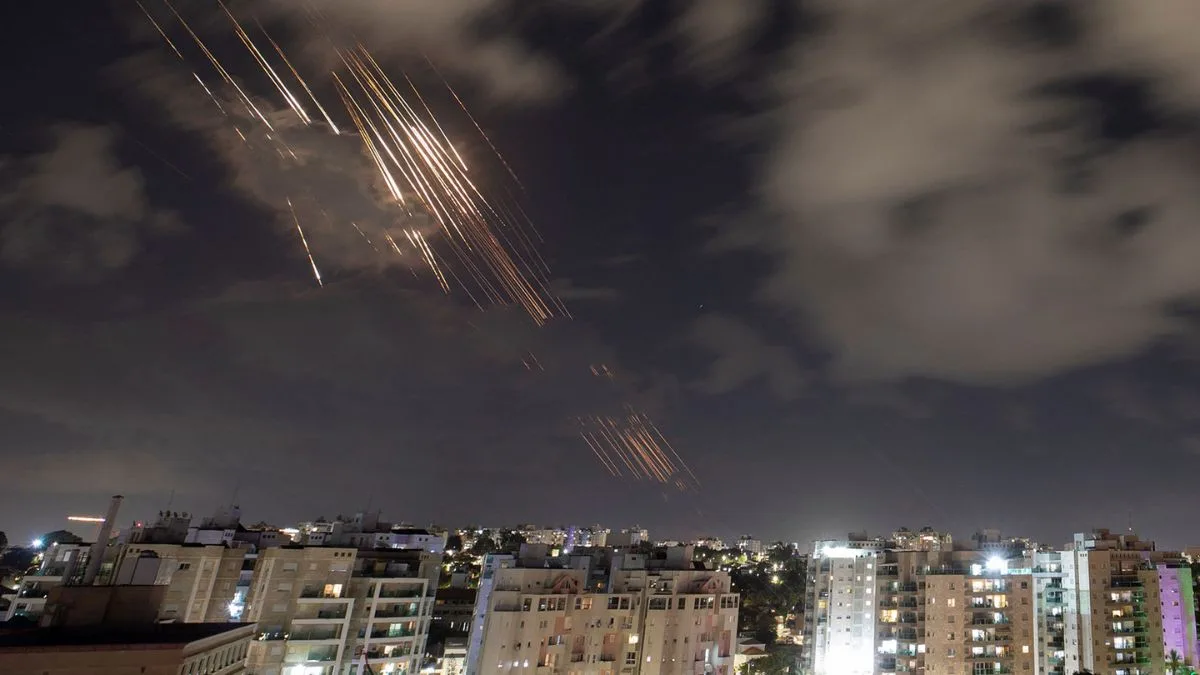
Interceptions light up the night sky above a city after missiles were launched amid escalating tensions between Israel and Iran. (Reuters via ANI)
Fresh tensions erupted in West Asia on Monday after Israel launched military operations against Iran, with Iranian state media reporting explosions in Tehran, Isfahan and other cities, marking a sharp escalation in a conflict that has repeatedly threatened to derail a fragile ceasefire.
The latest flare-up comes as the United States attempts to keep diplomatic channels open with Tehran following nearly 100 days of conflict. Renewed missile exchanges between Iran and Israel have added pressure on negotiations already stalled over sanctions, frozen Iranian assets and wider regional security concerns.
Advertisement
According to Iran’s official news agency IRNA, at least two powerful explosions were heard in Tehran, while three blasts were reported in the central city of Isfahan. State broadcaster IRIB later reported multiple explosions in Tehran, Tabriz and Isfahan, indicating that the military engagement had spread across several locations.
Advertisement
The Israeli military later confirmed carrying out strikes on military targets in western and central Iran. In a statement issued early Monday, the Israel Defense Forces (IDF) said it had targeted military sites, though it did not immediately provide further operational details.
Iranian state media, citing the Islamic Revolutionary Guard Corps (IRGC), claimed Israel used “air-launched ballistic missiles” during the attacks. The claim could not be independently verified.
Israeli strikes followed a barrage of missiles fired by Iran towards Israel on Sunday evening.
The IDF said the Israeli Air Force was operating to intercept threats and carry out strikes where necessary.
“At this time, the Israeli Air Force is operating to intercept and strike threats where necessary,” the military said.
Israeli authorities later said all incoming projectiles had been intercepted. Emergency responders reported no casualties.
Air raid sirens were activated in several parts of Israel following the missile launches, prompting authorities to suspend educational activities across the country for Monday.
Amid the renewed hostilities, US President Donald Trump said Israeli Prime Minister Benjamin Netanyahu would have “no choice” but to accept any agreement negotiated between Washington and Tehran.
Speaking to the Financial Times, Trump said, “He won’t have any choice. I call the shots. I call all the shots. He doesn’t call the shots.”
Trump also maintained that Iran’s latest missile attack would not affect ongoing negotiations.
“It’s not going to have any impact on the deal,” he said.
According to reports cited by Axios and Israeli media, Trump also urged Netanyahu not to launch retaliatory strikes following the Iranian missile attack.
Iranian officials framed the missile attack as a response to developments elsewhere in the region.
Mohsen Rezaee, a military adviser to Iran’s supreme leadership, told the Iranian Students’ News Agency that the missile launch was intended as a warning against what he described as hostile actions in Lebanon.
The latest exchange follows intensified fighting involving Hezbollah. Earlier on Sunday, the Lebanese group launched attacks into northern Israel, prompting Israeli airstrikes on Beirut’s southern suburbs that reportedly killed two people and injured 11 others.
Tehran has continued to insist that progress in talks with Washington remains linked to developments in Lebanon and the broader regional situation.
A military adviser to Iranian Supreme Leader Mojtaba Khamenei told CNN that “the ball is in Trump’s court” regarding any future agreement between the two countries.
Separately, Trump argued that Iran’s military capabilities had been significantly reduced during the conflict.
In an interview with NBC’s Meet the Press, the US President claimed Iran now retained only a fraction of its previous missile stockpile.
“I would say, percentage-wise, maybe 21, 22 per cent of their missiles. It’s a lot of missiles. But it’s not what it was when we first attacked,” he said.
Trump also claimed that US military operations had severely damaged Iran’s missile production facilities, launch sites and drone infrastructure.
“We have totally destroyed their military,” he said.
Rejecting comparisons with previous US interventions in the Middle East, Trump said the current conflict would not become an “endless war”.
The President reiterated that preventing Iran from obtaining a nuclear weapon remained Washington’s primary objective and said diplomacy remained his preferred option.
“I think we’re very close,” Trump said of negotiations with Tehran, while warning that military action remained an alternative if talks failed.
The latest escalation is widely seen as the most serious challenge to the April 8 ceasefire, with diplomatic efforts now facing renewed uncertainty amid fresh military exchanges between Iran and Israel.
Advertisement

![‘Beginning of accountability’: Sonam Wangchuk reveals 3 written assurances from Centre before ending fast [VIDEO]](https://www.thestatesman.com/wp-content/uploads/2026/07/Sonam-Wangchuk-1-1-300x200.webp)
![‘Beginning of accountability’: Sonam Wangchuk reveals 3 written assurances from Centre before ending fast [VIDEO]](https://www.thestatesman.com/wp-content/uploads/2026/07/Sonam-Wangchuk-1-1.webp)