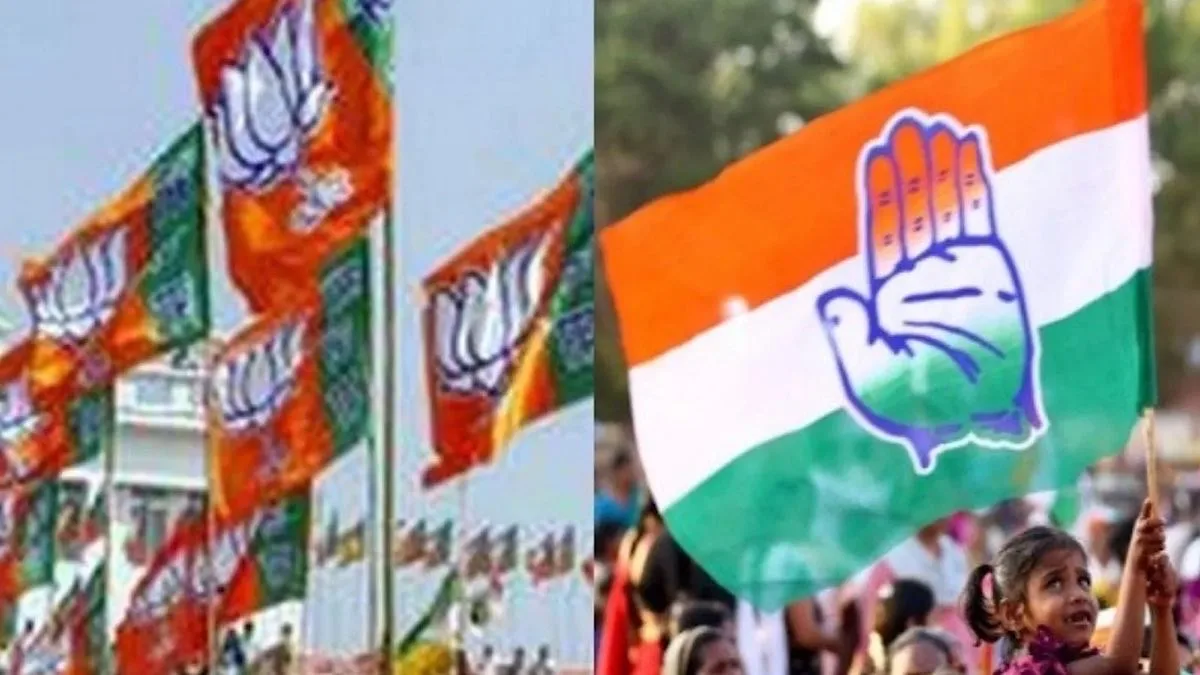
India’s elections have always been competitive, but recent financial disclosures show the playing field is becoming increasingly unequal. Data submitted to the Election Commission of India indicates that the gap in election spending between the Bharatiya Janata Party (BJP) and the Congress has widened sharply over the past decade, raising important questions about the future character of electoral competition. In the financial year 2014-15, when the general election was held, the BJP reported election-related expenditure of about Rs 925 crore, while the Congress spent roughly Rs 582 crore.
Five years later, during the 2019-20 election cycle, the BJP’s spending rose to Rs 1,352 crore compared to the Congress’s Rs 864 crore. The disparity existed, but it remained within a broadly comparable range. That balance shifted decisively in 2024-25. According to Election Commission filings, the BJP spent approximately Rs 3,355 crore on elections and general propaganda. The Congress, by contrast, reported expenditure of about Rs 896 crore. In practical terms, the ruling party spent nearly four times as much as its principal national rival ~ a scale of difference unseen in previous election cycles. The significance of this shift lies not merely in the figures, but in what modern campaigning requires. Elections today are continuous operations involving electronic media outreach, extensive advertising, highfrequency travel, logistical mobilisation, and rapid-response communication teams. These activities demand sustained financial capacity, not episodic fundraising.
Advertisement
Supporters of unrestricted fundraising often argue that money alone does not determine electoral outcomes. India’s state elections offer evidence for this claim. Well-funded campaigns have lost where local leadership, governance records, or social coalitions shifted preferences away from them. Voters, ultimately, cannot always be bought. Yet financial power shapes elections long before ballots are cast. It determines who dominates visibility, whose messaging saturates media platforms, and who can absorb mistakes without lasting damage. Money may not secure victory, but it widens the margin for recovery. The issue, therefore, is not legality. These figures are formally declared and publicly available. The deeper concern is whether transparency by itself is sufficient when disparities become structural. When one party can campaign nationally at scale while another must ration outreach, elections risk becoming contests of amplification rather than persuasion. Such imbalances have long-term implications. Political competition may gradually privilege organisational wealth over ideological clarity.
Smaller parties and financially weaker formations struggle to sustain national presence, while internal party renewal becomes harder without access to resources. India’s democracy remains vibrant and contested, but capacity now varies sharply between competitors. If this trend continues unchecked, the danger is not the absence of choice, but the quiet narrowing of democratic space. Elections must ultimately reward credibility, leadership, and public trust ~ not simply the ability to outspend opponents. When financial power grows too dominant, the arena may still appear open, even as its balance slowly tilts.