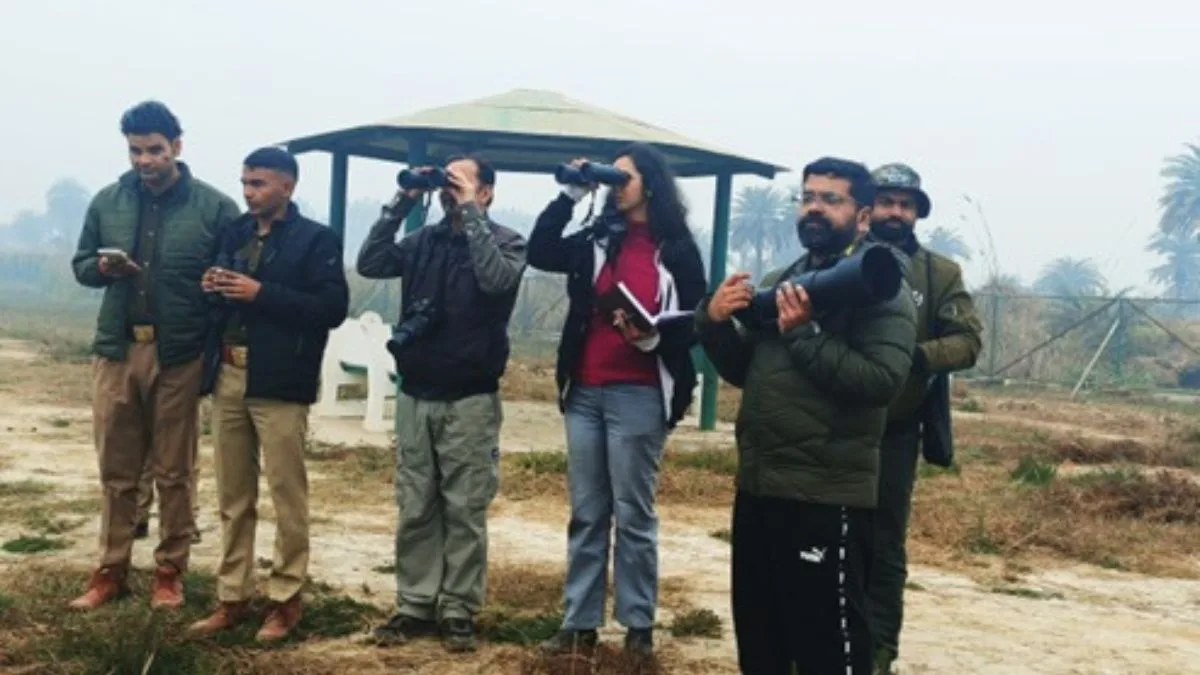
Under the Asian Waterbird Census-2026, a count of aquatic birds was conducted on Sunday at the Jodhpur Jhal wetland.
In the 6th consecutive year of the census, a record 72 species were registered this time. This included 11 endangered species.
Advertisement
The counting of aquatic birds began on Sunday at four wetlands in the Agra division. The process started at Jodhpur Jhal, near Farah, developed by the Uttar Pradesh Braj Pilgrimage Development Council.
Advertisement
The task was done under the direction of Neeraj Srivastava, Uttar Pradesh Coordinator of Wetlands International, and the leadership of Dr K P Singh, a wildlife ecologist with the Biodiversity Research and Development Society (BRDS).
The Biodiversity Research and Development Society, the Uttar Pradesh Braj Pilgrimage Development Council, and the Mathura Forest Department collaborated in this census program of Wetlands International.
At Jodhpur Jhal, under the Asian Waterbird Census 2026, 8 expert members in 2 groups conducted the count over an area of approximately 80 hectares in 3 hours.
As many as 72 species of aquatic birds were identified, including 32 migratory and 40 local species. Jodhpur Jhal has been developed by the Uttar Pradesh Braj Pilgrimage Development Council and is being maintained by the Forest Department.
At Jodhpur Jhal, 387 Bar-headed Geese, 249 Northern Pintails, and 184 Common Teals were recorded, in addition to Gadwall, Eurasian Wigeon, Northern Shoveler, Pied Avocet, Little Stint, Temminck’s Stint, Sandpiper, Wagtail, Black-winged Stilt, Purple Swamphen, Common Snipe, and others.
Eleven species listed on the IUCN Red List of Threatened Species were recorded at the Jodhpur Jhal wetland. These include the Sarus Crane, Black-necked Stork, Painted Stork, Oriental Darter, Common Pochard, Woolly-necked Stork, Black-tailed Godwit, Greater Spotted Eagle, River Tern, Ferruginous Pochard, and Black-headed Ibis.
According to Anil Patel, Chief Conservator of Forests, Agra Circle, the continuous monitoring and protection by the Forest Department have reduced the threats to migratory birds, resulting in an increase in their numbers.
Dr K P Singh stated that the wetland area at Jodhpur Jhal has been expanded by creating new aquatic habitats. As a result, the number of wetland-dependent species has increased.
Advertisement