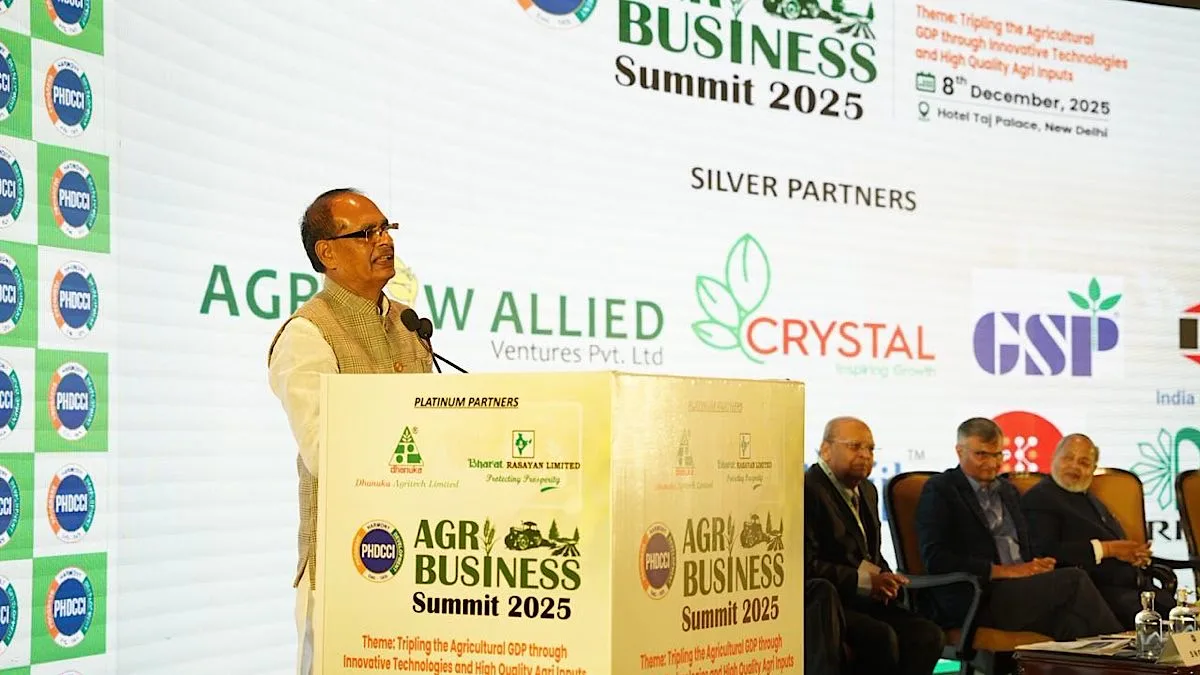
Union Agriculture Minister Shivraj Singh Chouhan on Monday highlighted the scale of transformation underway in the farm sector under the Modi government. From a sharp surge in sugarcane output to breakthroughs in climate-resilient seed development, the Minister said India is entering a phase of growth powered by technology, innovation and stronger support systems.
Addressing the inaugural session on ‘Tripling the Agricultural GDP by Using New Technology and Quality Agri Inputs’, Chouhan said sugarcane production has risen by 44 per cent since 2014. He presented this as a reflection of how Indian agriculture has benefited from scientific interventions and policy reforms.
He also highlighted the creation of 3,300 climate-resilient seed varieties and a 36 per cent improvement in overall agricultural production, driven by quality seeds, mechanisation and schemes such as the strengthened Minimum Support Price (MSP) framework.
Chouhan said India’s next phase of growth must focus on integrated farming systems, particularly for small and marginal farmers who operate landholdings of less than one hectare.
Advertisement
By combining crops, cattle, fisheries and allied activities, farmers can diversify income and reduce vulnerability. He stressed that such models help create sustainability and steady earnings even during climate-linked uncertainties.
The Minister also called for a strong push towards value addition, saying farmers must shift from selling raw produce to processing, packaging and branding their products.
These interventions, he said, hold the key to enabling farmers to capture higher value in domestic and global markets.
He underlined the government’s recent crackdown on low-quality bio-inputs. The number of bio-input producers has been brought down from 30,000 to just 8,000, leaving only those firms that meet strict quality standards.
Chouhan also flagged concerns over imbalanced fertilizer usage across the country. He said unscientific application can degrade soil quality and reduce long-term productivity.
Balanced fertilisation, based on scientific soil assessment, is vital to protect the prosperity of future generations.
Adding a global perspective, NITI Aayog Member Ramesh Chand said India must adopt a more precision-driven and meticulous approach to farming.
Drawing a comparison with China, he said Chinese farmers act like highly skilled land managers — paying attention to each detail, using inputs efficiently and innovating continuously.
Their intensive management practices, he said, help them achieve superior per-acre yields. India, he noted, can learn from such scientific fertiliser management and precision techniques to boost productivity.
Amid these discussions, Dr RG Agarwal, Chair of the Agribusiness Committee at PHDCCI, set the tone for the industry’s expectations and commitment.
He said, “India’s farmers have always delivered for the nation. Now, it is time we deliver for them — by ensuring they receive the best technologies, knowledge, and support to enhance their productivity and income. This summit reflects a united commitment to empower our annadatas and strengthen India’s agricultural future.”
Agarwal’s remarks echoed the larger sentiment that India’s farm growth story must now be driven by scientific inputs, modern technology and strong institutional backing.
As stakeholders deliberated on the pathway to tripling India’s agricultural GDP, the discussions converged on a common vision: building a future-ready farm ecosystem. Climate-resilient seeds, mechanisation, value addition, digital agriculture, balanced fertilisers and integrated farming models emerged as the central pillars of this strategy.
With global competition rising, climate challenges intensifying and the push toward self-reliance gaining momentum, the focus now is on ensuring India transitions swiftly from traditional practices to a modern, technology-driven agricultural economy—capable of meeting both national needs and global opportunities.