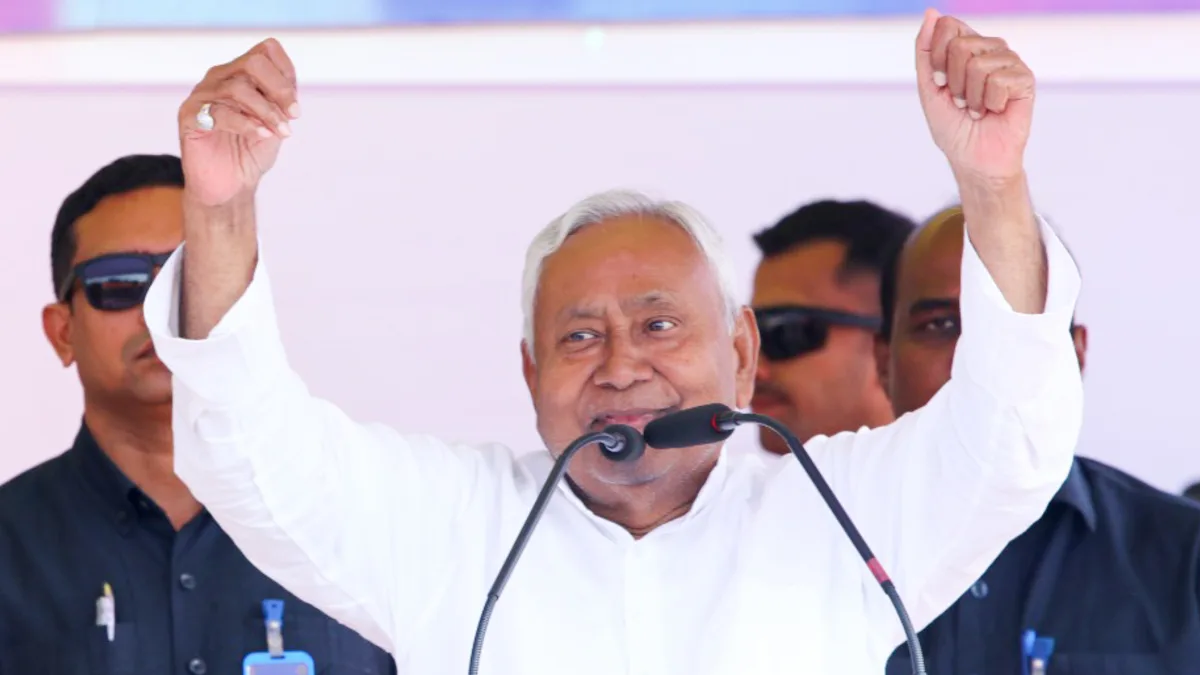
Bihar’s ultimate ‘Chanakya’, Nitish Kumar, has pulled it off once again.
On way to becoming the chief minister of the state for a record tenth term, Nitish remains one of India’s most enduring and enigmatic political figures.
Advertisement
Known variously as “Sushasan Babu” (the man of good governance), a ‘Chankaya’ or master strategist, and an inveterate pragmatist, Nitish has spent more than two decades shaping Bihar’s political landscape through a mix of administrative focus, electoral caste engineering, and agility in dumping or forming coalition, which remains unmatched in contemporary Indian politics.
The frequent change of platforms, from secular socialist to aligning with the right-wing BJP to being an upholder of Dalit rights, seems to have had no effect on his electoral pull or his political ability to achieve the impossible.
Born in 1951 in Bakhtiyarpur near Patna, Nitish Kumar, who had started life as an engineer in the Bihar Electricity Board, began his political journey during the JP Movement of the 1970s, part of a generation of leaders who cut their teeth in opposition to Indira Gandhi’s Emergency.
He gravitated toward the socialist camp that later evolved into the Janata Dal. After many torturous splits and mergers of the socialist political party, Kumar formed the Janata Dal (United).
As head of the JD(U)-BJP combine, Kumar tried to end the long reign in Bihar of rival erstwhile socialist Lalu Prasad’s RJD, and in March 2000, he was elected chief minister of the state for the first time.
However, this government was short-lived as the NDA did not have the numbers and had to make way for the RJD. Kumar then joined the Atal Behari Vajpayee cabinet and proved to be an effective administrator in his role as railway minister, introducing computerised railway reservation, and new railway zones, among other initiatives.
Kumar, who hails from the Kurmi community, then refocused on Bihar again, where with adroit caste engineering he stitched together a rainbow coalition of upper castes, very backward castes and scheduled castes to take on Lalu Prasad’s forces and win the key state for NDA.
His tenure as Chief Minister, beginning in 2005, is often credited with pulling Bihar out of the “jungle raj” narrative of lawlessness and chronic underdevelopment. Nitish focused on basic governance reforms, better policing, roads, health outreach, school attendance, and gender-focused welfare schemes.
His policies, from bicycle distribution to girls to reservations for women in local bodies, helped transform the state’s social architecture.
For the women of Bihar, he became a new “hero” for having banned liquor, a bane of rural society there, which had reduced many households to penury because of men’s drinking habits.
The improvement of rural roads and expansion of the public health system under his watch became key markers of Bihar’s early 2010s turnaround. Last September, he also brought in a controversial scheme to transfer Rs 10,000 to each woman to start self-employment ventures, which was criticized by the opposition and analysts for its timing just ahead of the elections.
Nitish Kumar’s political legacy is equally defined by his ideological fluidity. He has switched alliances multiple times between the BJP and the RJD-Congress combine; each move was justified as necessary for Bihar’s stability or national coherence.
Critics accuse him of opportunism; supporters argue he is a principled centrist trying to protect Bihar’s interests amid shifting national currents. Either way, few leaders have managed coalition politics with such finesse, repeatedly securing the Chief Minister’s position despite volatile electoral arithmetic.
As of 2025, Nitish, however, continues to occupy a pivotal, if complicated, role in state and national politics. His governance model, incremental reform, welfare delivery, and social balancing, still shapes policy debates within Bihar.
However, questions linger: Can Nitish reinvent Bihar’s economy to match its improvements in basic governance? And how will history judge his repeated political somersaults?
Questions about his health also linger. However, as one poster put up by his party-men says, “Tiger abhi zinda hai.”
For now, Nitish Kumar remains what he has long been: a cautious reformer, a shrewd tactician, and the central pillar of Bihar’s political order, both as a stabilising force and disruptor, depending on the moment and the lens through which he is viewed.