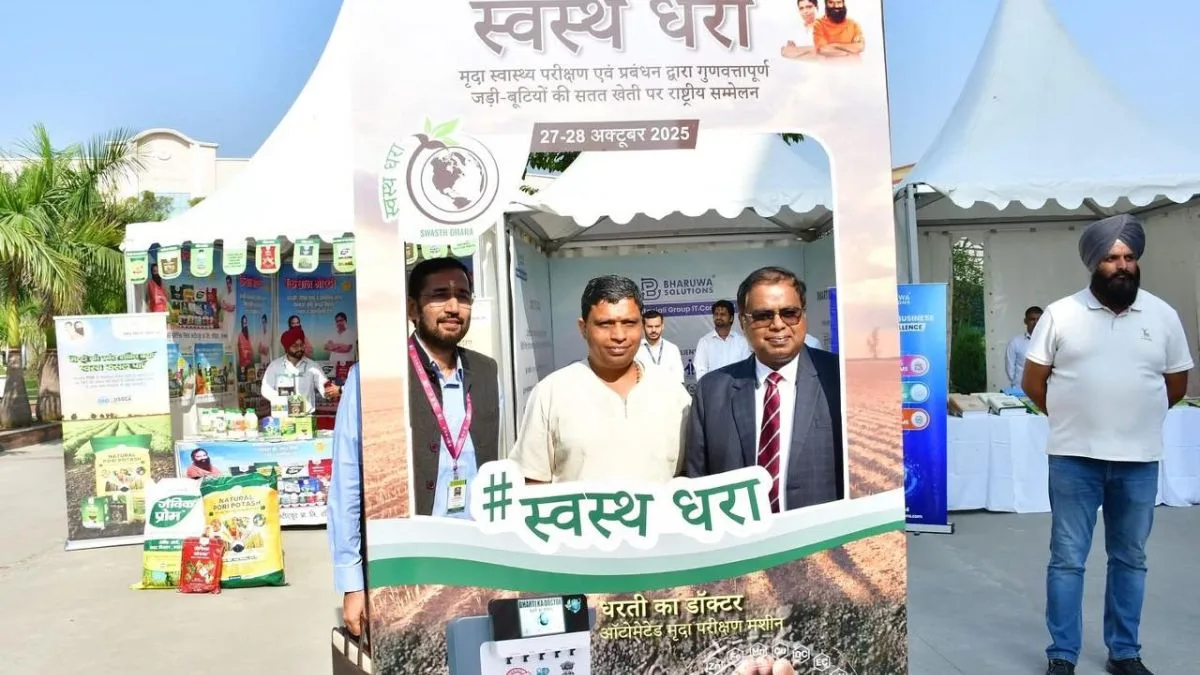
Under the aegis of the Ministry of AYUSH, Government of India, Patanjali Organic Research Institute, and RCS-CNR-1, and with the support of the National Bank for Agriculture and Rural Development (NABARD), a two-day national workshop on “Sustainable Cultivation of Medicinal Plants through Soil Testing and Management” was organized on October 27–28 under the ‘Swasth Dhara’ scheme at the Patanjali Research Foundation and Patanjali University Auditorium, in collaboration with Bharuwa Agriscience.
The workshop focused on the automated soil testing machine ‘Dharti Ka Doctor (DKD)’, with the objective of promoting long-term soil health, sustainable agriculture, and strengthening India’s global position in food security.
Advertisement
Acharya Balkrishna, Chancellor of Patanjali University, inaugurated the event by welcoming the chief guests with floral greetings, lamps, and mementos. The program commenced with the lighting of the lamp, Dhanvantari Vandana, and a group invocation by Dr. Archana Tiwari and her team.
The welcome address was delivered by Dr. K.N. Shamad, Director, Bharuwa Agriscience. On this occasion, Acharya Balkrishna and the distinguished guests jointly unveiled two books — ‘Swasth Dhara’ and ‘Medicinal Plants: Indigenous Genesis of Phytomedicines and Relevance in Industries’.
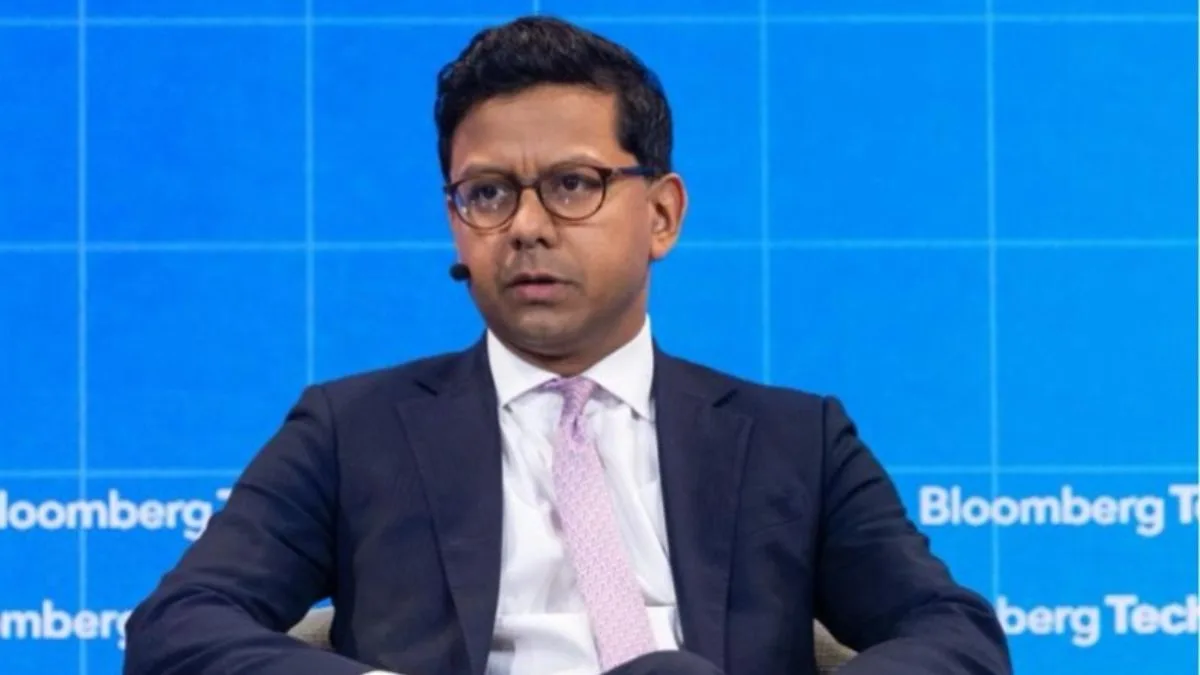
In his keynote address, Shaji K.V., Chairman, NABARD, stated that NABARD’s primary objective is to promote sustainable agriculture and rural development by extending credit facilities for agriculture, small industries, cottage and village industries, and other rural enterprises.
He emphasized the need for greater investment in rural development and the promotion of inclusive, sustainable agricultural practices. NABARD, through its various programs, is committed to strengthening financial inclusion across rural India via specialized, target-oriented initiatives.
Speaking about Patanjali’s future plans, he said the organization is focusing on enhancing farmers’ income, promoting organic farming, and adopting natural cultivation methods. He added that the current year is crucial for realizing the vision of a Developed India by 2027, expressing optimism that India could achieve developed nation status by the end of this fiscal year.
He also drew attention to the challenges posed by monoculture farming, which, while increasing productivity and profits, tends to deplete soil fertility and adversely affect biodiversity. Referring to government schemes such as PM-Kisan Samman Nidhi and the Dhan-Dhanya Mission, he noted that these initiatives are providing financial support and fostering self-reliance among farmers.
The ‘Dharti Ka Doctor’ machine developed by Patanjali has proven effective in improving soil health, and the collaboration between Patanjali and NABARD continues to strengthen.
Acharya Balkrishna Ji emphasized that “the protection of crops is integral to the protection of human health.” He said it is time to restore the fertility and vitality of the soil inherited from our ancestors and to revive ‘Mitti Ki Bhakti’ (devotion to the soil). Patanjali’s DKD machine is helping address soil-related challenges and working toward making the earth disease-free.
The machine can test key soil nutrients — Nitrogen, Phosphorus, Potassium, pH, Organic Carbon, and Electrical Conductivity — within just half an hour, providing accurate data on nutrient deficiencies or excesses.
Discussions during the workshop highlighted that soil becomes truly productive only when managed through restorative techniques that ensure present and future productivity and profitability. Improved soil health leads to higher yields at lower costs.
The foundation of soil improvement lies in maintaining a favorable environment for beneficial microorganisms, achieved through diverse cropping, cover crops, and minimizing soil erosion. Biodiversity was recognized as the cornerstone of successful farming systems, enhancing soil health, reducing costs, and improving profitability.
Experts also emphasized the importance of advancing agricultural technology for medicinal plants, which hold immense potential in the modern era.
In his technical presentation, Dr. K.N. Shamad explained that organic farming, as promoted by Patanjali Bharuwa Agriscience, relies on biofertilizers, green manure, and crop rotation instead of chemical fertilizers and pesticides.
This approach ensures soil fertility, ecological balance, and pollution-free production. The DKD automated soil testing machine helps identify the presence of vital nutrients such as Potassium, Phosphorus, Magnesium, and Calcium, thereby aiding in soil management, cost reduction, quality improvement, and yield enhancement.
Dr. Rajeshwar Singh Chandel from the University of Horticulture and Forestry, Solan, highlighted the effectiveness of integrated farming systems in hilly areas with limited land resources and emphasized the importance of traditional knowledge, innovative tools, and women’s participation.
Other experts, including Prof. B.R. Kamboj, Dr. J.N. Raina, Dr. G.P. Rao, and Dr. Pradeep Shamad, shared valuable insights on soil health, crop improvement, management techniques, and the future of global food security.
The programme concluded with a poster session, where winners were felicitated, followed by a vote of thanks to all guests and participants.