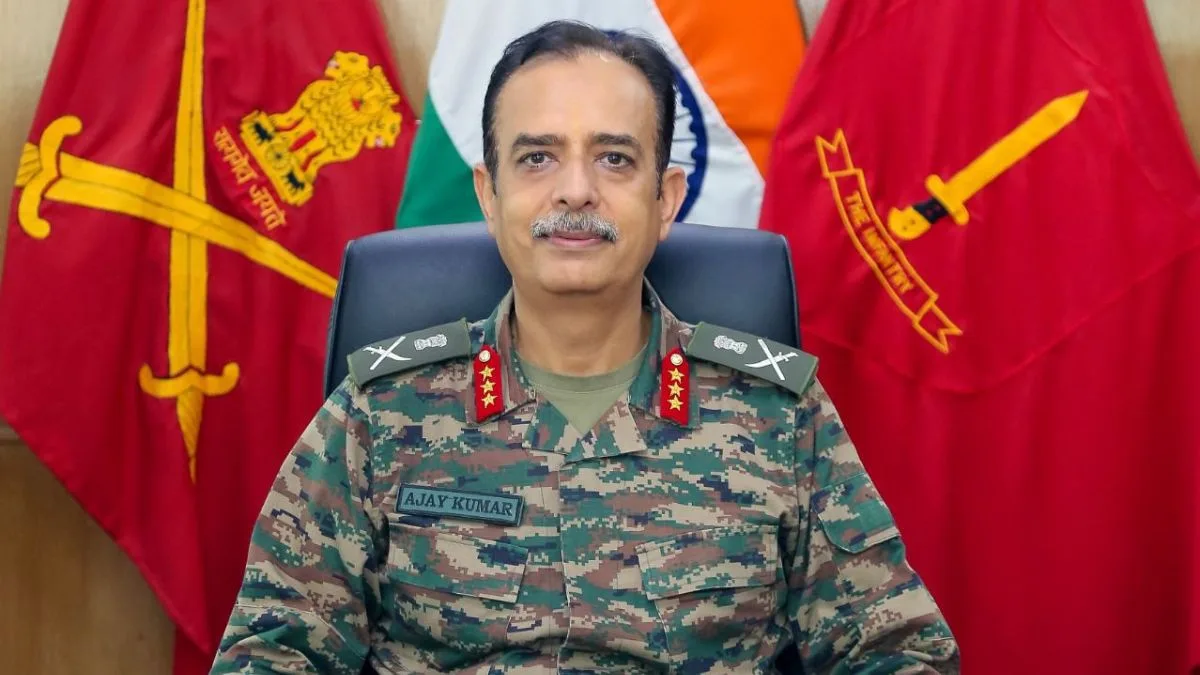
Describing Bhairav Commando Battalions as the “lean mean units”, Director General Infantry Lt Gen Ajay Kumar Wednesday said the newly-raised battalions represent agile, high-mobility Infantry formations that bridge the gaps between the conventional Infantry battalions and Special Forces.
Stating the battalions are designed for swift tactical strikes and rapid deployment, optimised for border and high-intensity contingencies, the DG said that it will comprise a troop strength between 200-250 with personnel also sourced from Signals, Army Air Defence and Artillery regiments. “As of now five battalions of Bhairav have already been raised. They have already been deployed in the area of independent operations. The on-the-job training, which started from 1st October, will culminate on 30th October and thereafter they are fully operationalised to take part in any operation,” he said.
Advertisement
Ahead of the Shaurya Diwas, formerly known as Infantry Day, observed on October 27, the DG Infantry spoke about “Ashni”, the Indian Army’s new drone platoons.
Kumar said that each infantry battalion will have one Ashni platoon taking its numbers to 380. Elaborating on the kinds of drones in the Ashni platoons, the DG said, “There are around 10 different types of drones, about four in the surveillance category and six designed for combat roles, including loitering munitions, kamikaze drones, and non-precision munition or dropping drones. In addition, we are also processing cases related to an anti-tank guided missile system and a foliage-penetration radar. This radar system, along with a drone that recently proved its effectiveness during one of our operations, has demonstrated significant operational value.”
The DG also spoke about Operation Sindoor which yielded critical insights into the evolving nature of modern warfare and joint military preparedness. “It underscored the need for precise alignment of tactical actions with broader strategic objectives to ensure mission success. It also highlighted the increasing importance of integrating enhanced Intelligence, Surveillance and Reconnaissance (ISR) capabilities for superior situational awareness and decision-making. A defining feature of the operation was the high level of jointness demonstrated among the Army, Air Force, Navy and other security agencies, reflecting true multi-domain synergy in planning and execution,” he said.
Furthermore, Operation Sindoor marked a notable shift towards non-contact, technology-enabled warfare, with drones, artificial intelligence systems and precision weaponry emerging as decisive tools shaping the future battlefield.
The Director General of Infantry outlined the ongoing modernisation and capability enhancement initiatives aimed at transforming the Infantry into a more agile, lethal, and technology-enabled force. He said the transformation is being driven by six key pillars; lethality, mobility, communication, battlefield transparency, survivability, and training.
Under the lethality pillar, the Infantry is inducting 7.62 mm assault rifles, fourth and fifth-generation anti-tank weapon systems, new rocket launchers, and loiter munitions to enable drone-assisted precision strikes. To enhance mobility, the force is fielding Quick Reaction Force Vehicles, All-Terrain Vehicles, and Light Specialist Vehicles designed for swift deployment and high-mobility operations across varied terrains.
In terms of communication, the Infantry is transitioning to advanced Software Defined Radios (SDR) that offer encrypted and interoperable battlefield connectivity, ensuring secure and seamless coordination during operations. The focus on battlefield transparency involves greater deployment of drones, surveillance radars, and thermal imagers to provide real-time situational awareness and superior operational planning.
Addressing survivability, the DG Infantry said that the troops are being equipped with NIJ Level IV ballistic protection gear, bulletproof jackets, tactical shields, and upgraded soldier kits to enhance personal safety in combat. On the training front, the Infantry is adopting state-of-the-art tactical simulators, containerised firing ranges, and digitally-aided combat training systems to ensure realistic and technology-driven preparation for modern warfare.