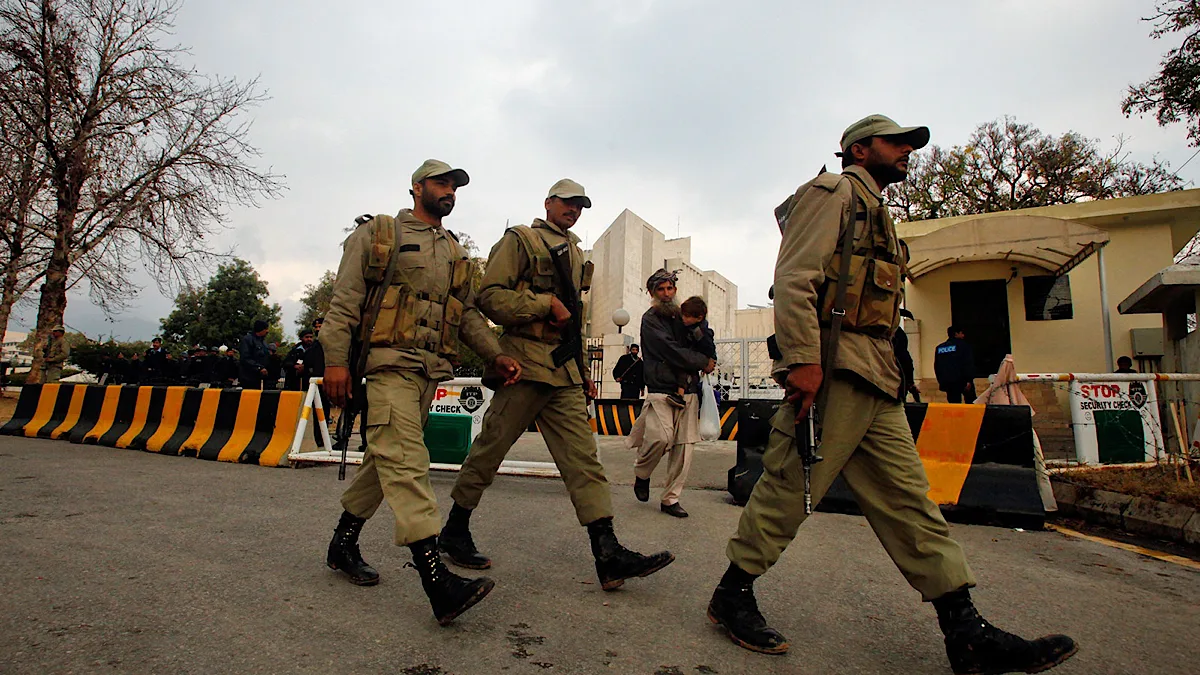
Pakistan faced two major protests in recent days. The first was in POK where the public rose in anger against rising costs, exploitation of resources and lack of basic amenities. Protests lasted two weeks, and were brutally crushed with over a dozen (officially reported) killed. Actual figures could be far higher. The region was cut off, essential services shut and protesting leaders coerced into signing an agreement with Islamabad. This may just be a temporary pause as anger continues to simmer. The second were protests led by the TLP (Tehreek-e-Labbaik Pakistan), a far-right Islamist party, against their failed marshal and puppet PM agreeing to the Gaza plan. In their opinion, the plan is suited to Israel’s demands. Saad Rizvi, the TLP leader, accused the Pakistani leadership of selling out to Israel. It is also rumoured that Pakistan may join the Abraham accords and recognize Israel, something the TLP is against.
The TLP had planned to protest in front of the US embassy in Islamabad. They were stopped at Muridke and their camp was attacked employing military power. True casualty figures may never be known but most likely were over 100. There are reports of bodies being dumped into the Sutlej River. These protests have been stalled but violence continues in Lahore, with the TLP refusing to back down. The TLP was once the darling of the Pakistan army, employed by it to initially bring down the Nawaz Sharief government and subsequently embarrass the Imran Khan government. Videos of a serving Pakistani general handing over money to each protestor for his service in support of the army will haunt Pakistan. Today the same institution threatens the army and its control over the state.
Advertisement
Saad Rizvi is now accused of being a RAW agent as the Pakistan military claims Indian currency was discovered in his house. Will RAW fund him with Indian Rupees? How dumb can Pakistan be? Apart from internal protests, the army is facing a confident TTP (Tehreek-e-Taliban Pakistan) in KP (Khyber Pakhtunkhwa) and the BLA (Balochistan Liberation Army) in Balochistan. Both operate from Afghan soil. Attacks have been on the rise. Reports mention ambushes on convoys and suicide attacks on posts almost on a daily basis. As per an Islamabad think tank, Centre for Research and Security Studies, almost 2,500 security personnel have been killed this year, the highest since 2015.
The TTP has emerged as one of Pakistan’s biggest national security threats. Apart from attacking security forces, it has revived Pashtun nationalism. Its support for the banned PTM (Pashtun Tahaffuz Movement), an organization seeking basic rights for Pashtuns whose leaders remain behind bars, has added to its influence. There were increased attacks by the TTP which forced Pakistan to launch airstrikes into Afghanistan. In Balochistan, the BLA and its affiliates have been striking Pakistani forces and infrastructure at will. The Jaffer express was targeted a second time. These attacks have impacted the CPEC, angering China. Pakistan recently inked a deal with the US to exploit rare earth minerals from Baluchistan, which cannot be implemented unless violence is curtailed. In both KP and Balochistan, Pakistan has resorted to airstrikes against its own population, a major blunder. These have alienated the locals as innocents have been killed. In no case has Pakistan attempted to handle grievances of the people, but has instead adopted a policy of arbitrary arrests and extra-judicial killings, hoping to subdue the population by force. It is a repeat of 1971 in erstwhile East Pakistan.
Desperate because of TTP strikes, Pakistan launched airstrikes across Afghanistan targeting the head of the TTP, Noor Wali Mehsud. These failed to eliminate him, while angering the Afghans. In retaliation Afghanistan attacked Pakistan posts along the Durand Line. Both sides claimed victory and mentioned that a ceasefire has been implemented based on request of the other. Afghanistan released videos of Pakistani soldiers who surrendered, weapons captured and Pakistani forces abandoning their posts. They even displayed captured vehicles and hung trousers of Pakistani soldiers in city centres. The Pakistan DGISPR (Inter Services Public Relations), false information campaign collapsed before the Afghans. Further angering Islamabad, Kabul turned down visa requests for the Pakistan defence minister, DG ISI and two other generals, who were seeking to restore ties.
The Afghan foreign minister, while on a visit to India, signed a joint statement describing the two nations as neighbours, implying POK and Gilgit Baltistan are part of India. He also commented on Pakistan’s handling of the TLP protests. After multiple rounds of conflict, a temporary ceasefire is in place, while talks are ongoing in Qatar. A desperate Pakistan defence minister, Khawaja Asif admitted that currently there are no ties with Kabul, ‘direct or indirect.’ Pakistan’s relations with India could sink no further. After pausing Operation Sindoor and recent warnings by service chiefs to Rawalpindi on stronger retaliation, Indo-Pak ties remain tense.
Pakistan’s relations with Iran are tenuous, to say the least. Both had earlier exchanged missile attacks. Tehran is aware that Rawalpindi is behind ISIK attacks on its soil. Why is Pakistan in such a mess? It is largely due to policies adopted by its de-facto head, Asim Munir. His intent on moving closer to the US to gain temporary leverage has resulted in him selling Pakistan’s autonomy. The bootlicking video of Shehbaz Sharif praising Trump in Egypt has added to disgrace. Internally, the Pakistani leadership has failed to convince its people on why it backs an already failing Gaza peace plan.
Rather than address local grievances in KP and Balochistan, Pakistan adopts a policy of suppression, which can never work. It had misconstrued that its military power would put Kabul on the defensive. Kabul has not only challenged Pakistan militarily but also refused to stop supp or ting anti-Pak movements. Khawaja Asif summed up Pakistan’s scenario when he mentioned on the ongoing ceasefire with Afghanistan, “I have my doubts that the ceasefire will hold, because the decisions of the (Afghan) Taliban are being sponsored by Delhi,” adding, “Right now, Kabul is fighting a proxy war for Delhi.” It is so easy to deflect one’s own failures on others. While India prepares for a 2.5 front conflict, Pakistan faces a three-front war, the third being a combination of freedom movements and internal protests. Its stability remains uncertain. A collapsing economy adds to its challenges. It is a nuclear power, trudging along, a threat to its neighbours, solely due to its hybrid governing model, with a clueless failed marshal controlling the state.
(The writer is a retired Major-General of the Indian Army.)