Hydrogen rail signals clean energy leap
Prime Minister Modi flagged off India’s first indigenous hydrogen powered train on the Jind–Sonipat section, marking a historic leap in clean mobility and Atmanirbhar Bharat vision.
After his arrival in Navi Mumbai at 3 pm on Wednesday, Mr Modi took a walk through tour of the newly-built Adani-owned Navi Mumbai International Airport (NMIA) that is likely to be called Loknete DB Patil Navi Mumbai International Airport (NMIA).




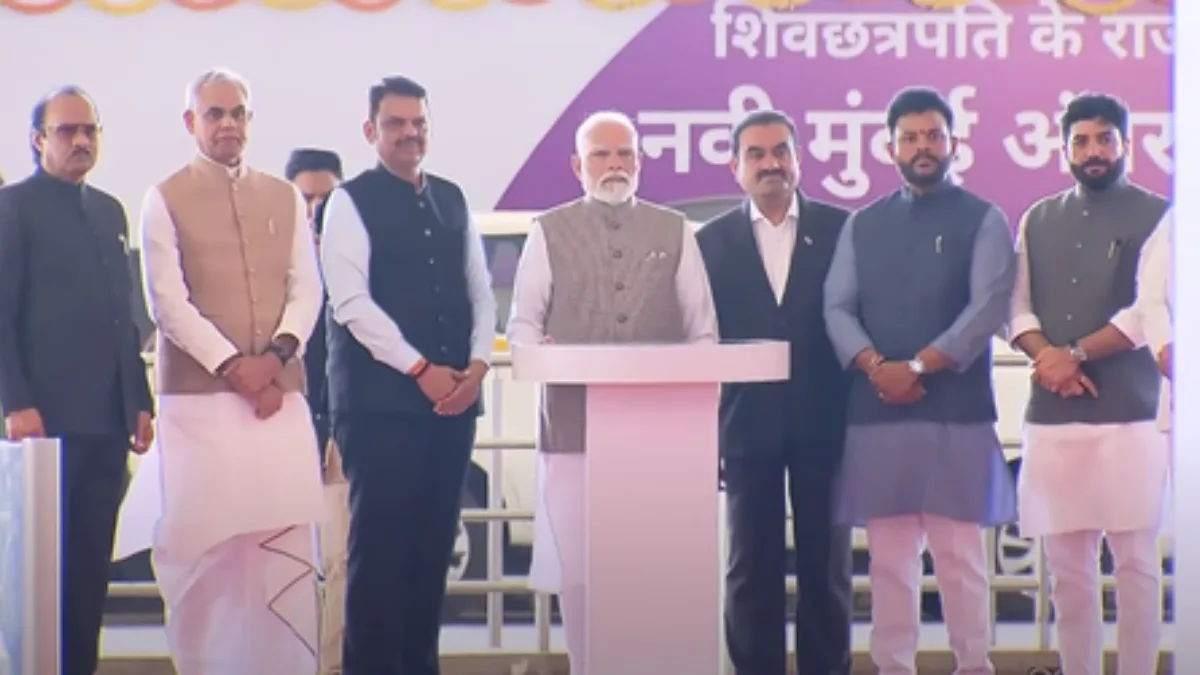
PM Modi inaugurates Phase 1 of Navi Mumbai International Airport (Photo Credits: IANS)
Prime Minister Narendra Modi inaugurated Phase-1 of the Navi Mumbai International Airport on Wednesday and launched the final phase of the fully underground Mumbai Metro Line-3 (Aqua Line) railway. He also launched ‘Mumbai One’, India’s first integrated common mobility app for 11 public transport operators.
After his arrival in Navi Mumbai at 3 pm on Wednesday, Mr Modi took a walk through tour of the newly-built Adani-owned Navi Mumbai International Airport (NMIA) that is likely to be called Loknete DB Patil Navi Mumbai International Airport (NMIA).
Advertisement
The prime minister inaugurated the NMIA by placing his hand on an electronic glass panel lighting up the entire airport after which he said, “In 2014, I had said it was my dream that even people wearing hawai chappals (slippers) should be able to travel by air. To fulfill this, it was important to set up new airports across the country. In 2014, India had 74 airports. Now, we have more than 160 airports.”
Advertisement
“The inauguration of the new airport in Mumbai is an example of Viksit Bharat. The airport’s lotus-shaped structure reflects our heritage and culture. It will boost trade with other countries and enhance access to the global market. The new airports and the UDAN scheme for affordable air travel have made air travel easier in the country,” he added.
“Now, Mumbai has a new airport (NMIA), which will be Asia’s largest connectivity hub. Mumbai’s long wait has come to an end with the inauguration of this airport. Today, the city also has a fully underground metro to facilitate easy travel across Mumbai. Launching an underground metro rail, with such careful construction in a city like Mumbai is a significant achievement,” PM Modi said.
During the inauguration of Phase 1 of the Navi Mumbai International Airport (NMIA), PM Modi met specially-abled children.
The inauguration of Phase 1 of the airport and other connectivity projects is expected to strengthen Mumbai’s position as a global hub of growth and opportunity. The airport, designed to be among the most efficient in the world with 1160 hectare area, will eventually handle 90 million passengers annually (MPPA) and 3.25 million metric tonnes of cargo.
“The NMIA will ease the capacity constraints in the Mumbai region, strengthen connectivity and bring even greater economic and social benefits to the Indian economy, global airlines’ grouping,” IATA said in an official statement.
The NMIA is expected to begin commercial operations in December though ticket sales are likely to start by the end of October. Built at a cost of Rs 19,650 crore under a public-private partnership between Adani Airports and CIDCO, the NMIA has an annual passenger handling capacity of 9 crore passengers and an annual cargo handling capacity of 3.25 MMT.
This second international airport for the Mumbai Metropolitan Region aims to ease congestion at the Chhatrapati Shivaji Maharaj International Airport (CSMIA) and elevate Mumbai’s status among global cities with multi-airport systems.
Later, the PM inaugurated Phase 2B of the Mumbai Metro Line-3 underground railway, stretching from Acharya Atre Chowk (Worli) to Cuffe Parade in South Mumbai, constructed at a cost of Rs 12,200 crore.
The PM dedicated the entire Rs 37,270-crore Mumbai Metro Line 3 (Aqua Line) to the nation, marking a major milestone in the city’s urban transport transformation. Regular services will begin shortly, with trains running from 5.55 am to 10.30 pm between Aarey JVLR and Acharya Atre Chowk, carrying up to 13 lakh passengers daily.
The Aqua Line will connect seamlessly with Central Railway at Chhatrapati Shivaji Maharaj Terminus (CSMT) railway station and Western Railway at Mumbai Central and Churchgate, improving intermodal travel. It will enhance access to Nariman Point, Fort, Kalbadevi, RBI, BSE, and Mantralaya, easing travel for professionals working in the city’s core business and administrative zones.
The Aqua Line will provide direct Metro access to Chhatrapati Shivaji Maharaj International Airport (CSMIA from South Mumbai, which would be a major relief for air travellers. Once operational, the Aqua Line will serve around 13 lakh passengers daily, cutting travel time from Cuffe Parade to Aarey JVLR to just one hour, compared to the current around two hours by road, official sources said.
The PM also launched the ‘Mumbai One’ app that will integrate 11 public transport operators, allowing commuters to use a single digital ticket across metro, monorail, suburban rail, and bus services. The app offers real-time journey updates, route alternatives, digital ticketing, and safety features, enhancing convenience, efficiency, and commuter safety.
Towards the end of his Wednesday schedule, PM Modi inaugurated the Short-Term Employability Program (STEP), launched by Maharashtra’s Department of Skill, Employment, Entrepreneurship, and Innovation. STEP operates across 400 government-run industrial training institutes (ITIs) and 150 technical high schools, creating 2,500 training batches, including women-only batches and courses in emerging technologies such as AI, IoT, electric vehicles, solar power as well as additive manufacturing, which is also known as 3D printing.
On Thursday, October 9, PM Modi is scheduled to host UK Prime Minister Keir Starmer in Mumbai to review the India–UK Comprehensive Strategic Partnership and the Vision 2035 roadmap. Both leaders will attend a CEO Forum and the 6th edition of the Global Fintech Fest (GFF 2025) at the Jio World Centre, delivering keynote addresses.
GFF 2025, themed “Empowering Finance for a Better World,” will bring together policymakers, regulators, investors, innovators, and academicians from over 75 countries, featuring 7,500 companies, 800 speakers, 400 exhibitors, and 70 regulators. International participants include the Monetary Authority of Singapore, Deutsche Bundesbank, Banque de France, and Swiss FINMA, highlighting GFF’s growing status as a global forum for financial policy dialogue and innovation.
Advertisement