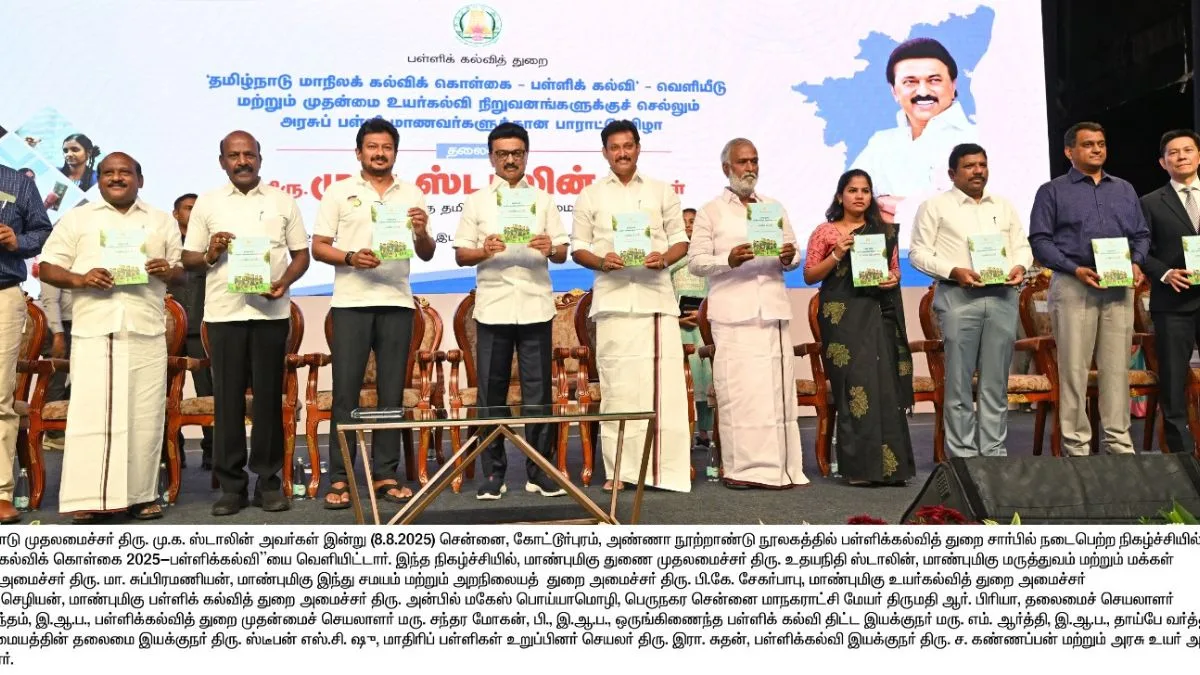
Rejecting the New Education Policy of the BJP-led Union government in toto, the State Education Policy (SEP) released by Chief Minister MK Stalin on Friday affirms continuation of Tamil Nadu’s more than half century-old two-language formula of mother tongue Tamil and English denying any space for Hindi in state-run and aided schools.
While the state’s policy for Higher Education is still awaited, the SEP for school education, unveiled by the chief minister, is a bold message of the DMK government that Tamil Nadu will follow its own path in the domain of education.
Advertisement
Interestingly, the SEP mandates teaching Tamil as a subject from classes I to X at all schools, including those under CBSE and ICSE or international curricula as per the Tamil Nadu Tamil Learning Act, 2006. Besides scrapping public examinations for classes 3, 5 and 8, proposed in the NEP, it has done away with the one for Plus One (11th class) which will come into effect from this academic year.
“Tamil Nadu has a distinct school of thought which negates discrimination and regressive traditions and practices. We will not allow the sneaking of anything antithetical to scientific and rational thinking. Education has to be rational, progressive and forward looking and the SEP has been designed to extend education to all,” said Stalin, speaking on the occasion, asserting “The DMK government is firm on following the two-language policy.”
Drafted by a 14-member panel headed by former judge of Madras High Court, D Murugesan, the SEP has prioritised science, AI, and English proficiency to prepare the students for the future. Submitted in July last, it has rejected key provisions in the NEP like common entrance examinations for Under Graduate programmes. Tamil Nadu will take the consolidated marks of Class 11 and 12 for admissions to arts and sciences UG courses.
While listing the current status of teaching and learning in schools, the SEP has identified the following challenges among others: optimising curriculum for critical thinking, conceptual clarity and life skills, overcoming exam-centric pedagogy, showcasing TN’s rich cultural and historical heritage and legacy, pedagogical diversity and addressing uneven implementation of progressive and experiential learning, addressing learning gaps, especially those in rural, disadvantaged and tribal areas and last but not the least insufficient focus on social justice for which it recommended enriching curricular content to address structures of inequality related to caste, gender and socio-economic status by redesigning and rationalising the curriculum by including progressive social movements.
Laying emphasis on advancing Science, Technology, Engineering, Arts and Mathematics (STEAM) education, an integrated approach to equip students in multi-disciplinary enquiry, the SEP has advocated continuous training for teachers and technology-based assessment. Underlining the importance of making students proficient and competent in literacy and numeracy, the policy has suggested a holistic reform of curriculum and pedagogy, by making the students at the centre of school education.
On institutional reforms, the SEP has called for strengthening community engagement in the management of state-run and aided schools to foster diversity and inclusivity by promoting greater representation for women and parents from marginalised communities and youth besides eliciting the active support of the alumni and Corporate Social Responsibility (CSR) initiatives.