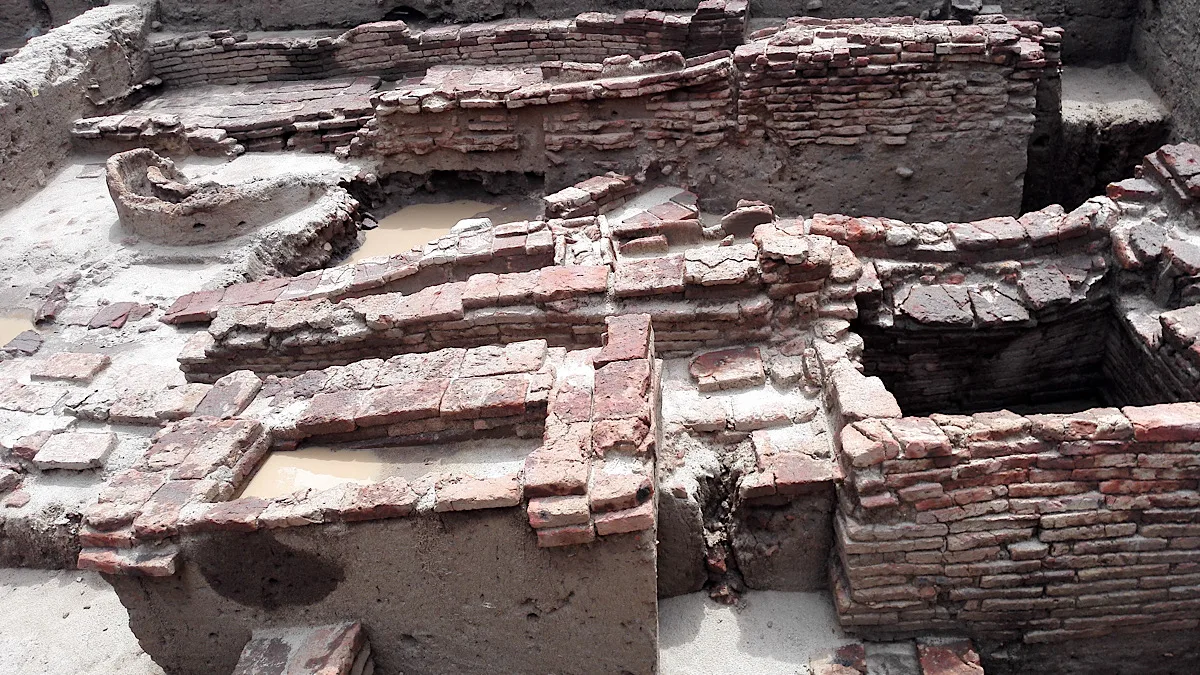
The discovery of the ancient settlement at Keeladi in Tamil Nadu is much more than an archaeological milestone ~ it is a profound challenge to longstanding narratives about Indian civilisation. As trench after trench yields evidence of a literate, urban society dating back over 2,500 years, the soil of Keeladi appears to be unearthing not just artefacts, but forgotten truths. For over a century, mainstream historical discourse has portrayed Indian civilisation as a northern phenomenon, emerging first through the Indus Valley Civilisation and later through the Vedic culture of the Gangetic plains.
This view, while based on significant finds, has long relegated southern India to a supporting role ~ a region waiting to be “civilised” by Aryan influence from the north. Keeladi destabilises that account by revealing a complex, well-organised settlement in the deep south from the same period. The presence of sophisticated brick structures, planned water systems, and most notably Tamil Brahmi script graffiti dating back to the 6th century BCE, opens up the possibility that the south’s civilisational arc was not derivative but parallel. If the Tamil Brahmi script did not emerge from the Ashokan Brahmi, but developed independently ~ perhaps with shared roots in the Indus Valley script ~ it compels a wholesale revision of how we understand the evolution of literacy, language, and statecraft in ancient India. But with history comes politics.
Advertisement
The debate surrounding Keeladi’s significance has quickly become entangled in the enduring north-south divide of Indian identity. State governments see in Keeladi a wellspring of regional pride and cultural legitimacy, while central institutions appear hesitant, invoking procedural objections and calls for more scientific rigour. This tug-of war is not merely about archaeology ~ it is about ownership of the national narrative. Such defensiveness reveals how central historical memory is to political legitimacy. By claiming that civilisation originated in one part of the country and spread outward, certain groups have sought to establish cultural dominance. But Keeladi reminds us that civilisation, like language and culture, does not flow in one direction.
It branches, adapts, and emerges in multiple places simultaneously. This is not to say that we should jump to conclusions. Extraordinary claims require extraordinary evidence. But to suppress or delay emerging data because it unsettles an established order is to do violence to both science and society. Children visiting the Keeladi museum are encountering a history far more diverse than textbooks suggest. For many, it’s a first tangible link to a past that includes them ~ not as footnotes, but as central actors in India’s civilisational journey. Keeladi’s greatest gift may not be the artefacts it reveals, but the questions it forces us to ask ~ about who we are, where we came from, and who gets to decide which pasts matter. History, like identity, is layered. And the deeper we dig, the more complex ~ and connected ~ it becomes.