IAF’s Jaguar fighter aircraft crashes near Churu in Rajasthan
Pilot of the crashed Jaguar fighter jet died in the crash.
On Wednesday the IAF lost its two pilots, Squadron Leader Lokender and Flight Lieutenant Rishi Raj Singh, after a twin-seater Jaguar trainer aircraft crashed in Banoda village in the Churu district of Rajasthan.




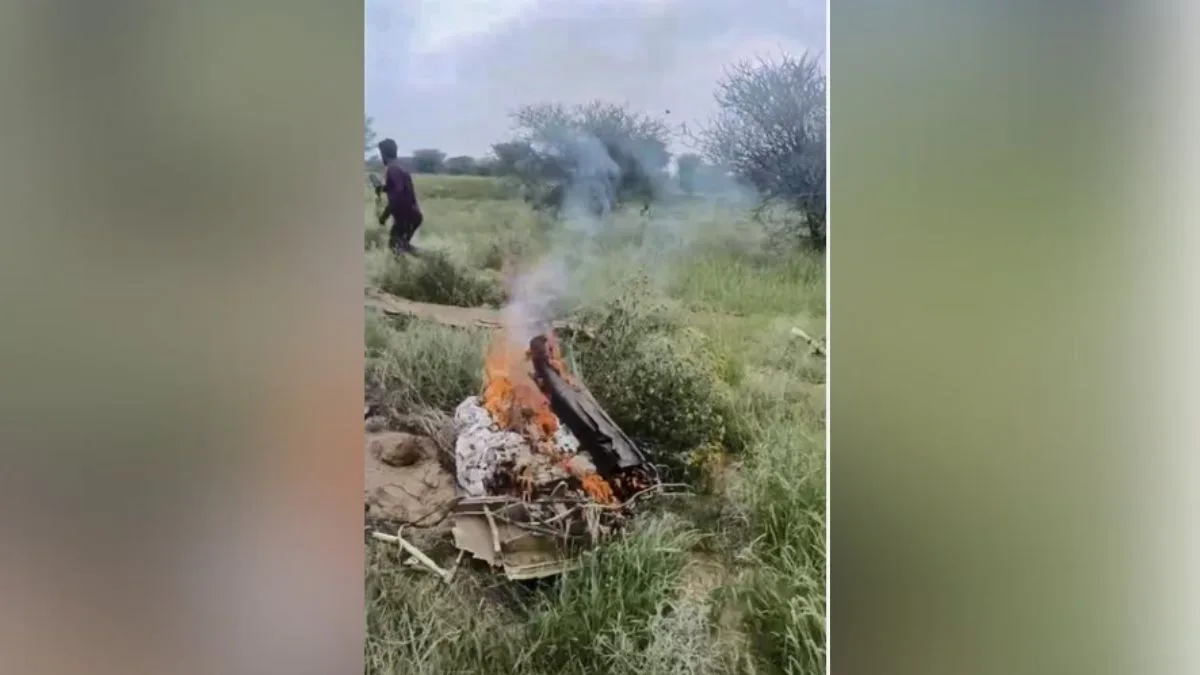
A twin-seater Jaguar trainer aircraft crashed in Banoda village in the Churu district of Rajasthan. (File Photo: IANS)
Amidst the rising concerns about the aging fleet of Jaguars owned by the Indian Air Force, former fighter pilots have come to its rescue claiming that it is a safe machine which is being constantly upgraded to deliver to its optimum potential.
On Wednesday the IAF lost its two pilots, Squadron Leader Lokender and Flight Lieutenant Rishi Raj Singh, after a twin-seater Jaguar trainer aircraft crashed in Banoda village in the Churu district of Rajasthan.
Advertisement
Notably this is the third Jaguar crash in 2025. In March a Jaguar aircraft Indian Air Force (IAF) crashed in Ambala during a routine training sortie after encountering a system malfunction.
Advertisement
In April, a Jaguar two-seater fighter aircraft had crashed in Jamnagar, Gujarat. The crash left one pilot dead while the other escaped with grievous injuries.
Initially inducted into the Indian Air Force in late 70’s the British French fighter bomber comes in two variants- single seater and twin seater. Speaking with The Statesman Air Vice Marshal Sanjay Bhatnagar (retd.), a former Mig pilot, said that Jaguars are built to be flown at low levels, thus giving them an edge during the strike operations.
“Until and unless a complete check of the aircraft is undertaken coupled with the reccee of the flight route, a go ahead is not given for the flight. The place where the mishap took place has been earmarked specifically as the low flying zone to carry out the trainee sorties.”
Adding that the Jaguars have maintained a good track record in terms of deliverability, the recent spate of accidents cannot be attributed it to being a ‘flying coffin’.
“Those calling Jaguars as the next flying coffin have no idea how flight checks are undertaken. Even though aircraft systems are old but they are always being upgraded. Even the ammunition carrying capability has also been upgraded by HAL keeping in mind the changing needs. IAF has the highest reliability record when it comes to flight safety. Recently, it dominated Operation Sindoor and is backed up with the best instruments of military power to be used in national security.”
Stating that by jumping to conclusions even before the enquiry into the crash is completed, the critics are doing disservice to the nation, Air Vice Marshal Sunil Jayant Nanodkar (Retd.), a former Jaguar pilot, stated that the age of the aircraft is immaterial as it is routinely upgraded and maintained.
However, calling for an urgent need to upgrade the military budget to procure latest equipment and upgrade the existing ones, the veteran pilot said that to protect the borders certain number of fighter squadrons are required. “Unfortunately, the numbers are dwindling and we are left to fight with what we have,” he said.
“All over the world Jaguars have been phased out and we are the only ones who are operating them in large numbers. Over the years, Jaguars have been upgraded from flying at low levels to high levels. Its weaponry system has also undergone an upgrade. But, they are ideally designed to fly in cooler climates unlike the hot and humid conditions we have in our country,” he said.
Stating that the margin of error is very limited in Jaguars, the Nanodkar said since the jet comes with twin engines, in the event of a bird hit, due to low level flight trajectory, the pilot has the support of the second engine with which one can smoothly fly and land the air craft.
“We train like we do when we are at war and if we don’t train hard, we won’t have an edge over the enemy when in actual war. To fight with sword, we have to train with a sword and once in a while we will get a nick,” he said.
Advertisement