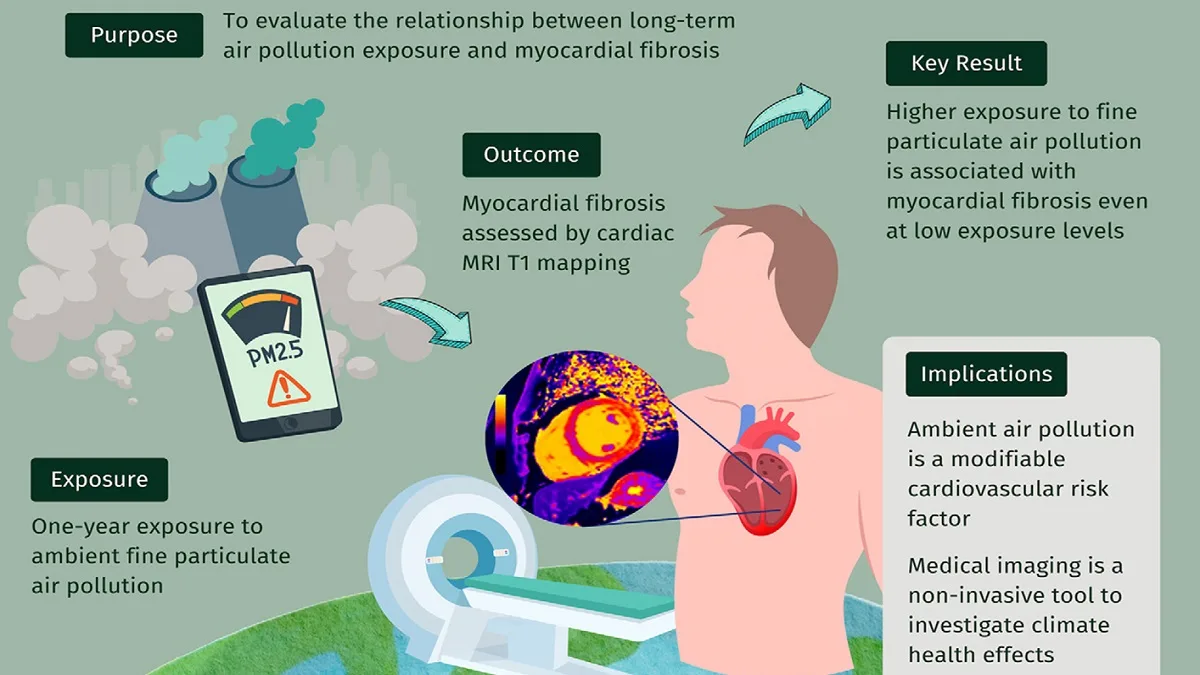
Researchers from the University of Toronto have found that long-term exposure to PM2.5 particulate matter—even at levels considered safe—is associated with myocardial fibrosis, an irreversible scarring of the heart muscle that often precedes heart failure.
“Once the heart muscle is scarred, there’s no going back,” said Dr Prateek Chaudhary, a cardiologist from ASIAN Hospital, Faridabad, not involved in the study. “This fibrous tissue can’t contract or pump blood the way healthy muscle does, which puts long-term strain on the heart, even in people with no prior symptoms.”
Advertisement
He explained that when the heart is injured—whether from a heart attack or chronic stress like pollution—damaged muscle is replaced by fibrous tissue. “This fibrous tissue doesn’t contract like normal muscle. Over time, it weakens the heart’s ability to pump blood efficiently, setting the stage for heart failure,” he added.
According to the study published on Tuesday in the journal Radiology, early signs of heart damage were observed at a daily mean ambient PM2.5 concentration of 7.7 micrograms per cubic meter, well below the daily limits set by global air quality guidelines, reinforcing the growing hypothesis that there may be no safe level of exposure.
“We know that if you’re exposed to air pollution, you’re at higher risk of cardiac disease, including higher risk of having a heart attack,” said the study’s lead author Kate Hanneman, Professor, Department of Medical Imaging, University of Toronto. “We wanted to understand what drives this increased risk at the tissue level.”
To understand the underlying changes in the heart muscle resulting from constant exposure to air pollution, Hanneman and her colleagues analysed cardiac MRI scans, a noninvasive imaging technique, of approximately 700 subjects, including 201 healthy candidates and 493 patients with dilated cardiomyopathy, a disease that makes it more difficult for the heart to pump blood.
Participants underwent cardiac MRI between January 2018 and December 2022 at a tertiary care center in Toronto, Canada. For this retrospective study, researchers estimated mean daily ambient PM2.5 levels for a year—calculated at 7.7 micrograms per cubic meter—by linking each patient’s postal code to publicly available data from the nearest government air quality monitoring station.
In comparison, PM2.5 levels in India are nearly five times higher than this average according to the standards set by the national pollution control agency, the Central Pollution Control Board (CPCB).
The study proposed that such damage to heart muscle increases the likelihood of cardiac arrest in people, both healthy and with pre-existing heart conditions, who breathe in the polluted air for prolonged periods. The largest effects were seen in women, smokers, and patients with hypertension.
The research also indicates that higher long-term exposure to fine particulate air pollution was linked with higher levels of myocardial fibrosis in both the patients with cardiomyopathy and the controls, suggesting that myocardial fibrosis may be an underlying mechanism by which air pollution leads to cardiovascular complications. Vehicular exhaust, industrial emissions, and wildfire smoke are the most common sources of these pollutants.
Dr Chaudhary said the research highlights one of the probable underlying mechanisms behind air pollution-related deaths from cardiovascular disease, a leading contributor to pollution-linked mortality worldwide, accounting for over 60% of such deaths.