New Book narrating Beijing’s misadventure on Tibetan people
People in North-east India still remember the aggression of 1962 from Communist China, which claimed a major portion of Arunachal Pradesh as Southern Tibet.
China’s National Meteorological Centre on Wednesday renewed a yellow alert, the third highest, for sandstorms in several areas across the country said to be the “most severe” of this year.




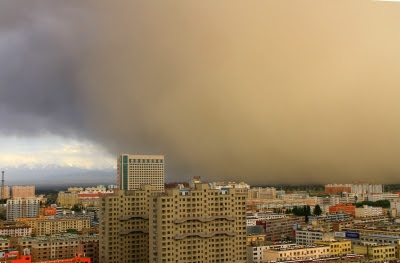
Representation image[Photo:IANS]
China’s National Meteorological Centre on Wednesday renewed a yellow alert, the third highest, for sandstorms in several areas across the country said to be the “most severe” of this year.
Floating sand and dust are expected to hit some areas in Xinjiang, Qinghai, Gansu, Ningxia, Inner Mongolia, Shaanxi, Shanxi, Hebei, Beijing, Tianjin, Heilongjiang, Jilin, Liaoning, Shandong, Henan, Jiangsu, Anhui and Hubei, Xinhua news agency quoted the Centre as saying.
Advertisement
Some regions in Inner Mongolia, Beijing, Tianjin and Hebei will see sandstorms and even strong sandstorms, it added.
Advertisement
The Centre has advised the public to take precautions against floating sand and dust, to close doors and windows in time, to wear facemasks, and suggested that drivers should prepare for poor visibility.
According to the state-run Global Times daily, most of China’s northern parts have seen little rainfall since March and there is no snow cover across Mongolia and the northwest region due to higher temperatures.
On Wednesday, dense clouds enveloped the Chinese capital where the air quality index of PM10 have exceeded monitoring charts, CNN quoted Beijing Ecological Environment Monitoring Centre as saying.
Weather authorities in Beijing warned people not to go outdoors for exercise and other activities, and have asked drivers to stay vigilant and reduce speed because of low visibility.
Beijing is regularly hit with sandstorms in the spring with the smog made worse by rising industrial activities and rapid deforestation throughout northern China.
Advertisement