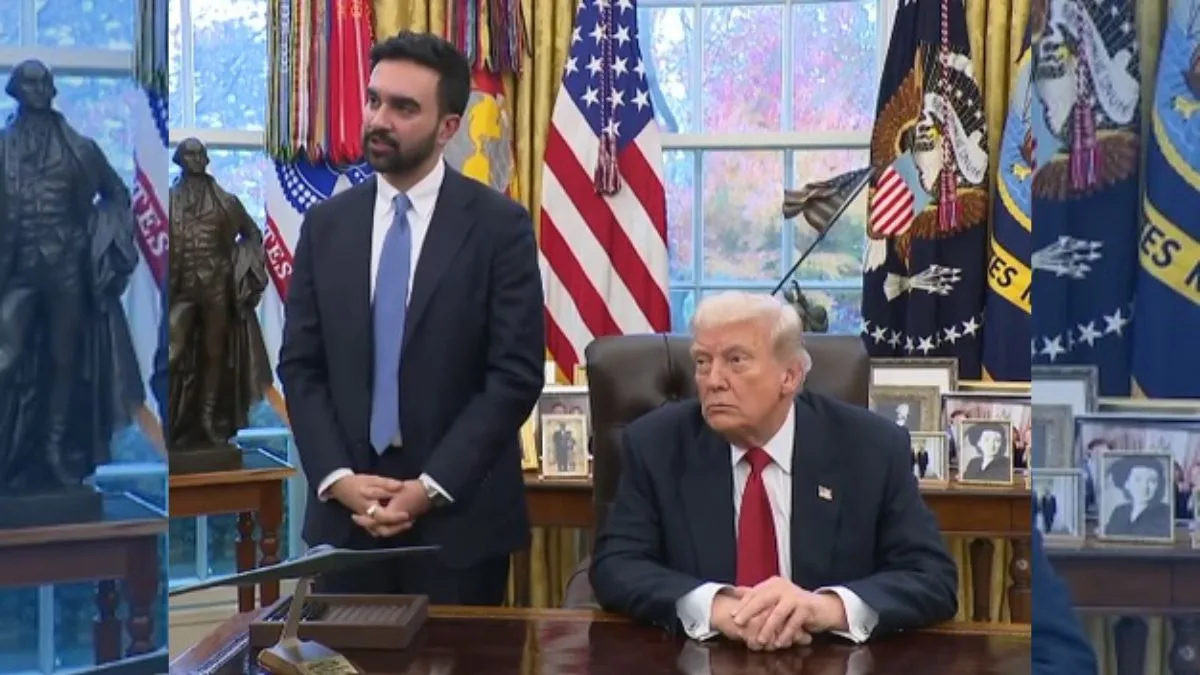
US President Donald Trump struck a noticeably calmer tone on Friday as he welcomed New York City mayor-elect Zohran Mamdani to the White House. The meeting marked a shift from the tense exchanges that defined the long and bitter mayoral campaign.
Both leaders later described the discussion as constructive. Trump told reporters it had been a “great meeting,” adding that “the better he does, the happier I am.” He said he felt “confident” Mamdani could do a “good job” leading the country’s largest city.
Advertisement
White House meeting signals a shift in tone
Mamdani echoed that sentiment, calling it a “productive meeting” and noting that the conversation was “not on places of disagreement, which there are many, but focused on the shared purpose that we have in serving New Yorkers.”
Trump said the discussion focused heavily on public safety and immigration enforcement. He stressed that the administration would prioritise “murderers, drug dealers and some very bad people,” adding, “we want to get him out, and the mayor wants to have peace…we’re going to work together. I think he wants to get them out, maybe more than I do.”
Focus on safety and immigration enforcement
Hours before the meeting, Trump had already softened his stance publicly. In an interview with Fox News, he said he believed both he and Mamdani “will get along fine,” even though the mayor-elect had a “different philosophy.” He added that both leaders wanted to “make New York strong.”
The shift followed Trump’s reaction to Mamdani’s election-night speech, in which the mayor-elect told him to “turn the volume up” on the television. “So, hear me, President Trump, when I say this: to get to any of us, you will have to get through all of us,” Mamdani had said.
Campaign hostilities fade after months of clashes
Responding to the remark, Trump admitted he had targeted Mamdani “a little too hard” on the trail. “It was…hard to be totally friendly toward the opponent…he had some interesting opponents, but he ran a good race. I don’t know exactly what he means by turn the volume up…He has to be careful what he says that to me…he was very nice in calling…and we’re gonna have a meeting…I think it’s going to be quite civil,” he said.
The White House’s tone had been far sharper the previous day, when officials described Mamdani as a “communist.” Throughout the campaign, Trump used similar language while predicting economic and social decline if Mamdani won. He even endorsed Mamdani’s opponent, former New York governor Andrew Cuomo, who ran as an independent.
Mamdani’s win marks a milestone in New York’s politics
Despite the attacks, Mamdani defeated Cuomo by nearly nine percentage points on November 4, becoming the first Democratic socialist elected mayor of New York City.