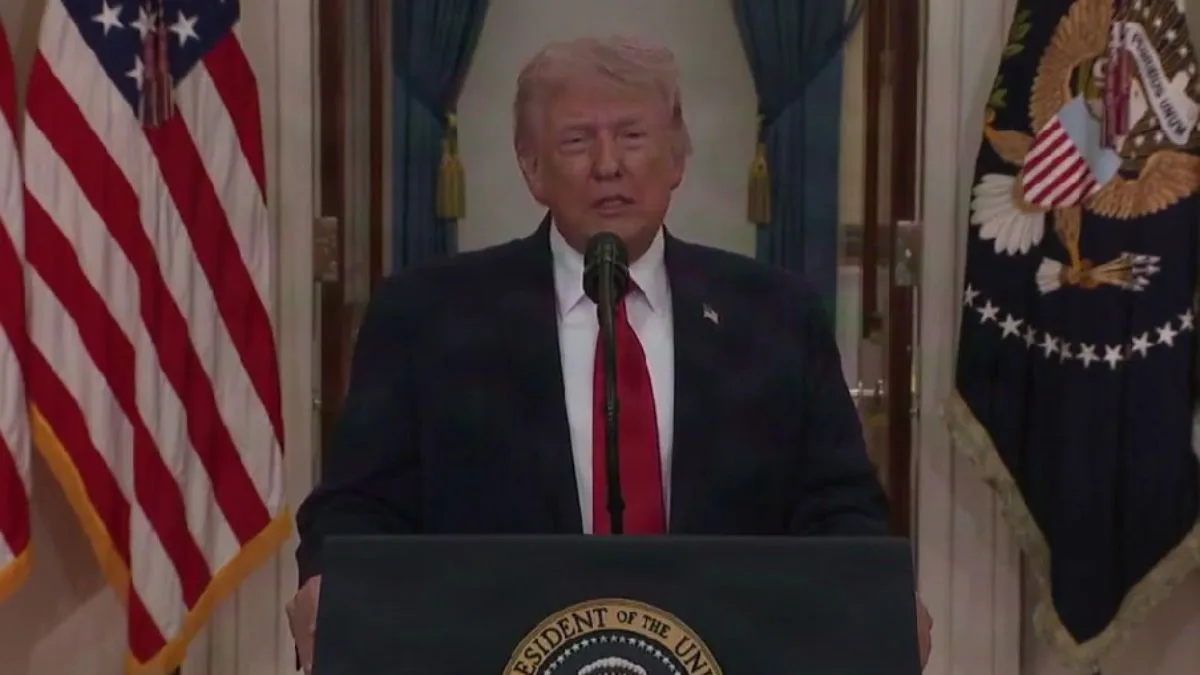
In a prime time address to the nation, US President Donald Trump declared the American military campaign against Iran was nearing its end, then warned that the worst may still be coming. The speech was equal parts victory lap and ultimatum, and the gap between those two things is where the real story lives.
Trump has placed a two-to-three-week window on the table. That is the time he has given diplomacy to work before, by his own account, the United States moves to a new and more devastating phase of strikes. What he said on Wednesday night matters. What he meant matters more.
Advertisement
THE CLAIM
Thirty-two days. That is how long Trump says it took the United States military to, in his words, “eviscerate” Iran. He told the nation the country “essentially is really no longer a threat”. He listed the timelines of every major American conflict to underline the point: World War I lasted one year, seven months and five days; World War II ran three years, eight months and 25 days; Vietnam went on for 19 years, five months and 29 days. He took weeks.
That contrast is deliberate. That contradiction between victory and escalation is the story.
WHAT HE SAID
Trump claimed Iran’s navy is gone, its air force in ruins, many of its leaders dead, and its missile and drone capabilities sharply reduced. Weapons factories and launch systems, he said, have been destroyed. “I am pleased to say that these core strategic objectives are nearing completion,” he said.
He also said Iran’s nuclear sites have been hit so hard that it would take months to get near the “nuclear dust” and that the US has them under intense satellite surveillance. “If we see them make a move, even a move for it, we’ll hit them with missiles very hard again,” he said.
WHAT HE MEANT
The victory language was deliberate. But so was the escalation threat tucked inside it.
Trump warned that if no deal is reached, the US would hit Iran’s electric generating plants, “each and every one of them, very hard and probably simultaneously.” Oil facilities, he added, have not been targeted so far, but could be. American forces could “take them back to the stone ages where they belong” within two to three weeks.
This is not the language of a commander winding down a war. It is the language of one trying to force a settlement by making the alternative look catastrophic.
The subtext is consistent with what those close to Trump have acknowledged privately: Iran’s leadership does not yet believe it is losing badly enough to accept terms favourable to Washington. The power grid threat is designed to change that calculation.
THE NUMBER THAT MATTERS
Two to three weeks.
That is the window Trump has placed on the table, both as a deadline for diplomacy and as a timeline for the next phase of strikes. It is the most operationally significant detail in the entire address, and it was not accidental. Washington is, in effect, telling Tehran: the clock is running.
THE LINE THAT WILL BE REMEMBERED
“Take them back to the stone ages where they belong.”
This is the sharpest line Trump delivered and the one most likely to harden positions on both sides. It signals not just military intent but a level of contempt for Iran’s current leadership that makes a negotiated off-ramp significantly harder to construct, even as back-channel talks through mediators reportedly continue.
WHAT IT SIGNALS
Three things are now in play simultaneously.
First, the US is projecting imminent victory while keeping maximum military pressure on the table, a dual-track posture designed to give Iran a face-saving exit and a terrifying alternative at the same time.
Second, the Hormuz question is unresolved and volatile. Trump urged oil-dependent nations to “go to the strait and just take it, protect it”, a remarkable call that effectively asks American allies to shoulder the burden of keeping global energy routes open. The strait’s status will determine whether the economic fallout from this war outlasts the military campaign itself.
Third, regime change, while not the stated goal, may already be underway by other means. Trump acknowledged that Iran’s earlier leadership is gone and a new group is in place, a shift that has received almost no attention but may matter enormously for what a post-war Iran looks like.
WHAT HAPPENS NEXT
If no deal emerges in the coming weeks, the US has signalled it will move against Iran’s civilian power infrastructure, a step that would mark a significant escalation with consequences far beyond the battlefield.
If a ceasefire is reached, the reopening of the Strait of Hormuz becomes the first test of whether any agreement holds.
Either way, the next two to three weeks are not the end of this story. They are, by Trump’s own framing, the most consequential phase yet.