From Kolkata to the Cosmos: Science City’s Immersive Voyage to Mars
The occasion marked not merely the unveiling of a film but an invitation to reflect on humanity’s timeless fascination with the cosmos and its next great frontier.
Interstellar comet 3I/ATLAS, only the third known object from outside our solar system, will pass closest to Earth on December 19, 2025. Discovered by NASA’s ATLAS telescope in Chile, the fast-moving comet has intrigued scientists with its hyperbolic trajectory, extreme speed and unusual green coma, sparking global scientific interest and ongoing observations.




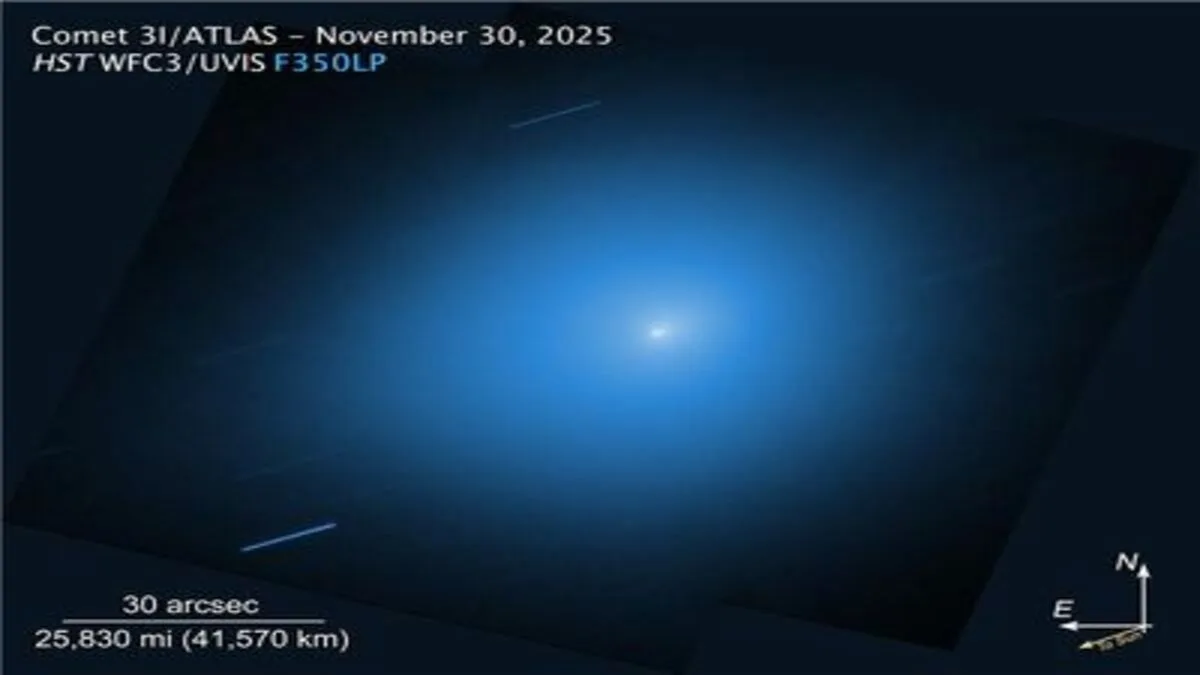
Interstellar comet 3I/ATLAS (picture credits: NASA)
Earth will witness a rare cosmic event on December 19, 2025 as 3I/ATLAS, an interstellar comet that originated from outside the solar system, makes its closest approach to the planet. It will pass Earth at a distance of about 1.8 astronomical units (AU) [roughly 170 million miles] with no threat to the planet. NASA’s Asteroid Terrestrial-IMPACT Last Alert System (ATLAS) survey telescope discovered it on July 1, 2025 in Chile which was later confirmed by astronomers that it is the only third known interstellar object to enter the solar system after 1I/’Oumuamua in 2017 and 2I/Borisov in 2019.
Unlike typical comets which loop around the Sun and return decades or centuries later, the 3I/ATLAS has a hyperbolic trajectory meaning it is a one-time visitor and is just passing through our solar system.
Advertisement
The comet is travelling at a lightning speed of around 130,000 miles (209,000 kilometres) per hour, the highest velocity ever recorded of any solar system object. Such a speed cannot be explained by Solar System dynamics alone, another key indicator of its interstellar origin.
Advertisement
Made up of icy water, carbon compounds and dust grains, mysterious nickel gas has also been detected in the comet’s gas plume inviting curiosity regarding its chemistry at enormous distances from the Sun. Observations show that it has begun displaying typical cometary features, i.e. the glowing coma surrounding its nucleus and a tail stretching away from the Sun. What is more fascinating is its bright green hue that maybe caused due to some chemical reaction with the Sun sparking worldwide observation.
While observations about the 3I/ATLAS remain consistent with known cometary behaviour, some features like the intensity of its activity and the composition of its gases has sparked controversies amidst studies. Scientists note that the conclusions derived are based on limited comparisons and that observations are underway as the coming months are expected to clarify these uncertainties and further help with the scientific understanding of 3I/ATLAS.
Advertisement