Sea Change
India’s maritime ambitions cannot be measured by a ceremonial warship commissioning or ambitious infrastructure announcements alone.
US President Donald Trump has criticised Canada for opposing the Greenland ‘Golden Dome’ defence plan, warning that Ottawa’s growing trade engagement with China could undermine its security.





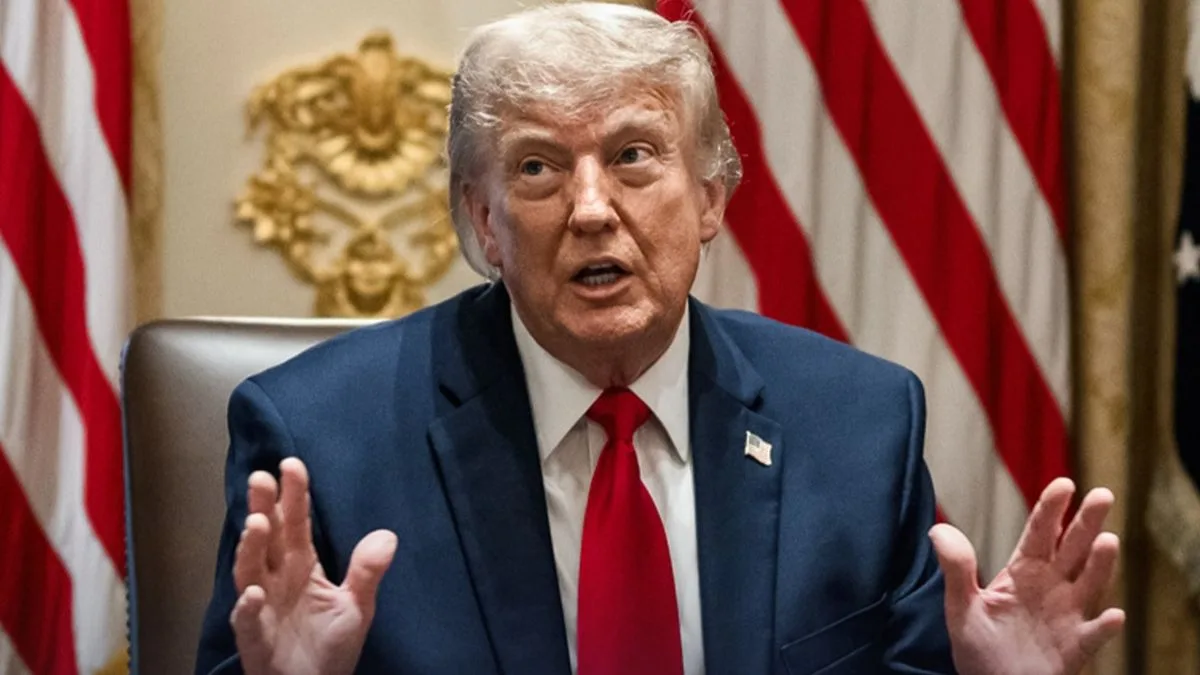
US President Donald Trump addresses an audience. In a separate image, Canadian Prime Minister Mark Carney meets Chinese President Xi Jinping, amid growing tensions over defence and trade choices. | IANS
US President Donald Trump has sharply criticised Canada for opposing his proposed “Golden Dome” missile defence project, warning that Ottawa’s growing engagement with China could leave it strategically vulnerable.
In a post on his social media platform Truth Social, Trump accused Canada of rejecting a security initiative that, he said, would also protect Canadian territory. He contrasted that decision with Ottawa’s recent trade outreach to Beijing.
Advertisement
“Canada is against The Golden Dome being built over Greenland, even though The Golden Dome would protect Canada. Instead, they voted in favour of doing business with China, who will ‘eat them up’ within the first year!” Trump wrote.
Advertisement
The remarks reflect a further deterioration in US-Canada ties, with defence, trade and geopolitics now colliding publicly.
Trump’s comments follow his address earlier this week at the World Economic Forum in Davos, where he openly questioned Canada’s stance on security cooperation with the United States.
“Canada gets a lot of freebies from us, by the way. They should also be grateful, but they’re not. I saw your Prime Minister yesterday; he wasn’t so grateful. They should be grateful to us,” Trump said during the forum, adding that the proposed Golden Dome missile defence system would extend protection to Canada as well.
“Canada lives because of the United States. Remember that, Mark, the next time you make your statements,” Trump said, directing his remarks at Canadian Prime Minister Mark Carney.
Greenland has emerged as a sensitive strategic point in this exchange. While Trump did not explicitly link tariffs to Greenland during his Davos speech, Carney later criticised the use of economic pressure in global diplomacy, a comment widely seen as a response to Washington’s approach.
At Davos, Carney warned that the world was entering “an era of great power rivalry, where the rules-based order is fading.”
Tensions have been compounded by Canada’s recent trade agreement with China, announced on January 17. Carney said the deal would open significant new export opportunities for Canadian businesses and workers.
“We’ve secured a new trade agreement with China — unlocking more than $7 billion in export markets for Canadian workers and businesses,” Carney said in a post on X.
A statement from the Canadian Prime Minister’s Office described the agreement as part of a broader effort to diversify trade partnerships in a “more divided and uncertain world,” adding that China, as the world’s second-largest economy, offered “enormous opportunities” for Canada.
Under the arrangement, Canada has agreed to reduce its 100 per cent tariff on Chinese electric vehicles, in exchange for lower Chinese tariffs on Canadian agricultural exports, including canola. According to CBS News, China will cut its tariff on canola seeds from 84 per cent to about 15 per cent, while Canada will cap Chinese EV imports at 49,000 vehicles annually, rising to around 70,000 over five years.
Carney has argued that China has become a more reliable economic partner than the United States.
“Our relationship has progressed in recent months with China. It is more predictable, and you see results coming from that,” he said, as quoted by CBS News.
Canada currently faces a 35 per cent levy on its goods, alongside broader US tariffs, including 50 per cent on imported metals and 25 per cent on non-US automobiles.
There is a broader backdrop to the dispute. Both sides had earlier threatened tariffs of up to 100 per cent, though some Chinese products were later exempted until November 10, 2026, following a meeting between Trump and Chinese President Xi Jinping.
Advertisement