The history of computing has primarily revolved around physical materials. From the silicon transistors of the mid-20th century to today’s powerful H100 GPU clusters, we have based intelligence on refined sand. However, as we explore the limits of Large Language Models and Generative AI, we are reaching a physical barrier known as the “Energy Wall.” A modern AI training cluster consumes megawatts of power, requiring dedicated electrical substations and liquid-cooling systems to prevent its silicon heart from overheating.
In stark contrast, the most sophisticated computer in the known universe, the human brain, operates on approximately 20 watts of power. It runs on the caloric equivalent of a single banana. This massive 100,000-fold difference in efficiency has birthed a new, albeit unsettling, frontier: Wetware. By merging living biological cells with silicon hardware, Australia’s Cortical Labs has successfully trained 800,000 human neurons to play the video game Doom in a matter of days. We are witnessing the emergence of Synthetic Biological Intelligence (SBI), the next stage of human evolution where the line between “born” and “built” begins to dissolve. While the Western approach to SBI is often framed as a commercial extension of the digital economy, India’s engagement with biological computing is rooted in a strategic imperative for “Deep-Tech Sovereignty”.
Advertisement
Moving away from a service-led ‘IT Support’ model to a sovereign ‘Deep-Tech’ mission, India has prioritised ‘Sustainable Biocomputing’ as a pillar of healthcare, self-reliance, and climate resilience. By expanding research beyond human stem cells to engineered bacteria and molecular-analog devices,India aims to ensure that these disruptive technologies promote medical advancement and humanitarian outcomes, rather than mere digital dominance. While Australia’s Cortical Labs offers ‘Wetware as a Service’ (WaaS), which costs $35,000 for access to living human neurons, India is pursuing a broader
Beyond the clinic, this frontier provides a path toward “Sovereign AI Hardware.” In today’s geopolitical climate, AI chips are the new oil, and India’s dependence on global GPU supply chains remains a strategic vulnerability. The rise of Wetware offers a “leapfrog” opportunity.
biological path. Guided by the Indian Institute of Science (IISc) and the Saha Institute of Nuclear Physics (SINP), India is exploring beyond human cells to investigate the fundamental building blocks of life, such as molecules and bacteria, to create a new form of intelligence. At the Saha Institute of Nuclear Physics, Dr Sangram Bagh and his team have achieved what was once considered science fiction: they have engineered living bacteria to function as “bactoneurons.” By re-programming the genetic circuits of E. coli, they created a biological neural network capable of complex logic.
These bacterial colonies have been trained to solve mathematical problems, such as identifying prime numbers and distinguishing vowels from consonants. This is SBI in its purest form. Unlike human neurons, which are fragile and ethically complex, bacterial computers are resilient, scalable, and can be grown in virtually any environment. India’s research here suggests a future where “living hardware” could be used for environmental sensing or deep-space exploration, where silicon would fail. Meanwhile, at IISc’s Centre for Nano Science and Engineering (CeNSE), Prof.
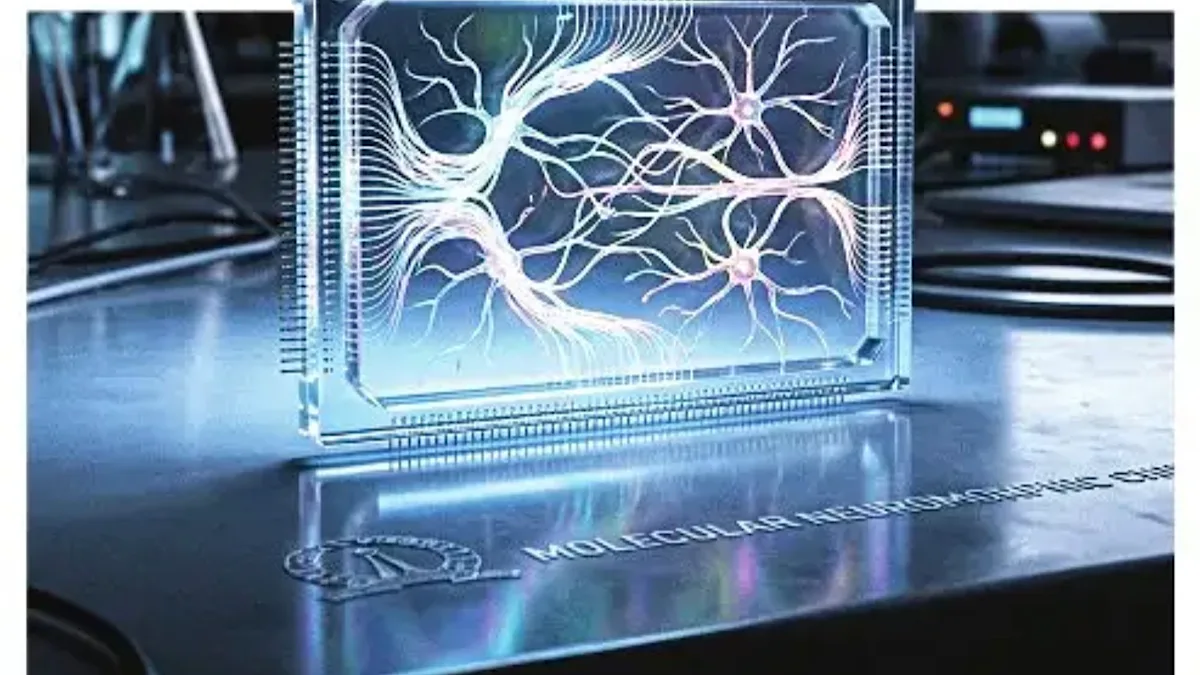
Goswami has bypassed the traditional binary logic of silicon. His team developed a “brain-on-a-chip” using a molecular film that mimics the brain’s analog nature. While a standard computer chip works in 0s and 1s, the IISc chip can store and process data in 16,500 different states. By mimicking the “memristive” properties of a biological synapse, this chip can perform massive AI computations at a fraction of the energy. It represents the “dry” side of neuromorphic computing, applying the lessons of biology to high-end physics. This is India’s answer to the energy wall: hardware that thinks like a brain without needing a laboratory to keep it alive.
The transition to Wetware and Neuromorphic computing in India is driven by two high-impact imperatives: medical liberation and strategic sovereignty. One of the most profound applications of India’s bio-computing research is in the field of Brain-Computer Interfaces (BCI). In 2026, the “Brain Co-Processor” project emerged from Bengaluru, aimed at stroke survivors and patients with spinal cord injuries. Traditional neural implants are often rejected as foreign objects; however, by using neuromorphic chips that “speak” the brain’s electrical language, Indian researchers are developing interfaces that learn alongside the patient. A stroke survivor’s brain can “offload” lost motor functions to the co-processor, which then re-trains the nervous system, restoring the dignity of movement to millions.
Beyond the clinic, this frontier provides a path toward “Sovereign AI Hardware.” In today’s geopolitical climate, AI chips are the new oil, and India’s dependence on global GPU supply chains remains a strategic vulnerability. The rise of Wetware offers a “leapfrog” opportunity. If India can perfect chips that run on milliwatts, it will eliminate the need for energy-guzzling data centres. Sovereign AI, designed, powered, and housed entirely within the subcontinent, becomes a reality. A neuromorphic “Sovereign Chip” could allow a handheld device to run a full-scale LLM locally, bypassing cloud infrastructure controlled by foreign tech giants. This leap did not emerge in isolation. It is the calculated outcome of a structural shift in India’s scientific policy.
The India Semiconductor Mission, backed by $10 billion in incentives, was designed not just for fabrication but to strengthen domestic chip design. Complementing this, the National Mission on Interdisciplinary Cyber-Physical Systems created 21 Technology Innovation Hubs to bridge the gap between AI, robotics, and biological engineering. More recently, the BioE3 Policy (Biotechnology for Economy, Environment, and Employment) has identified “Bio-AI” as a strategic frontier, providing regulatory clarity for the engineering of living cells for computation. As we stand on the precipice of this “Wetware Frontier,” the questions we face are as much philosophical as they are technical. If a colony of bacteria can solve primes, we must interrogate the very nature of intelligence.
While the “scary” factor of “growing” computers in a vat challenges our definitions of life, India’s unique cultural framework becomes a global asset. While Western paradigms often prioritise digital hegemony, India’s trajectory remains anchored in the civilizational tenets of Seva and Antyodaya. Biological computation represents the most profound technological inflexion point since the harnessing of electricity. India’s strategic responsibility is to ensure this frontier serves as a conduit to a sovereign, empathetic future, not a tool for ‘Bio-hegemony.
(THE WRITER IS A POLICY CONSULTANT INTERESTED IN GEOPOLITICS, INTERNATIONAL RELATIONS AND POLICY MAKING.)