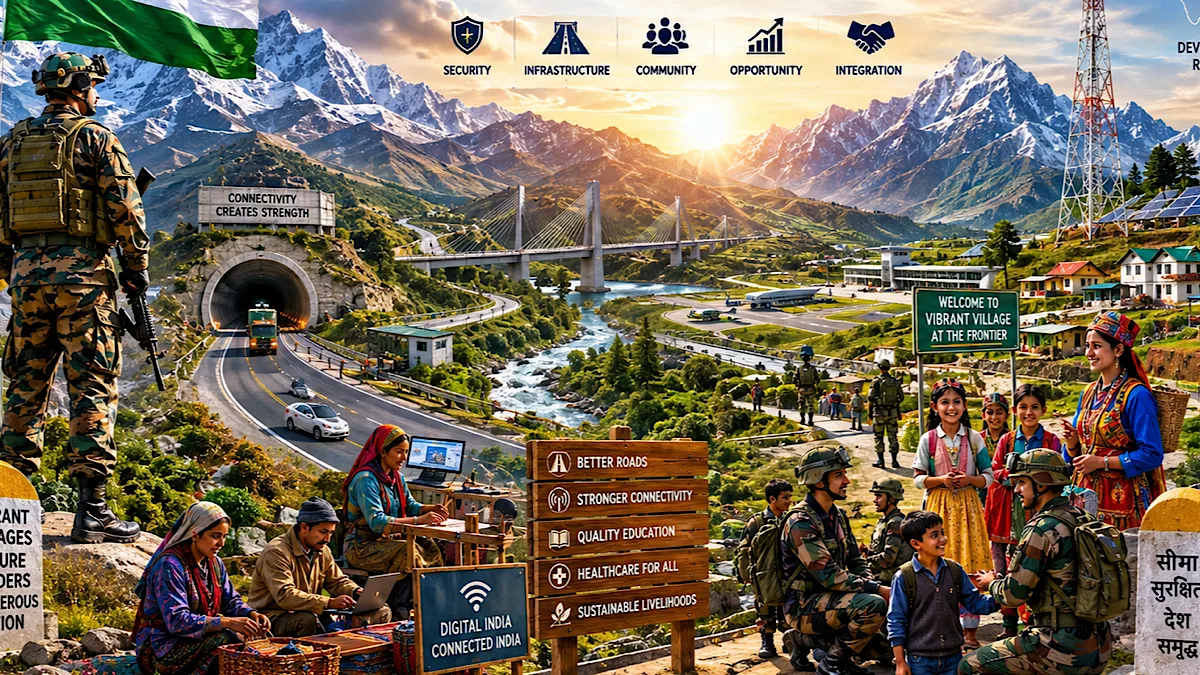
For much of independent India’s history, border security has been viewed primarily through a military lens. The focus has understandably been on troop deployment , surveillance, fencing , and infrastructure designed to deter external threats. While these measures remain essential, the changing nature of national security demands a broader perspective. In the twenty-first century, secure borders are not created solely by soldiers and security installations. They are also strengthened by thriving communities, economic opportunities, modern infrastructure, and effective governance.
India’s frontier regions must therefore be viewed not merely as lines of defence but as engines of strategic development. India shares more than 15,000 kilometres of land borders with seven countries. These frontier regions encompass some of the country’s most challenging terrain, from the high-altitude deserts of Ladakh to the dense forests of the Northeast and the riverine boundaries of eastern India. Historically, many border districts remained economically underdeveloped due to difficult geography, limited connectivity, and inadequate public investment.
Advertisement
As a result, large sections of India’s frontiers came to be characterised by sparse populations, weak infrastructure, and restricted economic activity. Such conditions create vulnerabilities that traditional military measures alone cannot address. Security challenges in border areas often arise not merely from external threats but from the absence of development. Poor connectivity, limited employment opportunities, inadequate healthcare facilities, and weak educational infrastructure can contribute to migration away from border villages.
When populations decline in strategically sensitive regions, the state’s presence becomes less visible, economic activity diminishes, and vulnerabilities can increase. The concept of border development as a component of national security is therefore gaining greater relevance. The underlying logic is straightforward. Communities that are economically secure, socially integrated, and well-connected to the national mainstream contribute significantly to territorial stability. Residents of border regions often serve as the country’s first line of awareness regarding developments along the frontier.
Their continued presence and prosperity strengthen national resilience in ways that military infrastructure alone cannot achieve. The importance of this approach has become particularly evident in India’s northern and northeastern regions. The border tensions witnessed in recent years have highlighted the strategic value of roads, bridges, tunnels, telecommunications networks, and air connectivity. Modern military operations depend heavily on logistics and mobility. Infrastructure that supports civilian development frequently enhances defence preparedness as well.
A road that facilitates trade and tourism can also improve military deployment capabilities. Telecommunications networks that connect remote villages can simultaneously strengthen surveillance and emergency response systems. This recognition has informed several recent policy initiatives. Programmes aimed at improving border infrastructure and revitalising frontier villages reflect a growing understanding that national security and development are interconnected objectives. The Vibrant Villages Programme, for example, seeks to improve living conditions and economic opportunities in strategically important border settlements.
The goal is not merely to prevent outmigration but to transform these areas into vibrant communities that contribute to regional and national development. The Northeast offers an instructive example of this evolving approach. For decades, the region was viewed through the prism of insurgency and security concerns. Today, however, policymakers increasingly recognise its potential as India’s gateway to Southeast Asia. Investments in highways, railways, airports, digital connectivity, and cross-border trade infrastructure are reshaping the region’s strategic significance. Security remains important, but it is increasingly complemented by efforts to promote economic integration and connectivity. A similar transformation is occurring in other frontier regions.
In Ladakh and Arunachal Pradesh, infrastructure development has accelerated significantly in recent years. Improved roads, tunnels, and communication systems not only strengthen defence capabilities but also enhance the quality of life for local populations. These investments demonstrate that strategy preparedness & developmental objectives can reinforce one another. The changing nature of global security further strengthens the case for a development-oriented approach. Contemporary threats often transcend traditional military boundaries. Cross-border crime, illegal migration, narcotics trafficking, cyber vulnerabilities, and information warfare require comprehensive responses involving multiple institutions.
Border management is no longer the exclusive responsibility of security agencies. It increasingly involves civil administration, local governments, infrastructure planners, and development agencies. Economic integration also plays an important role in long-term security. Border regions that benefit from legitimate trade and investment are often more resilient to illicit activities. Enhanced connectivity with neighbouring countries can generate employment, encourage entrepreneurship, and strengthen regional stability. This does not diminish the importance of vigilance; rather, it highlights the need for a balanced strategy that combines security measures with economic opportunity.
However, development initiatives must be implemented thoughtfully. Infrastructure projects should respect environmental concerns and local cultural identities. Frontier communities should be active participants in development planning rather than passive recipients of centrally designed programmes. Sustainable growth requires consultation, inclusion, and sensitivity to regional realities. The future of India’s border security lies in integrating defence and development into a coherent national strategy. Military strength will always remain a vital component of frontier management, particularly given the country’s complex geopolitical environment.
Yet security cannot be sustained indefinitely in regions that lack economic vitality and social opportunity. India’s border areas should no longer be seen as remote outposts at the margins of national life. They are strategic assets with the potential to contribute to economic growth, regional connectivity, and national resilience. By investing in people as well as infrastructure, and in development as well as defence, India can transform its frontiers from zones of vulnerability into pillars of strength. In an era of evolving security challenges, that may prove to be the most effective form of border defence.
(The writer is a civil engineer, a consultant to the Rashtriya Raksha University, and a contemporary affairs commentator. The views are personal. He can be reached at siddharth001.roy@gmail.com)