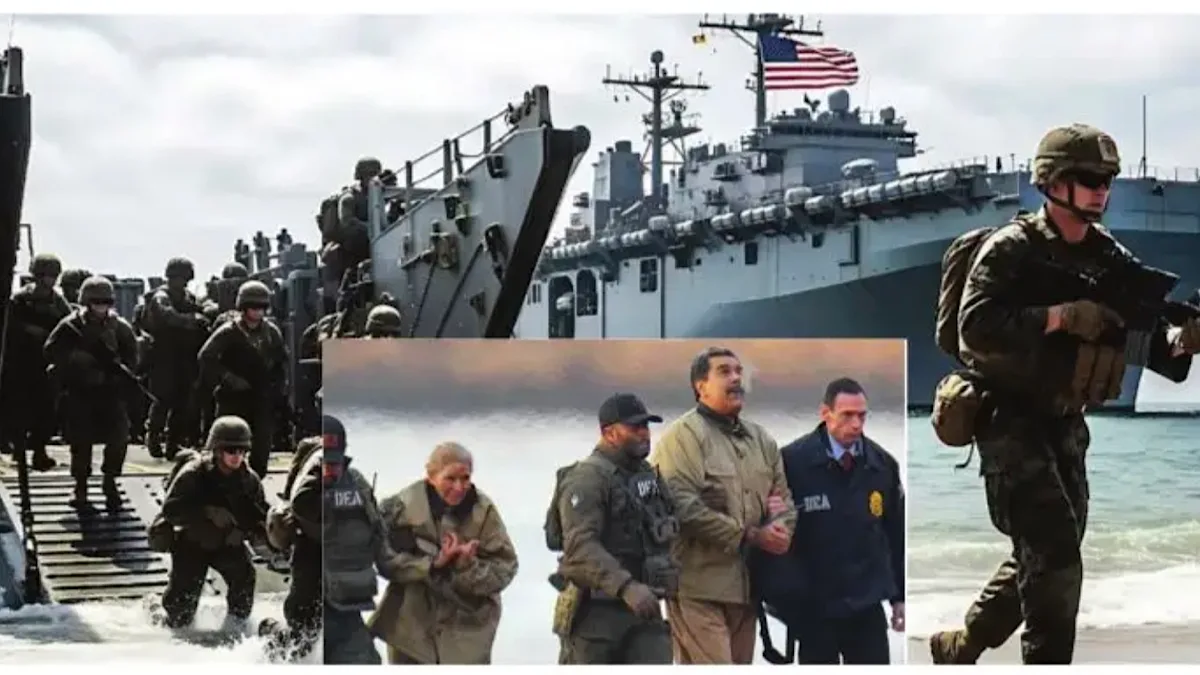
The arrest of Venezuelan President Nicolás Maduro by U.S. forces in the early hours of 3 January 2026 stands as one of the most dramatic and contentious episodes in recent international politics. While Washington has projected the operation as a decisive strike against narco-trafficking and authoritarianism, much of the international community views it as an unprecedented act of regime change carried out through unilateral military force.
The episode raises serious questions about sovereignty, the erosion of international norms, and the difficult choices confronting middle powers such as India in an increasingly polarized world. From the U.S. perspective, the operation aligns closely with President Donald Trump’s long-standing approach to Venezuela. Maduro has faced indictments in U.S. courts since 2020 on charges related to narco-terrorism, drug trafficking, and arms smuggling. Trump has consistently portrayed Venezuela as a criminal state run by a cartel rather than a legitimate government.
The January operation, involving extensive military strikes and a special forces raid in Caracas, culminated in the capture of Maduro and his wife and their transfer to New York for prosecution. Trump defended the action as swift, necessary, and justified, arguing that Venezuela posed a direct security threat within America’s strategic “home region.” This justification, however, weakens under broader scrutiny. International law rests firmly on the principles of sovereignty and non-intervention. The forcible seizure of a sitting head of state from within his own country, without consent or a United Nations mandate, has little precedent in modern international relations.
Even states that have been sharply critical of Maduro’s authoritarian rule have refrained from endorsing the means used to remove him. The UN Secretary-General’s warning that the action sets a “dangerous precedent” reflects widespread concern that normalizing such interventions could further erode already fragile restraints on the use of force. Trump’s statements following the operation have only deepened scepticism about Washington’s intentions. His open references to U.S. oil companies taking control of Venezuela’s energy resources, and assertions that the United States would “run Venezuela temporarily” until a transition is arranged, evoke uncomfortable parallels with earlier American interventions, most notably Iraq.
Those experiences demonstrate that externally imposed regime change, even when justified in moral or security terms, often leads to prolonged instability, resistance, and humanitarian distress. Expecting a smooth political transition in Venezuela, a deeply polarized society with a long history of anti-imperialist sentiment, appears highly unrealistic. Within Venezuela, the immediate aftermath has been tense but relatively subdued. The Supreme Court’s request that Vice President Delcy Rodríguez assume the role of acting president was intended to ensure continuity, yet her refusal to do so and insistence that Maduro remains the legitimate leader underscores the regime’s attempt to project unity and resist what it calls an illegal abduction.
The absence of widespread unrest so far should not be interpreted as acceptance of U.S. actions. Rather, it reflects a population exhausted by years of economic collapse and sanctions. Whether this fragile calm can be sustained remains uncertain. International reactions reveal a sharply divided global order. Russia and China have strongly condemned the operation as a blatant violation of sovereignty and demanded Maduro’s immediate release. Several Latin American countries, including Brazil, Mexico, and Colombia, have warned that the action risks destabilizing the region and reviving memories of an era dominated by U.S. military interventions in the hemisphere. The European Union has adopted a more cautious position, reiterating that Maduro lacks democratic legitimacy while simultaneously emphasizing the importance of adhering to international law. This ambivalence highlights a broader dilemma: opposition to authoritarian governance does not automatically translate into approval of the methods used to dismantle it.
For India, the episode poses a particularly complex diplomatic challenge. New Delhi’s direct economic stakes in Venezuela are limited. Bilateral trade has declined sharply due to U.S. sanctions, and the Indian diaspora in Venezuela is small. The issue, therefore, is not material interest but principle. India has long championed sovereignty, non-intervention, and a rules-based international order, positions shaped by its own colonial experience and its leadership role in the Global South. Remaining silent or overly cautious in response to such a clear use of force risks undermining this normative posture. At the same time, India’s strategic partnership with the United States has deepened significantly over the past two decades, encompassing defence cooperation, technology transfer, and convergence in the Indo-Pacific.
This relationship has not been free of tensions, as seen in trade disputes and differences over Russia-related issues. A strong public condemnation of Washington’s actions in Venezuela could further complicate these sensitive dynamics. India’s measured response so far ~ expressing concern, urging dialogue, and emphasizing civilian safety ~ reflects an effort to balance principles with pragmatism. This dilemma is emblematic of a wider trend in contemporary geopolitics, where middle powers are increasingly compelled to navigate between normative commitments and strategic realities. The U.S. defence of its actions rests on the claim that extraordinary threats justify extraordinary measures. If such reasoning becomes widely accepted, however, international law risks becoming irrelevant.
Today it is Venezuela; tomorrow it could be any state deemed illegitimate or threatening by a more powerful neighbour. The episode also highlights the steady erosion of multilateralism. A divided UN Security Council is unlikely to produce a meaningful response, reinforcing a pattern in which powerful states act unilaterally and seek justification later. This weakening of collective institutions is particularly troubling for countries like India that have consistently argued for strengthening and reforming global governance structures. Ultimately, the capture of Nicolás Maduro is about far more than the fate of one leader or one country. It represents a test of how far unilateral power can be exercised before the constraints of international order give way entirely.
Maduro’s record on democracy, human rights, and governance may be flawed, yet addressing those failures through military abduction sets a precedent that could be exploited by others with far less defensible motives. History offers ample evidence that externally imposed regime change rarely delivers the stability or democratic outcomes it promises. As the situation unfolds, the central question is not only what lies ahead for Venezuela, but what kind of global order is being shaped by such actions. For India and other middle powers, the challenge is to articulate a principled position that upholds international law without sacrificing strategic autonomy. The choices made now will resonate far beyond Caracas, shaping expectations about power, legitimacy, and restraint in an increasingly uncertain world.
(The writer is Associate Fellow, Manohar Parrikar Institute for Defence Studies and Analyse)
Advertisement