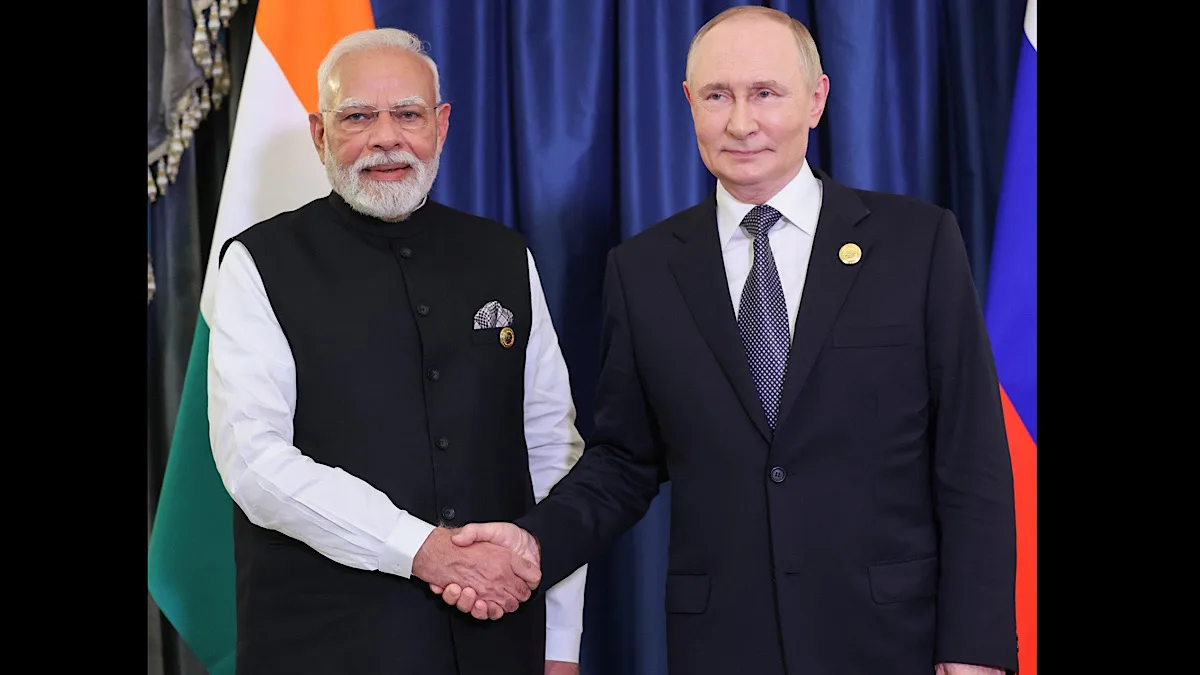
Prime Minister Narendra Modi’s meeting with Russian President Vladimir Putin on the side-lines of the Shanghai Cooperation Organisation summit in Tianjin carried more weight than the symbolism of a shared limousine ride. It offered a glimpse into India’s evolving calculus at a moment when global alignments are being redrawn under duress. The optics were striking. A visibly relaxed exchange between the Indian and Russian leaders, one punctuated by warmth and informality, was far removed from the coercive language emanating from Washington.
The United States has slapped unprecedented tariffs on Indian goods, ostensibly to punish New Delhi for sustaining energy and defence ties with Moscow, and unleashed undiplomatic rhetoric that suggests an inclination to treat India as a supplicant. Yet, rather than displaying retreat, India chose to reinforce its comfort with Russia in a highly public setting, and under the watchful gaze of Chinese President Xi Jinping. This triangulation is significant. For China, hosting both Mr Modi and Mr Putin in Tianjin was an opportunity to showcase a platform that can rival Western-led forums. For Russia, embattled by sanctions and ultimatums, it was a stage to demonstrate that it is not isolated, that powerful partners are still willing to sit beside it.
Advertisement
And for India, the moment was about signalling resilience: strategic autonomy is not to be dictated by tariff sticks or diplomatic deadlines. India’s posture marks neither defiance nor reckless adventurism. It reflects a careful weighing of national interests in an environment where economic pressure and security imperatives intersect constantly. The economic stakes are considerable. A 50 per cent tariff wall raised by the United States threatens to bite into India’s exports, particularly in sectors that had come to rely on the American market.
The penalty surcharge linked to Russian transactions adds insult to injury, effectively demanding that India choose between affordable oil and access to the US consumer. But a country of India’s size and ambition cannot afford to be reduced to such binary choices. The partnership with Russia is not merely sentimental, rooted in Cold War history. It is a matter of hard economics and national security. Energy flows, defence cooperation, and emerging technology exchanges are too critical to abandon at the flick of a tariff wand. Critics may argue that the choreography in Tianjin risks alienating Washington at a delicate time. Yet, the larger truth is that America’s own strategy is narrowing India’s options. By conflating legitimate trade disputes with geopolitical coercion, Washington is leaving little space for constructive give-and-take.
That vacuum is inevitably filled by alternative arrangements ~ even if they carry their own risks. What emerges from Tianjin, therefore, is not merely the image of three leaders clasping hands, but the outline of a multipolar reality. India will continue to value its partnership with the United States, but not at the expense of its sovereign choices. If tariffs and ultimatums are the language of the day, then gestures of solidarity with Russia and pragmatic cooperation with China will remain indispensable instruments of Indian diplomacy.