All eyes on NDA’s ‘Mangal Milan’ meeting on Tuesday
The National Democratic Alliance (NDA) Parliamentary Party meeting, now called 'Mangal Milan', will be held on Tuesday at Parliament House.
Long years back, when I was posted in Bihar under the Lalu regime, a Bihari friend had told me, “To understand Bihar, you must realise that Bihar is more a state of mind than reality.”




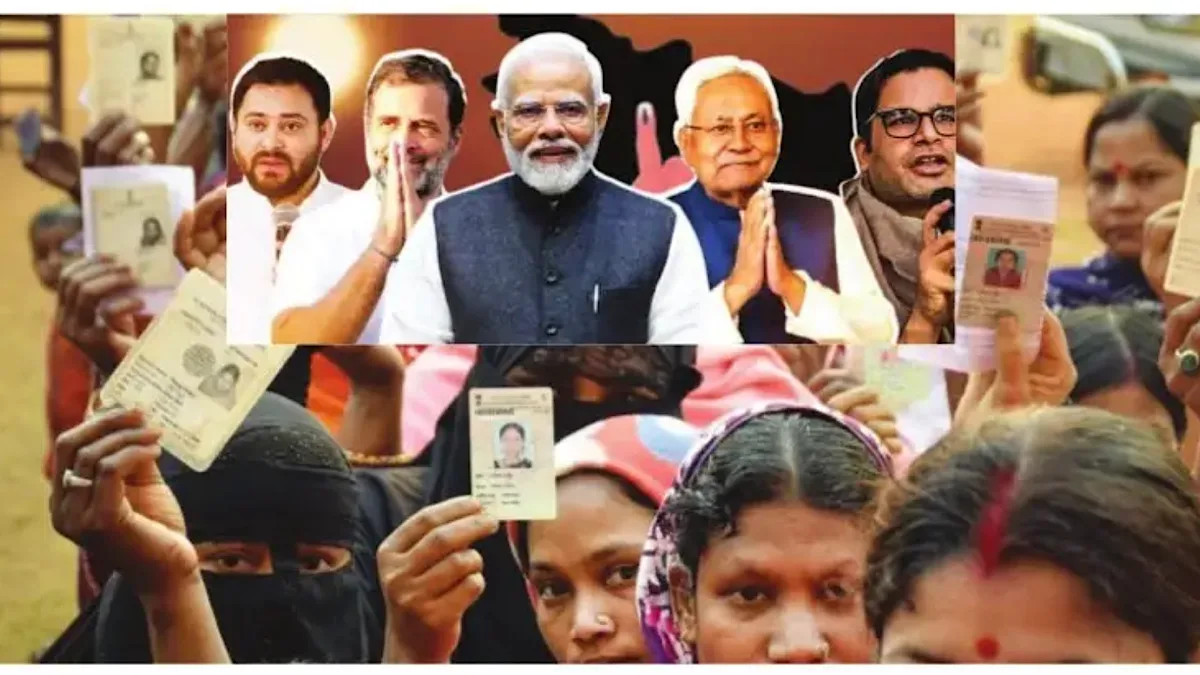
Photo:SNS
Long years back, when I was posted in Bihar under the Lalu regime, a Bihari friend had told me, “To understand Bihar, you must realise that Bihar is more a state of mind than reality.” Looking at the poll promises floating around, I am reminded once again of this statement, especially for the fabulous promises made by the RJD. Its leader is the Mahagathbandhan alliance’s CM candidate Tejaswi Prasad Yadav, the worthy son of Lalu Prasad, who had presided over the state’s Jungle Raj of 15 years, when state-patronised kidnapping and extortion were the state’s only thriving industries.
I have first-hand experience of seeing how, under his watch, the state had completely withered away in the Marxist sense. Tejaswi was also briefly in the seat of power, twice as deputy to Nitish Kumar, first in 2015 for some 17 months and again in 2022 for 20 months, when Nitish hobnobbed with the RJD before returning to NDA after citing allegations of large-scale corruption against Tejaswi and the RJD. Tejaswi, who was unable to lure enough Biharis with his promise of only 10 lakh government jobs to vote him to power in 2020, has raised the stakes much higher this time, promising to enact a new law within 20 days to provide one government job to each family in Bihar within 20 months.
Advertisement
Bihar has about 10 lakh regular government employees and roughly an equal number of contract employees. As per the last caste survey conducted by the Nitish government in 2022, it has a population of 13 crore and 2.7 crore households. If we discount the existing regular employees, there are still an additional 2.6 crore jobs to be created within 20 months to fulfil Tejaswi’s promise. At the lowest pay scale, a government employee in Bihar earns about Rs 30,000 per month. At this rate, the promise would cost the exchequer a humongous annual sum of Rs 9.36 lakh crore – more than thrice its entire budget of Rs 2.94 lakh crore for 2025-26. Tejaswi, who himself has never passed out of school, is probably unaware that it is not the government’s business to give jobs but to facilitate the creation of jobs by the private sector by improving infrastructure, law and order, access to market and improving the quality of education to harvest people with employable skills. Bihar lags all other states in these determinants of growth.
Advertisement
The private sector is practically absent, and its per capita income remains below all major states, just as it was thirty years ago. The distance of its per capita income from India’s average has widened over the last 30 years. Its per capita income is now only 35 per cent of the national average, which has not improved during Nitish Kumar’s rule. The election manifesto of RJD, called Tejaswi Pran Patra, has made many other promises too, like restoration of the old pension scheme, Rs 1 lakh annual cash transfer to women from poor families (estimated cost: Rs 72,000 crore), apart from the usual freebies of Rs 2,500 monthly cash transfers to “economically weak” women (Cost: Rs 28,000 crore), plus 200 units of free electricity (Rs 39,000 crore), subsidised gas cylinders, etc.
There is no use estimating the financial cost of these freebies as his one job per family promise will exhaust the entire budget and drive the state into the depths of debt and despair for the next few generations. What is starkly missing is the roadmap to fulfil these promises, assuming that voters would be too ensnared to question their feasibility. Indeed, in 2020, he almost succeeded in forming the government, winning 110 seats for the Mahagathbandhan alliance as against 125 for the NDA.
In another few days, we would know whether Bihari voters have succumbed to his mind-bending promises ~ in case they do, it would be interesting to see what kind of jobs would be offered to 2.6 crore people and what productive purposes these would serve, what qualifications would be needed for these jobs and whether adequate number of qualified people can be found in a state with only 62 per cent literacy, a 73 per cent school dropout rate and only 80,000 graduates, or where would these 2.6 crore government employees sit till enough office rooms are built, for which again there will be no money in the treasury already bankrupt beyond recovery.
Given that only about 5.7 per cent of workers in Bihar were employed in manufacturing as of 2022-23, and nearly half the workers have to find employment in the primary sector in a state with 88 per cent rural population, his promise of 2.6 crore government jobs can only point to the state of his mind. To put the promises in a proper perspective, let us also consider that only 28 per cent of Bihar’s revenue comes from its own resources, indicating its overwhelming dependence on central transfers. It has not recovered from the loss of revenues from excise and sales tax on alcohol after Nitish had imposed prohibition in 2016, and its tax: GSDP ratio has dropped from 6.9 per cent then to only 5.7 per cent in FY2024.
AS of FY2024, its fiscal deficit stood at Rs 35,660 crore, or 4.2 per cent of GSDP, and its committed expenditure on salary, pension and interest payments consumed 38 per cent of its total revenue expenditure of Rs 1.9 lakh crore. With a debt: GSDP ratio of 35 per cent and the continued strain from elevated primary deficits, Bihar is still a long away from achieving sustainability of its debt of Rs 3 lakh crore. In FY 2024, of its total expenditure of Rs 2.5 lakh crore, it had spent Rs 30,000 crore on salaries and wages, Rs 24,000 crore on pension, Rs 17,600 crore on interest and Rs 16,000 crore on subsidies. There is hardly any fiscal space left to increase the expenditure on salaries.
Not that the NDA has covered itself with fiscal glory ~ just before the election dates were announced, it has doled out Rs 7,500 crore under the Mukhyamantri Mahila Rojgar Yojana ~ a scheme for cash transfer of Rs 10,000 to 75 lakh women, with additional support likely up to Rs 2 lakh. In its just-released election manifesto called “Sankalp Patra,” it has promised 1 crore government jobs despite its poor past record in this regard, given the fact that Bihar has only about 10 lakh regular government employees. The manifesto also promises 125 units of free electricity to households, increased support to farmers and fishermen, increased pensions for senior citizens/widows, etc. One crore government jobs alone would cost Rs 3.6 lakh crore ~ enough to exhaust Bihar’s entire budget, not to speak of its other promises.
But who bothers about economics and fiscal numbers, especially in Bihar, where, as is often said, people do not cast their votes but vote with their castes? The truth of this statement, however, is unknowable because all parties align their electoral strategies to caste dynamics, and the alternative has never been tested. Fiscal prudence has never mattered in any election, and will not this time either. Meanwhile, Rahul Gandhi has vowed to replace ‘Made in China’ with ‘Made in Bihar’.
Perhaps the paddy fields of Rohtas and Champaran are waiting to be the world’s next manufacturing powerhouse. In the same vein, Tejaswi has promised to exclude toddy (fermented local drink) from the scope of Bihar’s stringent prohibition law. It will certainly give the state a truly home-grown industry to boast of as a “Made in Bihar” enterprise, so that industries will ferment in Bihar to absorb its unemployed youth, while lifting the spirit of others to a happy state of mind that is Bihar. Who is bothered about hangovers while toasting toddy ~ one glass at a time?
The writer is a commentator, author, and academic. Opinions expressed are personal
Advertisement