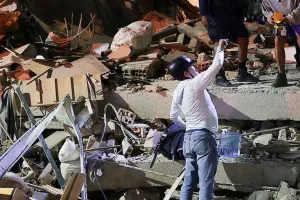
A missile meant for one man instead killed 10 peo ple ~ six of them children ~ waiting in line to fill water containers. This single tragic moment in Gaza encapsulates a far wider moral crisis. It is not merely about flawed targeting or “technical errors,” as claimed. It is about a repeated failure to protect civilians in a war that has dragged on for months with no visible safeguards for the most vulnerable.
The death toll in Gaza, now nearing 58,000, is not just a number ~ it is a reflection of a population systematically cornered. Civilians are being killed not while sheltering militants or attacking military targets, but while fetching water, collecting food, or lining up near humanitarian aid points. This makes the notion of precision warfare ring hollow. Even if the intention is to strike combatants, the outcome too often resembles collective punishment. These are not accidental footnotes to war ~ they are the recurring headlines. Each loss chips away at the distinction between mistake and neglect, eroding trust in military restraint altogether. Humanitarian corridors have become theatres of violence. Aid distribution sites and clinics, once assumed to be safe zones, are now perilous destinations.
Advertisement
The rise in gunshot wounds among civilians at – tempting to access basic provisions suggests that the line between security enforcement and indiscriminate force has grown dangerously thin. Civilian infrastructure has not just collapsed ~ it is being overwhelmed by fresh casualties faster than it can heal the wounded or bury the dead. The scale of displacement and infrastructural devastation means even a shortfall in fuel or medical supplies has exponential consequences. When ambulances cannot move and hospitals go dark, each new strike is not just a combat action ~ it becomes a systemic failure with consequences cascading far beyond the intended target. The military rationale frequently cited to justify these actions leans on legality and enemy proximity. But the ethical legitimacy of such force collapses when error becomes routine and review mechanisms yield no accountability. How many times can the world be asked to accept that civilians were “unintended” casualties when the places they die in ~ markets, aid queues, water tanks ~ are inherently non-combatant spaces?
This erosion of civilian immunity in modern conflict zones must be confronted. It is no longer enough to express regret after the fact. There must be a proactive, demonstrable shift in tactics that prioritizes civilian life ~ not just in rhetoric but in results. Precision must not become a euphemism for impermissible collateral. A war that began as retaliation for a horrific attack has since lost clarity in purpose. If it now systematically prevents access to food, water, fuel, and medicine while claiming to target militants, then its effects speak louder than its intentions. The credibility of any military campaign depends not only on the enemy it claims to neutralize, but on the civilians it protects ~ or fails to.