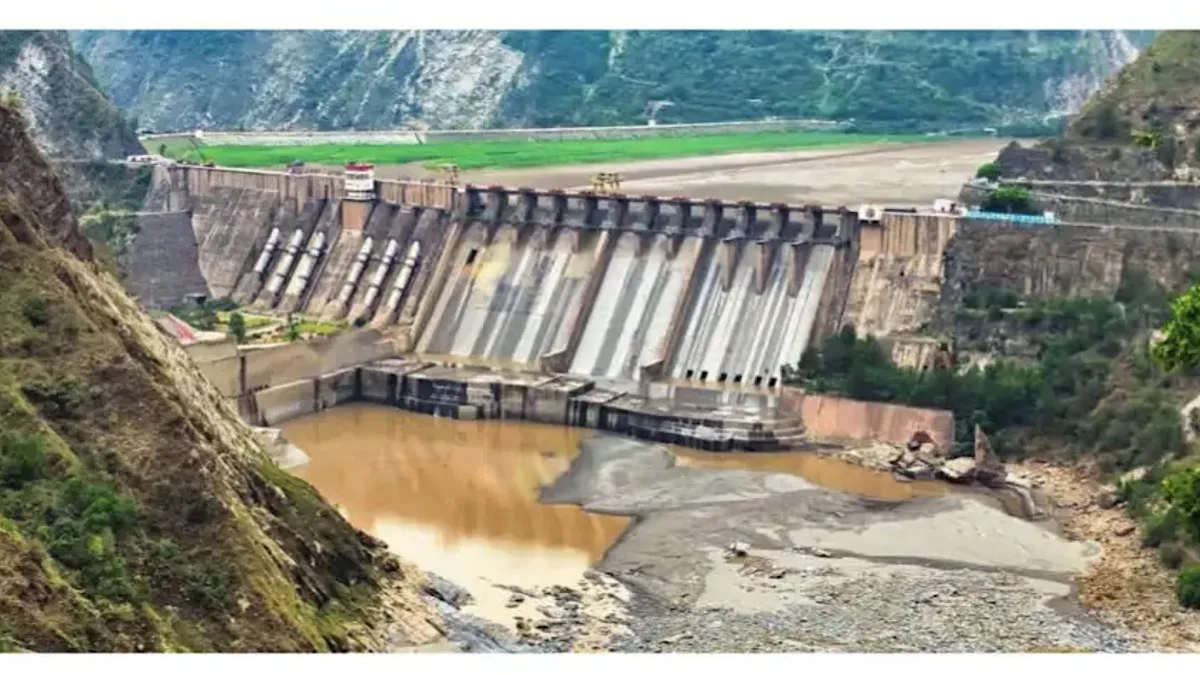
In a bold move that marks a decisive shift in India’s strategic calculus, the government has revived the long-stalled Sawalkote Hydroelectric Power Project on the Chenab River in Jammu and Kashmir. With a capacity of 1,856 MW, Sawalkote is not just India’s largest hydroelectric initiative in the Union Territory ~ it is a clear signal of India’s recalibrated water, energy, and security policies following the suspension of the Indus Waters Treaty (IWT) with Pakistan in April 2025.
Originally conceived in the 1960s, the Sawalkote project languished for decades under the constraints of the IWT, which severely limited India’s cap – acity to harness the potential of the western rivers ~ Indus, Jhel – um, and Chenab ~ allocated to Pakistan for unrestricted use. The Indus Waters Treaty, signed in 1960 under the aegis of the World Bank, was long hailed as a rare example of enduring cooperation between two bitter rivals. However, with Pakistan’s continued support for cross border terrorism ~ most recently exemplified by the deadly Pahalgam terror attack in April 2025 that claimed 26 lives ~ India suspended the treaty, citing national security and sovereign rights as paramount. The symbolic and substantive statement that “blood and water will not flow together” encapsulated India’s growing impatience with asymmetric obligations under the treaty.
Advertisement
The strategic revival of the Sawalkote project follows this suspension. On 29 July 2025, NHPC Ltd. floated a Rs 200- crore international tender for planning, design, and engineering, with bids open until September 10. The project will feature a 192.5-metre-high roller compacted concrete gravity dam and a run-of-the-river system, generating approximately 8,000 million units of electricity annually. The dam will be constructed near Sidhu village in Ramban district, nestled between Jammu and Srinagar. Nine turbines, an underground power station, and three water tunnels will form the technical core of this complex.
Though originally estimated at Rs 8,000 crore, the current project cost has soared past Rs 22,000 crore, with projections nearing Rs 30,000 crore due to delays and inflation. This project is not an isolated undertaking. In fact, Sawalkote is part of a broader hydro – power renaissance in Jammu and Kashmir. India is pushing ahead with six previously stalled projects ~ including Kirthai I & II, Pakal Dul, Kiru, Ratle, and Parnai ~ which together could contribute over 10,000 MW of electricity to the region’s grid.
With more than 10,000 sq. km of snow-fed catchment upstream, particularly in the Chenab basin, these projects promise year round hydropower generation and a stable clean energy future. The implications of this policy shift extend far beyond electricity generation. The move from non-consumptive use to direct strategic utilization of the western rivers challenges the very foundation of the IWT. It signifies India’s intent to assert its rights more fully over water resources that originate within its territory but have disproportionately benefited Pakistan.
The Union Government’s designation of the Sawalkote project as one of “national importance” in June 2025 has expedited bureaucratic clearances, over ridden earlier environmental objections, and triggered rapid mobilisation for implementation. The timing and symbolism of this transformation are unmistakable. While India’s earlier hydro initiatives, like the Baglihar and Salal projects, had already reduced downstream water flows into Pakistan during key cropping seasons, the Sawalkote project, combined with others in the pipeline, represents a cumulative blow to Pakistan’s water security.
Flows at the Marala headworks have already witnessed up to 90 per cent reduction during peak periods, severely affecting agricultural productivity, especially for water-intensive crops like paddy and cotton. In response, Pakistan’s Prime Minister Shehbaz Sharif has called the IWT suspension an “act of war,” urging New Delhi to return to the negotiating table ~ a plea that has thus far found no resonance in India’s strategic quarters. India’s new position is that the treaty cannot coexist with terrorism. External Affairs Minister S. Jaishankar has made it clear in Parliament that the IWT will remain suspended until Pakistan provides irreversible and verifiable guarantees of ending support for terrorism.
Home Minister Amit Shah has echoed these sentiments, calling the treaty “one-sided” and affirming Indian farmers’ right to the waters of Indus and its tributaries. The rhetoric surrounding this shift may sound unyielding, but it resonates with a broader public sentiment and a strategic vision that sees water not merely as a natural resource, but as a geopolitical asset. This integrated strategy, merging energy independence, water security, and national defense, marks a paradigm shift. India is no longer content with symbolic gestures or incremental policy shifts.
By aligning its hydro-infrastructure push with national security goals, it has laid down a red line ~ terrorism will have real costs, and those costs will now include the recalibration of long-standing treaties that no longer serve mutual interests. Environmentally, the Sawalkote project raises challenges. More than a dozen villages in its vicinity will need to be relocated, and there are concerns over biodiversity, river ecology, and seismic vulnerability. Past delays were caused in part by such environmental assessments, political disputes, legal hurdles, and military logistics, as an army transit camp lies in the project area.
These will have to be addressed with sensitivity, particularly given the fragile Himalayan ecosystem. However, with the project being treated as a national priority, these issues are expected to be managed through compensatory measures, rehabilitation schemes, and rapid administrative coordination. The decision to proceed with large-scale hydro development also reflects India’s broader ambition to transition to clean energy.
As climate change intensifies and energy demands rise, hydropower offers a dependable, scalable, and renewable alternative to fossil fuels. Moreover, the strategic location of these projects in Jammu and Kashmir serves a dual purpose: generating electricity for the national grid and consolidating India’s physical and infrastructural presence in a sensitive border region. Politically, the move has been framed as a course correction from the past.
Prime Minister Modi has openly criticized Jawaharlal Nehru’s role in the original treaty, arguing that it was excessively generous to Pakistan. The current administration’s actions are thus part of a broader ideological reorientation, where national interest, security, and self-reliance are the cornerstones of foreign and domestic policy alike. India’s suspension of the IWT and the rapid revival of strategic hydropower projects are, therefore, not just technical or administrative decisions. They are statements of intent ~ intent to defend national sovereignty, optimize natural resources, and redefine the terms of engagement with adversaries. The Sawalkote project stands as a testament to this evolving vision: a dam not just of concrete and turbines, but of resolve and recalibrated power.
(The writer is Associate Fellow, Manohar Parrikar Institute for Defense Studies & Analyses)