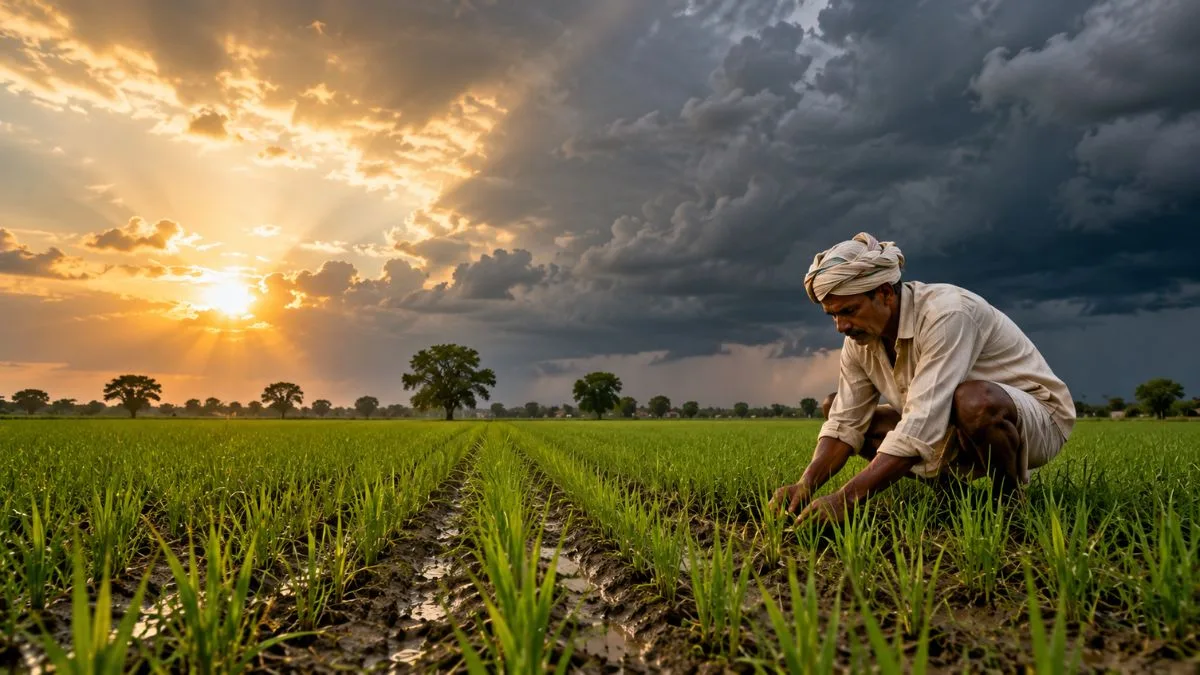
The weakest link in Indian agriculture has never been the farmer. It has been the country’s enduring dependence on a monsoon that is becoming increasingly unpredictable. An unusually dry June, accompanied by delayed sowing of key kharif crops, should therefore be read not as an isolated weather event but as another warning that climate volatility is exposing structural weaknesses that successive governments have failed to address decisively. The immediate concern is obvious.
Delayed rainfall has slowed the planting of rice and other rain-fed crops, raising fears of lower agricultural output, pressure on edible oil imports and reduced rural incomes. Agriculture still supports nearly half of India’s workforce, even though its contribution to GDP is much smaller. When the monsoon falters, the consequences extend well beyond farms, affecting food prices, rural consumption, employment and overall economic growth. Yet this is not a repeat of the food shortages that haunted India before the Green Revolution.
Advertisement
Large public grain stocks provide an important cushion against temporary production shocks, and the monsoon season has several weeks left to recover. A good spell of rainfall in July and August could narrow the sowing deficit considerably. That should temper alarmist predictions of an imminent food crisis. But buffer stocks are only a short-term insurance policy. They cannot compensate indefinitely for a farming system that remains excessively dependent on timely rainfall. Nearly half of India’s cultivated land still lacks assured irrigation, making millions of farmers vulnerable to every delayed onset, prolonged dry spell or uneven distribution of rain.
Climate change is not necessarily reducing annual rainfall as much as it is making it more erratic, with long dry periods interrupted by short bursts of intense precipitation. Such rainfall is often less useful for agriculture than steady, well-distributed showers. This demands a shift in agricultural policy. The emphasis can no longer remain confined to procurement, minimum support prices and emergency relief after crop losses. Greater investment in irrigation, watershed management, rainwater harvesting, drought-resistant crop varieties, improved weather forecasting and crop diversification has become indispensable.
States must also discourage cultivation patterns that encourage excessive groundwater extraction, particularly in water-stressed regions growing paddy and sugarcane. The government’s contingency planning for districts vulnerable to deficient rainfall is a welcome acknowledgement that adaptation must now become central to agricultural policy. However, contingency plans cannot substitute for long-term institutional reform. The objective should not simply be to survive weak monsoons but to reduce the economy’s exposure to them. Solutions are available, and must be adopted.
India’s monsoon has always shaped its agriculture and economy. What has changed is the climate in which the monsoon now operates. The challenge before policymakers is no longer merely predicting rainfall but building an agricultural system resilient enough to withstand its growing uncertainty. That is the true lesson of this difficult beginning to the kharif season.