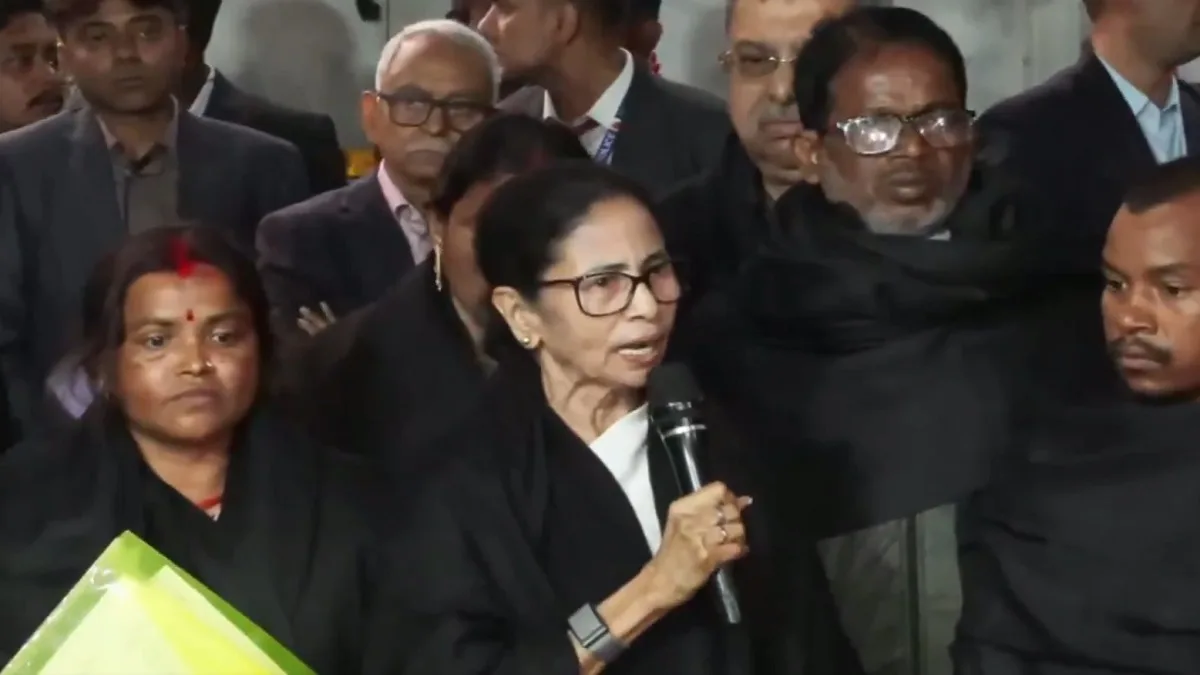
In an era when Indian politics increasingly feels scripted and predictable, there are still moments that disrupt the routine and force a rethink about democratic engagement. The recent spectacle of West Bengal Chief Minister Mamata Banerjee standing before the Supreme Court to argue her own case in the controversy over the Special Intensive Revision (SIR) of electoral rolls is one such moment.
It was not just a political gesture; it was a statement about how power, institutions, and citizenship are being contested today. A sitting Chief Minister personally pleading before the apex court is a first in India. In doing so, Ms Banerjee did not merely defend her government’s position; she framed the issue as one of democratic rights. The concern, as she put it, was that large numbers of voters could be excluded over technical discrepancies ~ spelling variations, documentation gaps, or name changes ~ through a process that was being rushed and unevenly applied. Her argument was simple but pointed: the right to vote cannot be reduced to a clerical exercise, especially in a country where identity documents often lag behind lived realities. The SIR dispute has, therefore, become more than a procedural quarrel. It touches a deeper anxiety about how institutions function in a politically charged environment.
Advertisement
When voter lists are revised at scale and speed, the margin for error widens ~ and errors in this domain are not neutral. They shape who counts, and who does not. By taking the fight to the Supreme Court herself, Banerjee chose confrontation over quiet negotiation, and visibility over discretion. To her critics, this is consistent with a combative style that often blurs the line between governance and spectacle. They will point to administrative shortcomings, to an abrasive political culture in the state, and to a tendency to personalise institutional disputes. These criticisms are not frivolous. West Bengal’s politics, like that of many states, carries the weight of unresolved governance challenges. Yet it is also impossible to ignore what this moment says about the wider political climate. Over the past decade, many Indian liberals have shifted from resistance to accommodation. Institutions that were once seen as arenas of contest are now often discussed in tones of weary fatalism. It is against this backdrop that Mamata Banerjee’s courtroom appearance acquires symbolic force.
She is not admired because she is flawless, or because her administration is beyond reproach. She is noticed because she refuses to accept resignation as a political strategy. Whether taking on a dominant party at the Centre or questioning the procedures of powerful institutions, she continues to act as if political outcomes are still negotiable. For a democracy that risks slipping into procedural quietism, that insistence matters. It reminds us that politics is not only about managing power, but about contesting it ~ sometimes noisily, sometimes awkwardly, but always in public view. In a time when many have lowered their expectations, the refusal to do so is itself a political statement.