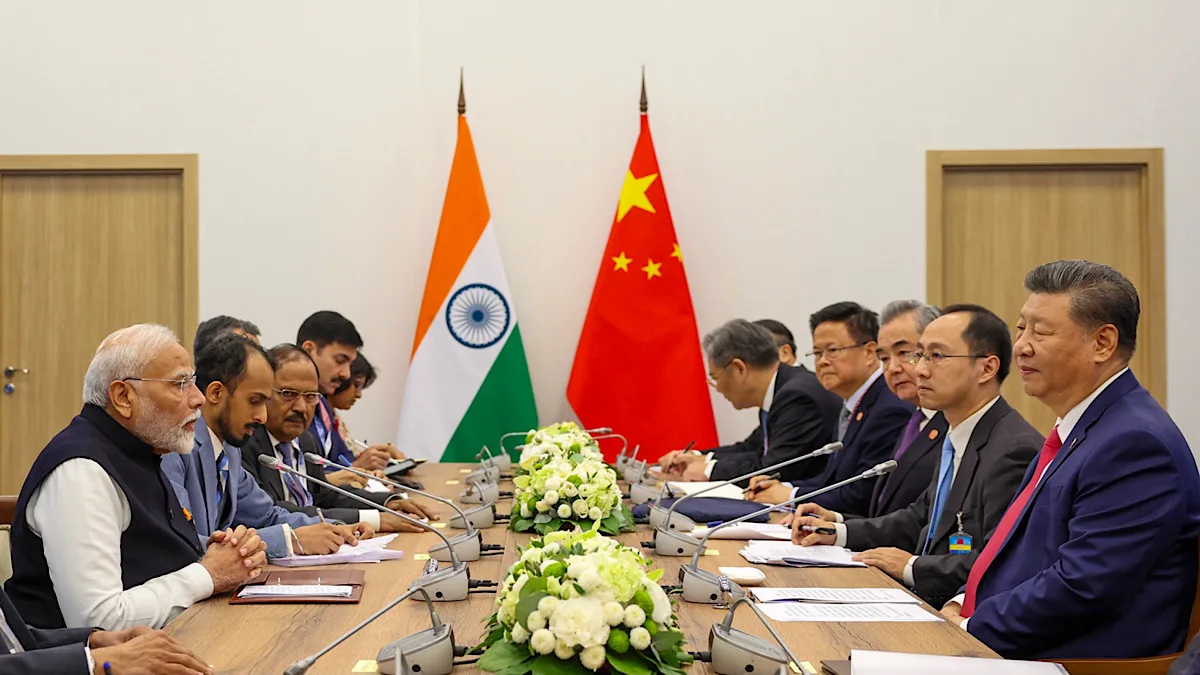
PM Narendra Modi and President Xi Jinping had a highly significant meeting on 31st August on the sidelines of the SCO summit in the Chinese port city of Tianjin. Xi said in his opening remarks that it is the right choice for both sides to be friends, and “to have the dragon and the elephant dance together,” referring to traditional symbols of the two nations. In response, PM Modi said India was “committed” to taking their countries’ relations forward “on the basis of mutual trust and respect.”
Meanwhile, against the background of India’s closer relationship with Russia and China on one hand and US-India trade tensions on the other, Trump said “Looks like we’ve lost India and Russia to deepest, darkest China.” However, a day later, when asked by a reporter if he was ready to reset relations with India at this point, Trump said that “India and the United States have a very special relationship. There is nothing to worry about. We just have moments on occasion”. Naturally, the question being asked in many circles is whether the elephant should dance with the dragon, as Xi suggested, or wait for recent tensions in Indo-US relations to settle down and then dance with the American bison? Which one would be a more reliable partner in the longer term?
Advertisement
Or, would choosing between these two powers be akin to choosing between the devil and the deep sea? The stark reality is that neither will be a long-term reliable partner. The elephant should not commit to dancing only with the dragon or the bison but should retain its freedom to choose a partner depending on the situation and its own requirements. In other words, India should continue to maintain its strategic autonomy. By navigating geopolitical volatility and diversifying its partnerships, India has positioned itself as a central player in a multipolar world. By continuing to purchase Russian oil despite US pressure, India has demonstrated that its foreign policy is guided by its own interests, not by any superpower’s demands.
India’s “multi-alignment” strategy allows it to engage with multiple powers simultaneously without being bound by rigid alliances. The reshaped global order has created new opportunities for India. China is driven to seek better ties with India primarily by economic motives and strategic considerations. Facing protectionist pressures from the United States, Beijing sees improved relations with New Delhi as a way to secure its economic interests and counter Western influence in the Indo-Pacific. While China has traditionally advocated improving the overall bilateral relationship irrespective of the border issue, India has insisted that the resolution of the border is central to the broader relationship.
Thus, while China and India have economic incentives to collaborate against US tariffs, deep strategic rivalry and long-standing border disputes persist. A fundamental and complete realignment is unlikely, and India will continue to maintain a cautious stance towards China. There can be no doubt that the biggest obstacle to normalization is the unresolved border dispute along the Line of Actual Control (LAC), which has been an irritant since the 1962 Sino-Indian War. The situation remains fragile despite some progress on de-escalation. India has insisted on restoring the “peace and tranquility” that existed on the border before the deadly 2020 skirmishes, viewing a resolution of the border as central to the broader relationship.
There are important geopolitical considerations which also need to be taken into account. China supports Pakistan against India through various means, including providing military equipment, intelligence, and economic assistance. This support is often seen as part of a strategic alliance aimed at countering India’s influence in the region. India feels that the China-Pakistan axis, characterized by strong military and economic ties, poses a strategic challenge for India. This axis is working against Indian interests, particularly due to China’s support for Pakistan in regional disputes.
China is a major supplier of military equipment and technology to Pakistan, further strengthening their relationship but escalating mistrust with India. China has emerged as Pakistan’s largest arms supplier, accounting for almost 81 per cent of Islamabad’s weapon systems inventory. Among the weapons supplied by China to Pakistan are fighter jets, missiles, drones, radar systems, warships and submarines. China has also been implicated in assisting Pakistan’s nuclear weapons program. China’s support for Pakistan in the context of terrorist groups further fuels India’s concerns. China and Pakistan reportedly objected to the inclusion of The Resistance Front (TRF) and Lashkar-e-Taiba (LeT) in a UN Security Council statement condemning the 22 April 2025 Pahalgam attack. This aligns with a past pattern where China has blocked India’s attempts to designate Pakistan-based terrorists and outfits under the UN’s 1267 sanctions regime. Thus, the recent improvements in China-India relations should be viewed as a calculated, tactical detente.
While dialogue has resumed on issues like trade and people-to-people exchanges, deeper strategic and security cooperation remains unlikely. The trust deficit runs deep, and India views China with suspicion after the 2020 border clashes. While driven by a shared interest in responding to a shifting US foreign policy, the deep structural competition and distrust mean that a fundamental realignment of relations may not yet be on the horizon. Turning to the India-US relationship since 2004, Washington and New Delhi pursued a “strategic partnership” based on shared values and generally convergent geopolitical interests. Numerous economic, security and global initiatives, including plans for civilian nuclear cooperation, are underway.
While the India-US partnership has been decades in the making and is rooted in shared democratic values, it is currently experiencing significant strain, particularly regarding trade and immigration policies under the Trump administration. The ‘Deep State’ in the United States favours a good relationship with India as it stands to gain a lot from it. The Deep State is a clandestine network which also includes high-level financial and industrial entities and leaders, including the military–industrial complex. Importantly, India ranks as the world’s biggest arms importing nation, and the US Deep State wants to increase its share of India’s defence imports.
India now buys a whole range of defence weaponry from the United States. This includes C-17 Globemaster III aircraft, AH-64 Apache attack helicopters, MH-60 Romeo helicopters, and P8I Poseidon Maritime reconnaissance aircraft. Many more deals are in the works. Bilateral trade has grown rapidly since 2000 and it amounted to USD 128.78 billion in 2023. India’s role in the Quad has brought shared purpose to Washington and New Delhi, both of which harbour concerns about China. Today, US-India cooperation spans defence, global health, sustainable development, climate, and technology, among other things.
(The writer, a retired IFS officer, served as India’s Ambassador to Kuwait and Morocco and as Consul-General in New York)