Edulji for replacing Harmanpreet as skipper, wants bold selection calls
Currently an advisor to the Mumbai Cricket Association (MCA), Edulji wants the national selectors to focus on the next generation of Indian women's cricketers.
Indian cricket has lifted countless trophies across formats and categories. But few victories carry the symbolic force of what unfolded in Colombo on Sunday.




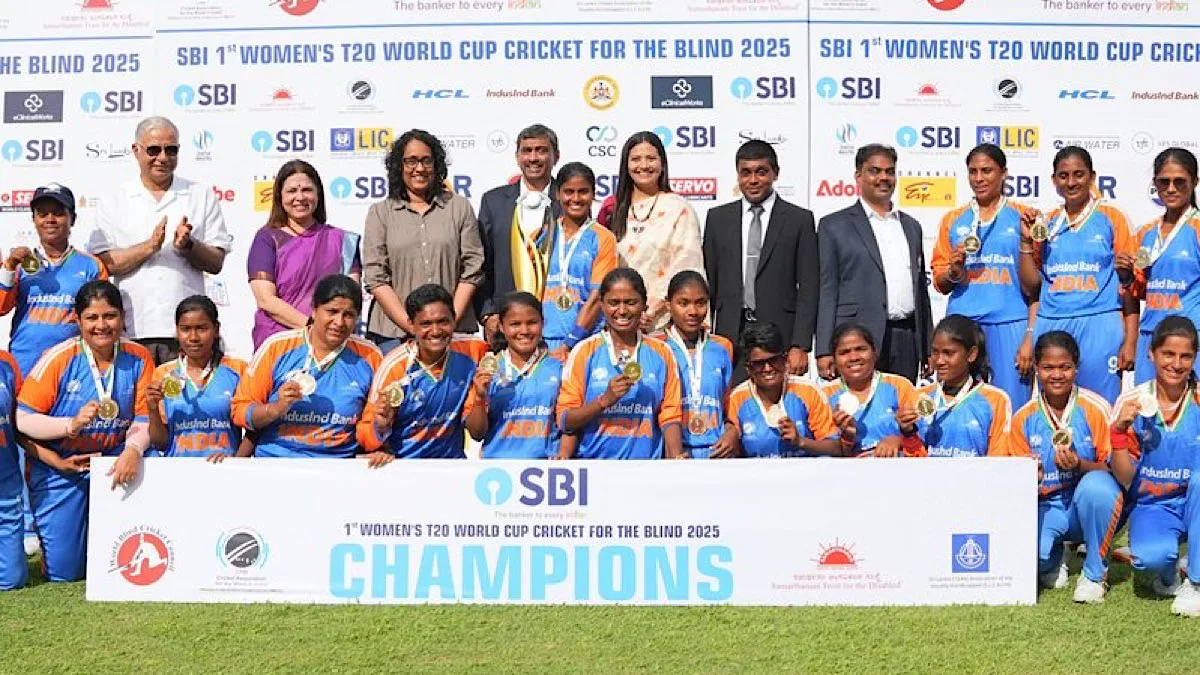
Indian cricket team won,Women’s T20 World Cup for the Blind (Photo:IANS)
Indian cricket has lifted countless trophies across formats and categories. But few victories carry the symbolic force of what unfolded in Colombo on Sunday. By winning the final of the inaugural Women’s T20 World Cup for the Blind ~ without losing a single match ~ the Indian team has rewritten not just sporting history but the narrative around disability and women’s empowerment in the country.
This triumph was not inevitable. Most of these players come from remote villages, from farming families that had never imagined their daughters would travel the world, let alone bring home a world title. Many took up the sport in their late teens, learning its modified rhythm: the ball that rattles, the underarm bowler who rolls it along the ground, the batter listening for the right moment to swing. Cricket, so familiar to India, became something entirely new ~ a sport that accommodates difference while demanding excellence.
Advertisement
And excellence is precisely what they delivered. Dominant in the league stage, ruthless in the knockouts, they crushed Sri Lanka earlier in the tournament and outplayed Australia. In the final, they chased down Nepal’s total with an authority that left no doubt about who ruled this historic competition. Phula Saren ~ an all-rounder from Odisha who lost vision in one eye as a child ~ smashed 44 off 27 balls and bowled tight overs. Her performance deservedly earned Player of the Match, but she would be the first to say the win belongs to every teammate who battled adversity long before facing any opponent. It is important to acknowledge what this team has overcome. Visually impaired women in India navigate multiple barriers: limited access to accessible education, societal stereotypes that treat disability as vulnerability, and the persistent belief that girls should remain within the domestic sphere. For them, the right to dream is itself a form of resistance. What their victory proves ~ loudly and proudly ~ is that talent flourishes when trust replaces doubt. When parents allow their daughters to step onto a field. When coaches invest in nurturing rather than excluding. When institutions recognise that representation matters, not as charity but as justice.
Advertisement
Broadcasts of these matches have already begun changing perceptions at home. Families watching their daughters’ peers in Indian colours now understand that blindness is not the end of possibility, it is the beginning of a different path to glory. The legacy of this win will be measured not just in medals, but in the next generation of visually impaired girls who demand space in school playgrounds and national stadiums alike. India’s blind women cricketers did not just win a World Cup. They won respect ~ solid, lasting, transformative. They have made sure that the world sees them, even if they cannot see the world in the way others do. And in doing so, they have shown a sporting nation what true vision looks like.
Advertisement