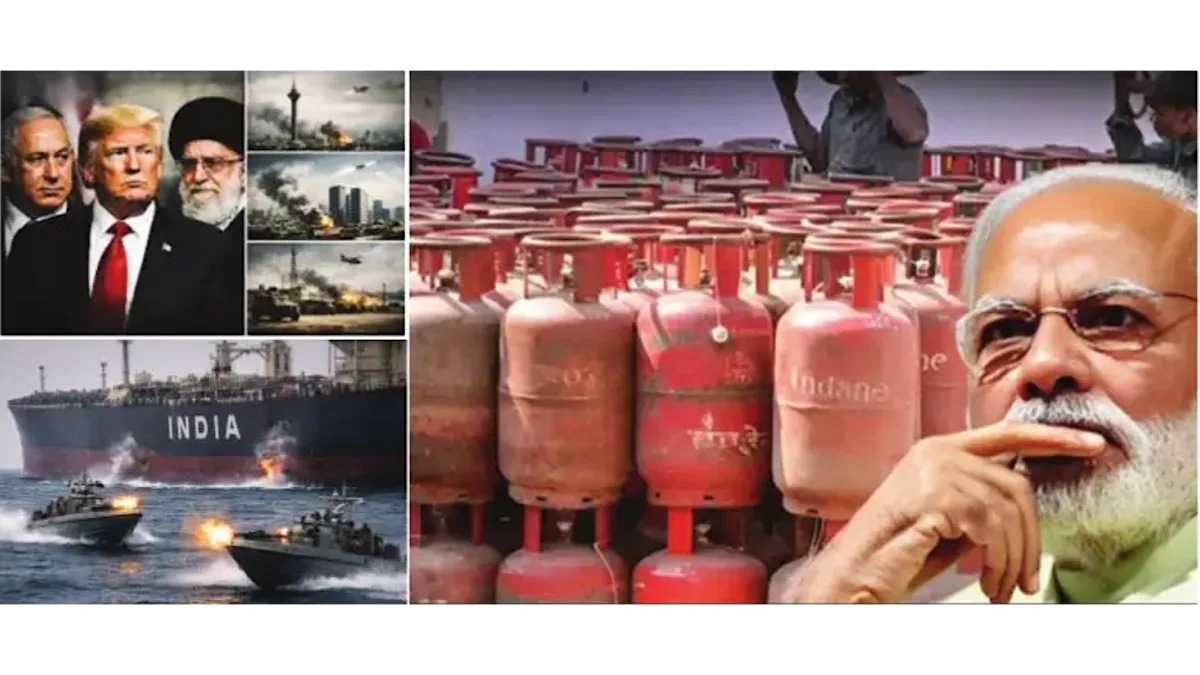
On 28 February 2026, the war that diplomats had spent two years rehearsing began. American and Israeli aircraft struck Iranian nuclear and missile installations; Iran’s Supreme Leader was killed, and by 2 March the Islamic Revolutionary Guard Corps had formally closed the Strait of Hormuz to merchant traffic, laying mines and warning off shipping. Two Indian-flagged tankers, including the VLCC Sanmar Herald, were turned back under gunfire despite prior clearance.
By mid-March, Brent had crossed $116 a barrel; by April the United States Navy was blockading Iranian ports. Indian Oil Corporation, in a measure without recent precedent, barred its own piped-gas customers from buying domestic LPG cylinders to ration a supply suddenly under stress. This is not a refinery story alone. India imports approximately 87 per cent of the crude oil it consumes, and roughly 48 per cent of those barrels came from the Middle East as recently as last winter.
Advertisement
But the sharper exposure is in the kitchen. Of the 33.15 million tonnes of liquefied petroleum gas India consumed in 2025, about 60 per cent was imported, and about 90 per cent of those imports originated from the Middle East. Every cylinder in every village queue is a longer logistical chain than the refinery feedstock the country has spent two decades worrying about. The fragility is structural; it is not subject to grand-bargain diplomacy; and it will be exposed each time the Persian Gulf catches fever.
The argument that follows is that India already owns the largest under-deployed civilian energy resource on earth, in plain view of every village panchayat ~ and that the consequent answer to Hormuz lies less in West Asian capitals than in the cattle sheds of Bardhaman, Beed and Bareilly. The numbers are uncomfortable. Of India’s 535.78 million livestock counted in the 20th Livestock Census of 2019, approximately 302 million are large bovines ~ the world’s largest such herd. NITI Aayog has estimated that the herd produces in the order of three million tonnes of dung every day.
Under the Ministry of New and Renewable Energy’s own technical standards, a kilogram of fresh cow dung yields roughly 0.04 cubic metres of biogas, and about thirty cubic metres of that gas carries the calorific equivalent of a single 14.2-kilogram LPG cylinder. The arithmetic produces a number so large that the policy mind, on first encountering it, tends to discard it as fanciful. It is not fanciful. It is what we have been throwing away each morning into a drain, or stacking against a wall to dry into low-calorific cakes.
A village-cluster biogas plant is technically unremarkable: a pit, an inlet for slurry, a fermentation chamber where mesophilic bacteria do their patient anaerobic work over a retention of about thirty days, a holder for the methane that rises, and piped distribution to fifty or a hundred households. The plant produces, as inevitable by-product, a stream of digested slurry ~ the digestate ~ that is, gram for gram, a finer organic fertiliser than urea, with the nutrient profile of farmyard manure and none of its weed-seed burden.
At cluster scale, piping gas to a hundred households at a tariff well below the prevailing LPG cylinder rate of Rs 918, the digestate alone ~ if sold to neighbouring farmers ~ covers operating cost. The household saves; the plant pays; the field gains. The principal beneficiary, however, is neither the household ledger nor the soil. She stands at the chulha. The Pradhan Mantri Ujjwala Yojana has put cylinders in over 10 crore poor kitchens; the harder secret of the scheme is that millions of those cylinders are refilled less often than the policy supposes, because Rs 900 is nine hundred rupees, and a smoky chulha is free.
A piped village biogas line, refilled by the buffalo in the corner, dissolves the trade-off. The respiratory cost ~ the cataract, the chronic bronchitis, the asthma in the child crawling underfoot ~ is among the largest avoidable disease burdens in rural India. The dung the household contributes, weighed and priced at a panchayat collection centre, becomes income; the gas that returns to her stove becomes dignity. Why, then, has none of this happened at scale? The architecture exists, but it has scattered.
India’s legacy household-biogas programme has been folded into the Biogas component of the National Bioenergy Programme (Phase I, 2021–22 to 2025–26), with a dedicated outlay of approximately Rs 100 crore within a broader Rs 858 crore envelope. The GOBAR-Dhan portal today lists about 1,219 functional family-and-cluster plants and 163 functional Compressed Biogas plants nationally – against the SATAT scheme’s target of 5,000 CBG units by 2024. The failures are not technological; the plants work where they are installed. They are institutional. The schemes have been split across three ministries ~ MNRE, Jal Shakti and Petroleum ~ each with its own forms, subsidy schedule and silence.
The Indian models that work, however, are already on the ground. Uttar Pradesh’s Gram-Urja pilot installs household digesters at a unit cost of about Rs 39,000, of which the family pays only about Rs 4,000; early reporting from the pilot’s 2,250 plants suggests household LPG consumption can fall by up to 70 per cent where the unit is well-fed and well-watered. Gujarat’s Banas Dairy cooperative ~ itself a lineal descendant of the milk model Verghese Kurien gave India ~ pays farmers a rupee for every kilogram of fresh dung delivered, processes it into Compressed Biogas and organic fertiliser, and is being expanded under a Rs 60-crore allocation in the state’s 2026-27 budget for ten new cooperative plants.
The household micro-economics and the cooperative aggregation logic are not theoretical exercises; both are running. The international comparators sober the ambition. China built, between the early 1980s and 2014, over forty million household digesters under disciplined central subsidy ~ and much of that infrastructure has since fallen idle as rural-to-urban migration emptied the feedstock villages and grid LPG eroded the case for households that no longer kept cattle. Nepal’s Biogas Support Programme, launched in 1992 with Dutch support, has installed over a quarter of a million domestic digesters, though field studies have repeatedly shown serious dis-adoption where aftersales service was thin.
Germany’s biogas industry ~ about 9,600 plants producing roughly 80.6 TWh of energy in 2025 ~ succeeded precisely because the federal feed-in-tariff structure made it a market rather than a scheme, and because the plants are owned by farmer cooperatives that have a twenty-year reason to keep them running. The lesson is consistent: subsidy without market discipline is a monument; market without subsidy is a project for the patient. What India needs, then, is not a new mission but the seriousness to coordinate the one it has.
Consolidate biogas under a single nodal authority ~ MNRE is the natural candidate ~ with a five-year cluster-installation target written into the Finance Commission’s devolution formula, prioritising the cattle-dense districts of Uttar Pradesh, Bihar, Madhya Pradesh, Rajasthan and Maharashtra. Route the construction subsidy through NABARD and the District Central Cooperative Banks in two tranches ~ half on commissioning, half against a verified six-month yield report countersigned by the Panchayati Raj institution.
Vest each cluster plant in a producer cooperative of dung suppliers on the Banas model, with gas tariff and digestate revenue divided by formula among the members. The architecture exists; only the political will to bind it together is missing. The Sanmar Herald turned around at Hormuz some weeks ago.
The Bardhaman housewife who buys her cylinder today is paying for that turnabout, though she will not see the figure on her receipt. India will not refine itself out of the Persian Gulf, but it can cook itself out of a great deal of it ~ from the cattle shed inward, one panchayat at a time. The shed is not glamorous. The dung is not romantic. Neither is the chokepoint.
(The writer, a practicing Chartered Accountant and a Vedantic Scholar, can be reached at kannan@cakt.in)