Relive composer & singer Pankaj Mallick’s journey through some memorabilia
The City of Joy is a treasure trove, we all know.
Lionel Messi’s brief and chaotic appearance in Kolkata was not merely a case of crowd impatience or celebrity excess.




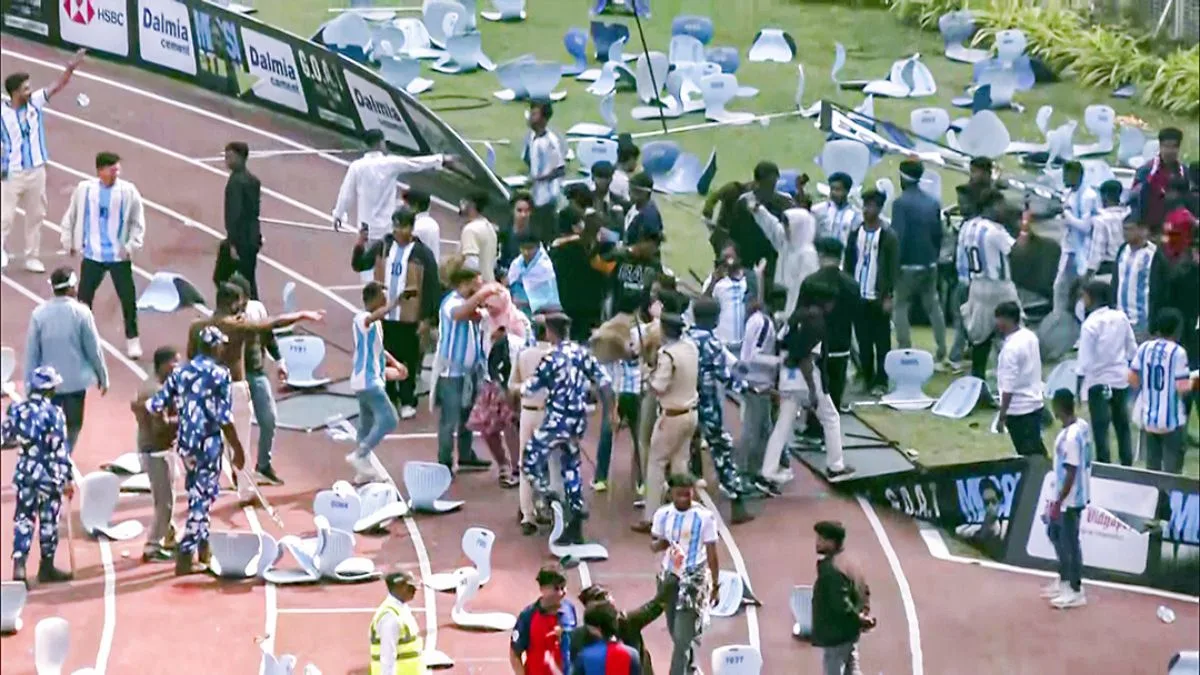
Spectators vandalised the Salt Lake Stadium. (ANI video grab)
Lionel Messi’s brief and chaotic appearance in Kolkata was not merely a case of crowd impatience or celebrity excess. It was a revealing moment about how India, and Bengal in particular, increasingly showcases global icons ~ with spectacle taking precedence over substance, and access over accountability. Kolkata is not a casual football city. Its relationship with the game runs deeper than marketing campaigns or fan zones, shaped by generations of club loyalties and packed derby days where passion, though intense, is also disciplined by familiarity. That is precisely why the anger at Salt Lake Stadium deserves to be understood, not dismissed.
What unfolded was less a riot of entitlement than a collapse of trust between organisers and an audience that felt misled. Thousands arrived believing they would see Messi in some meaningful way ~ perhaps a short exhibition, perhaps even a clear view unmediated by barricades of power. What they witnessed instead was a fleeting, tightly guarded circuit of the pitch, with the football icon visually consumed by a dense entourage of politicians, officials, and celebrities. The message, unintended but unmistakable, was that the event was designed for optics, not for fans. The problem began well before the stadium gates opened. A major public draw ~ the unveiling of a towering statue of Messi ~ was shifted to a virtual format for security reasons, yet the crowd was still directed towards a physical venue with little clarity on what would occur there.
Advertisement
In the absence of transparency, expectation filled the gap. When that expectation collapsed, frustration followed swiftly, and in some cases destructively. This was not about Messi himself. Global stars operate within strict security and commercial frameworks, and his conduct appears consistent with those constraints. Nor was it a failure of Kolkata’s football culture, which has long managed vast, emotionally charged gatherings without descending into chaos. The fault lay squarely in event management that underestimated both the intelligence and the emotional investment of its audience. There is also an uncomfortable truth about how such events are curated in India. The reflex to surround international figures with political visibility, VIP access and performative proximity often overwhelms the central purpose of the occasion. In doing so, it sidelines the very people who give these moments meaning.
Advertisement
When fans pay high prices and travel long distances, they are not buying a glimpse of governance; they are buying a connection, however brief, to the sport they love. The chief minister’s apology and the promise of an inquiry are necessary steps, but they should lead to something deeper than assigning blame. Kolkata’s stature as a football city deserves better planning, clearer communication and a respect for the crowd that goes beyond crowd control. If global icons are to be welcomed here, the lesson is simple: do not overpromise, do not obscure the moment with power, and never forget who the event is truly for.
Advertisement